Motion and Its Description — Important Questions
NIOS · Class 10 · Science & Tech
101 important questions from Motion and Its Description for NIOS Class 10 Science & Tech, with answers. Written for the board exams 2027.
Interactive on Super Tutor
Studying Motion and Its Description? Get the full interactive chapter.
Quizzes, flashcards, AI doubt-solver and a step-by-step study plan — built for important questions and more.
Free trial, no card needed.
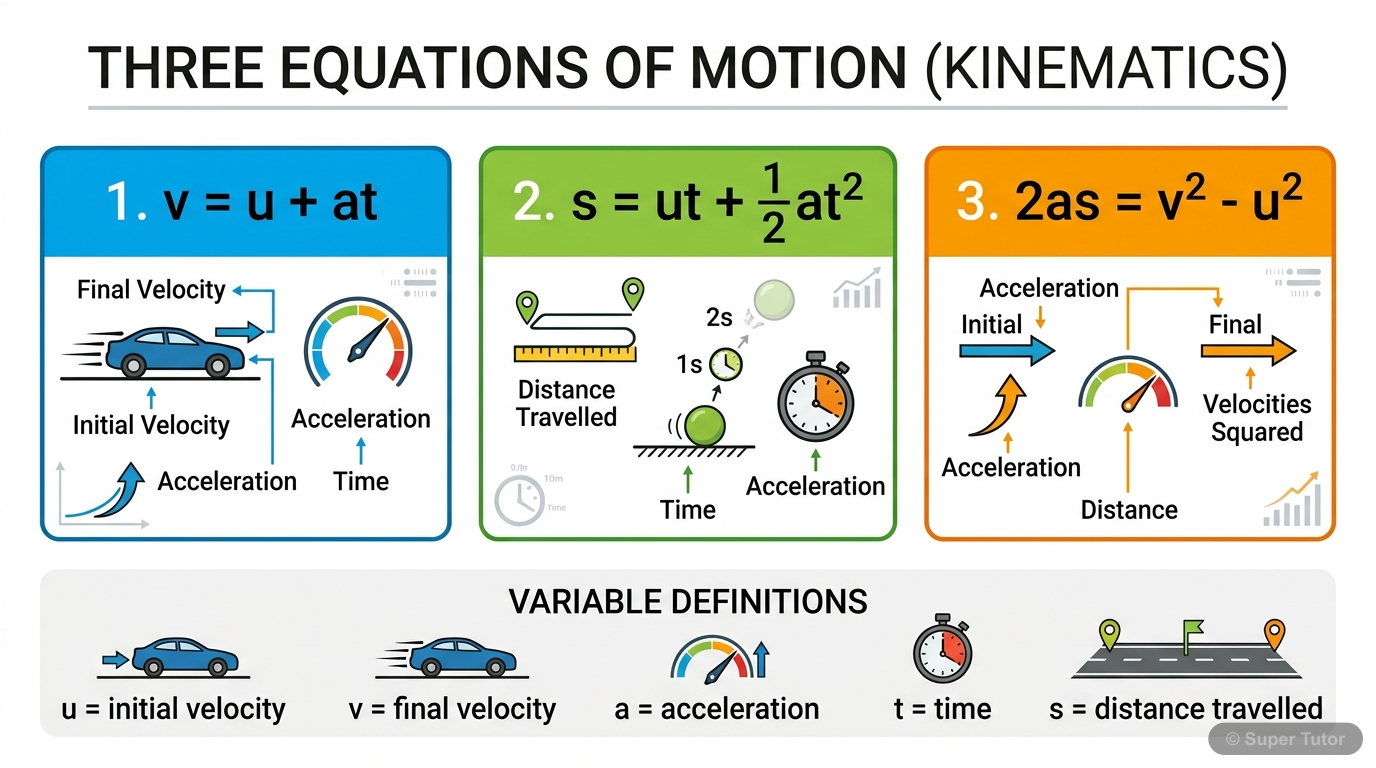
Learn better with visuals Super Tutor pairs illustrations like this with notes and quizzes for Motion and Its Description.
Important Questions from Motion and Its Description
Which equation of motion relates velocity, initial velocity, acceleration, and time?
Show answer
v = u + at
Step 1: This is the first equation of motion derived from the definition of acceleration. Step 2: Acceleration (a) = (final velocity - initial velocity)/time = (v - u)/t. Step 3: Rearranging: a × t = v - u. Step 4: Therefore: v = u + at, where v = final velocity, u = initial velocity, a = acceleration, t = time. Step 5: This equation helps us find final velocity when we know initial velocity, acceleration, and time taken.
A car travels 200 km in 4 hours. Its average speed is:
Show answer
50 km/h
Step 1: Average speed is calculated using the formula: Average speed = Total distance/Total time. Step 2: Given: Total distance = 200 km, Total time = 4 hours. Step 3: Average speed = 200 km ÷ 4 hours = 50 km/h. Step 4: This means the car covers 50 kilometers every hour on average. Step 5: Note that average speed may differ from instantaneous speed at any given moment during the journey.
In a position-time graph, a horizontal line indicates:
Show answer
Rest
Step 1: In a position-time graph, the x-axis represents time and y-axis represents position. Step 2: A horizontal line means position remains constant as time passes. Step 3: If position doesn't change with time, the object is not moving. Step 4: Therefore, a horizontal line indicates the object is at rest. Step 5: The slope of this line is zero, confirming zero velocity (no motion).
Which of the following represents uniform circular motion?
Show answer
The tip of a clock's second hand
Step 1: Uniform circular motion requires constant speed along a circular path. Step 2: The tip of a clock's second hand moves in a perfect circle around the center. Step 3: It covers equal distances (equal arc lengths) in equal time intervals. Step 4: The speed remains constant, but direction continuously changes. Step 5: Other options involve either non-circular paths or non-uniform motion patterns.
+97 more questions on Motion and Its Description (NIOS Class 10 Science & Tech)
Practise AllFrequently Asked Questions
What are the important topics in Motion and Its Description for NIOS Class 10 Science & Tech?
How many important questions are there in Motion and Its Description?
Sources & Official References
Content is aligned to the official syllabus. Refer to the board website for the latest curriculum.
More resources for Motion and Its Description
Practice Quiz
Test yourself with a quick quiz
Revision Notes
Key points for last-minute revision
Formula Sheet
The chapter's formulas in one place
Chapter Summary
Understand the chapter at a glance
Concept Maps
See how topics connect
Study Plan
Step-by-step plan for this chapter
Flashcards
Quick-fire cards for active recall
Syllabus
What topics to cover
For serious students
Get the full Motion and Its Description chapter — start free.
Quizzes, flashcards, an AI doubt solver and a study plan for NIOS Class 10 Science & Tech. Free to start, no card needed.