History of Life on Earth — Important Questions
NIOS · Class 10 · Science & Tech
44 important questions from History of Life on Earth for NIOS Class 10 Science & Tech, with answers. Written for the board exams 2027.
Interactive on Super Tutor
Studying History of Life on Earth? Get the full interactive chapter.
Quizzes, flashcards, AI doubt-solver and a step-by-step study plan — built for important questions and more.
Free trial, no card needed.
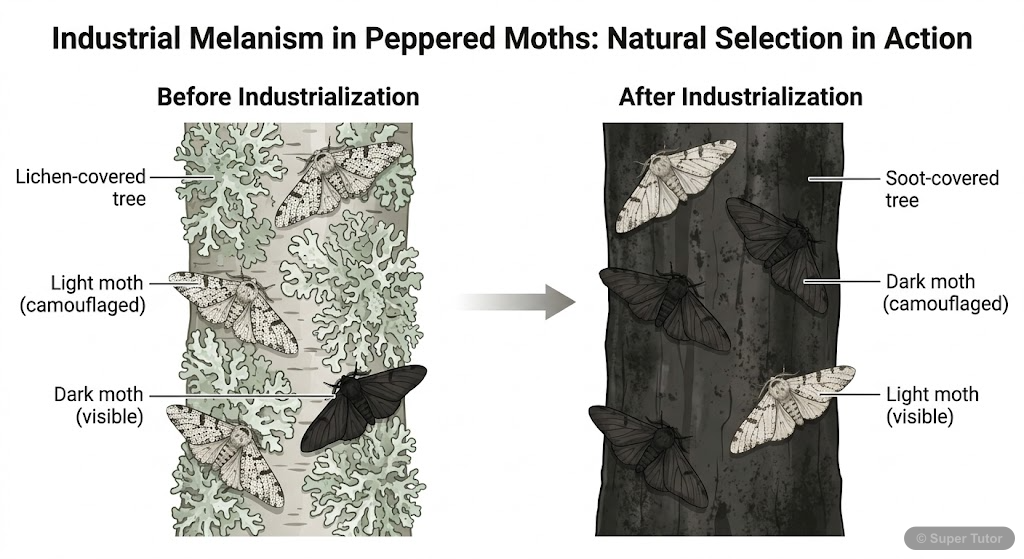
One of 9 illustrations for History of Life on Earth in Super Tutor — alongside flashcards, concept maps and practice questions.
Important Questions from History of Life on Earth
According to Darwin, what is the mechanism of evolution?
Show answer
Natural Selection
Step 1: Charles Darwin proposed Natural Selection as the primary mechanism driving evolution. Step 2: Natural selection means 'survival of the fittest' - organisms with advantageous traits survive and reproduce more. Step 3: Those with less favorable traits are eliminated over time through the 'struggle for existence'. Step 4: This process leads to gradual changes in populations over generations. Step 5: Darwin observed this during his voyage on HMS Beagle, particularly studying finches on the Galapagos Islands.
What is Neo-Darwinism?
Show answer
Darwin's theory modified with Mendelian genetics
Step 1: Darwin didn't know how heritable variations arose or were passed to offspring. Step 2: Mendel's principles of genetics were discovered around the same time but Darwin wasn't aware of them. Step 3: Later scientists incorporated Mendelian genetics into Darwin's theory. Step 4: This combination became known as Neo-Darwinism or the Modern Synthetic Theory of Evolution. Step 5: It explains both how variations occur (through genes/mutations) and how they're inherited (through Mendel's laws).
When did human evolution begin?
Show answer
1.5-2 million years ago
Step 1: Fossil evidence shows human evolution began approximately 1.5-2 million years ago. Step 2: This coincided with climate changes and glaciation that reduced forest cover. Step 3: Human ancestors had to adapt from tree-dwelling to ground-walking lifestyle. Step 4: The first human-like ancestor was Australopithecus, including the famous fossil 'Lucy'. Step 5: Modern humans (Homo sapiens sapiens) evolved only about 50,000 years ago.
What is the scientific name of modern humans?
Show answer
Homo sapiens sapiens
Step 1: Modern humans are scientifically classified as Homo sapiens sapiens. Step 2: 'Homo' refers to the genus (human), 'sapiens' means wise. Step 3: The double 'sapiens' distinguishes modern humans from earlier Homo sapiens like Neanderthals. Step 4: This classification reflects our advanced cognitive abilities and cultural development. Step 5: Modern humans evolved about 50,000 years ago and have remained largely unchanged biologically since then.
+40 more questions on History of Life on Earth (NIOS Class 10 Science & Tech)
Practise AllFrequently Asked Questions
What are the important topics in History of Life on Earth for NIOS Class 10 Science & Tech?
How many important questions are there in History of Life on Earth?
Sources & Official References
Content is aligned to the official syllabus. Refer to the board website for the latest curriculum.
More resources for History of Life on Earth
Practice Quiz
Test yourself with a quick quiz
Revision Notes
Key points for last-minute revision
Formula Sheet
The chapter's formulas in one place
Chapter Summary
Understand the chapter at a glance
Concept Maps
See how topics connect
Study Plan
Step-by-step plan for this chapter
Flashcards
Quick-fire cards for active recall
Syllabus
What topics to cover
For serious students
Get the full History of Life on Earth chapter — start free.
Quizzes, flashcards, an AI doubt solver and a study plan for NIOS Class 10 Science & Tech. Free to start, no card needed.