Reproduction — Important Questions
NIOS · Class 10 · Science & Tech
41 important questions from Reproduction for NIOS Class 10 Science & Tech, with answers. Written for the board exams 2027.
Interactive on Super Tutor
Studying Reproduction? Get the full interactive chapter.
Quizzes, flashcards, AI doubt-solver and a step-by-step study plan — built for important questions and more.
Free trial, no card needed.
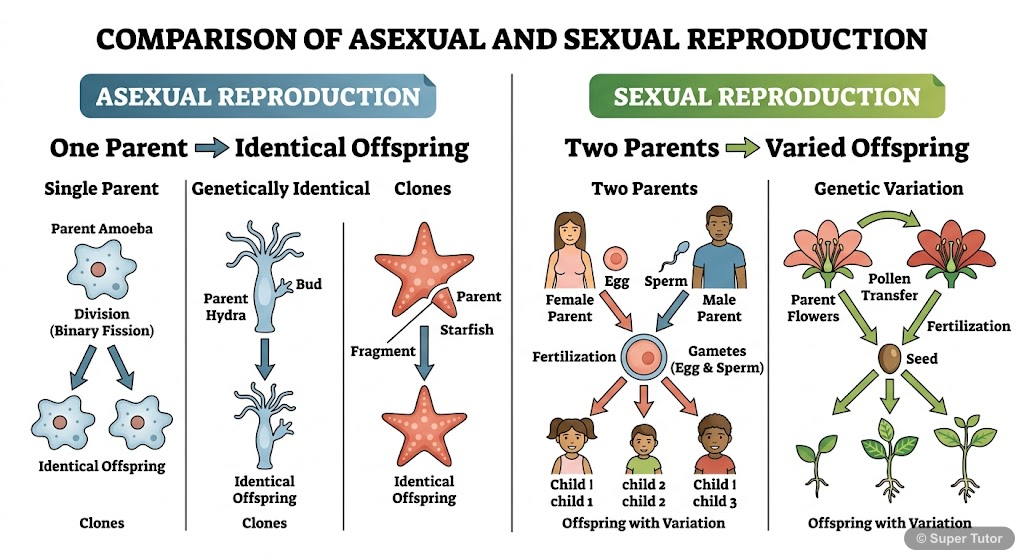
Learn better with visuals Super Tutor pairs illustrations like this with notes and quizzes for Reproduction.
Important Questions from Reproduction
Which hormone is responsible for the development of secondary sexual characteristics in males?
Show answer
Testosterone
Step 1: Testosterone is the primary male sex hormone secreted by the testes during puberty. Step 2: This hormone is responsible for the development of secondary sexual characteristics in boys. Step 3: These characteristics include deepening of voice, growth of facial hair, broadening of shoulders, and muscle development. Step 4: Estrogen and progesterone are female hormones, while oxytocin helps in childbirth. Step 5: Testosterone also plays a role in the production of sperm and the development of male reproductive organs.
In which part of the female reproductive system does fertilization usually occur?
Show answer
Fallopian tube
Step 1: After ovulation, the egg travels from the ovary into the fallopian tube (oviduct). Step 2: If sperm are present, fertilization typically occurs in the fallopian tube. Step 3: The sperm swims up through the vagina, cervix, and uterus to reach the fallopian tube. Step 4: Once fertilized, the zygote travels down the fallopian tube to the uterus for implantation. Step 5: The fallopian tube provides the ideal environment for the sperm and egg to meet and fuse.
Which of the following is an example of vegetative propagation?
Show answer
Growth of potato from tuber
Step 1: Vegetative propagation is a form of asexual reproduction where new plants grow from vegetative parts like roots, stems, or leaves. Step 2: Potato tubers are modified underground stems that can give rise to new potato plants. Step 3: Each 'eye' on a potato tuber can sprout into a new plant with the same genetic makeup as the parent. Step 4: Seed germination involves sexual reproduction as seeds form from fertilized ovules. Step 5: This method is commonly used by farmers to grow crops like potatoes, ensuring identical plants with desirable characteristics.
What is the scientific term for animals that lay eggs?
Show answer
Oviparous
Step 1: Oviparous animals are those that reproduce by laying eggs outside their body. Step 2: The embryo develops inside the egg, getting nourishment from the yolk. Step 3: Examples include birds, reptiles, fish, and amphibians like frogs. Step 4: Viviparous animals give birth to live young that develop inside the mother's womb. Step 5: The term 'ovi' comes from 'ovum' meaning egg, making it easy to remember this classification.
+37 more questions on Reproduction (NIOS Class 10 Science & Tech)
Practise AllFrequently Asked Questions
What are the important topics in Reproduction for NIOS Class 10 Science & Tech?
How many important questions are there in Reproduction?
Sources & Official References
Content is aligned to the official syllabus. Refer to the board website for the latest curriculum.
More resources for Reproduction
For serious students
Get the full Reproduction chapter — start free.
Quizzes, flashcards, an AI doubt solver and a study plan for NIOS Class 10 Science & Tech. Free to start, no card needed.