Metals and Non-Metals — Important Questions
NIOS · Class 10 · Science & Tech
44 important questions from Metals and Non-Metals for NIOS Class 10 Science & Tech, with answers. Written for the board exams 2027.
Interactive on Super Tutor
Studying Metals and Non-Metals? Get the full interactive chapter.
Quizzes, flashcards, AI doubt-solver and a step-by-step study plan — built for important questions and more.
Free trial, no card needed.
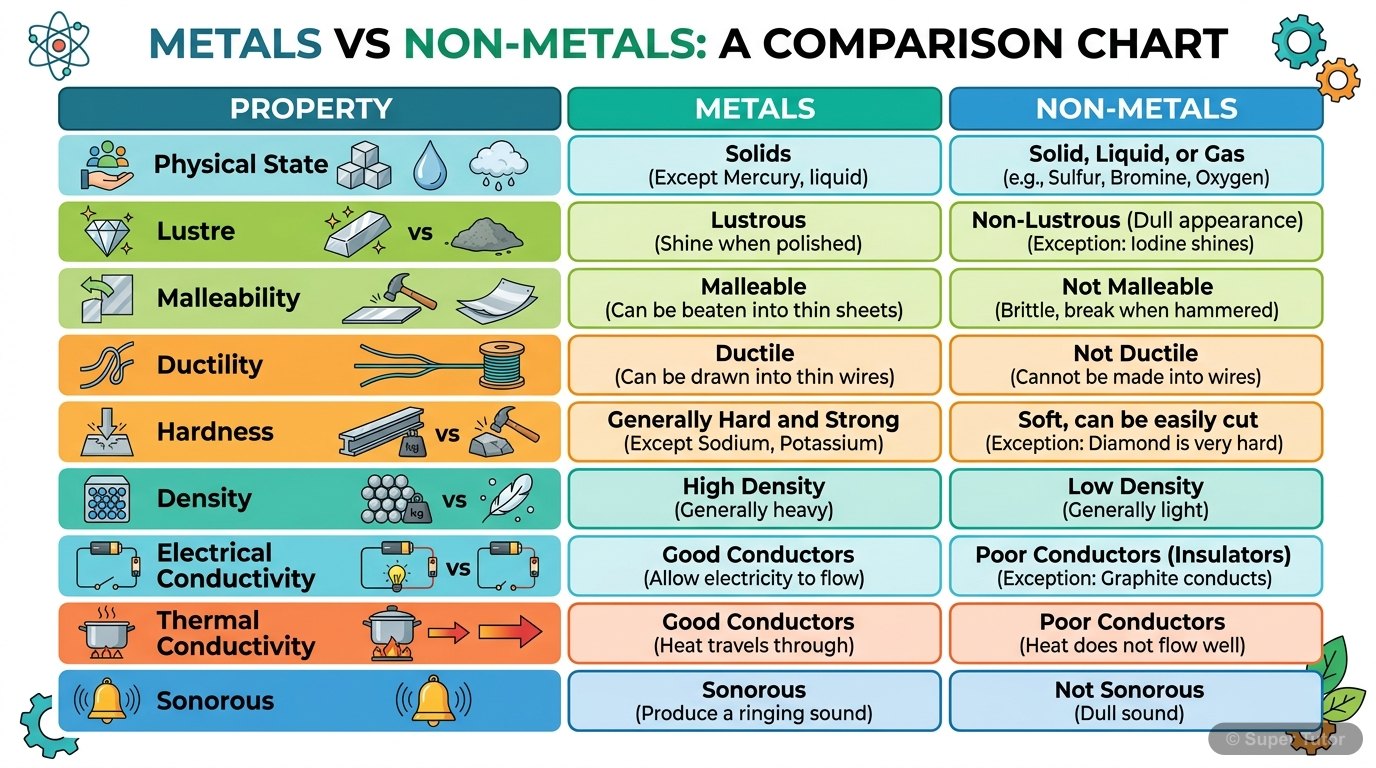
Learn better with visuals Super Tutor pairs illustrations like this with notes and quizzes for Metals and Non-Metals.
Important Questions from Metals and Non-Metals
Which process is used to extract highly reactive metals like sodium from their compounds?
Show answer
Electrolysis
Step 1: Highly reactive metals like sodium, potassium, and magnesium have very high affinity for oxygen. Step 2: These metals cannot be reduced using carbon because they are more reactive than carbon. Step 3: Electrolysis is used where electric current is passed through molten salts of these metals. Step 4: During electrolysis, metal ions gain electrons at the cathode and are reduced to form pure metals. Step 5: For example, sodium is obtained by electrolysis of molten NaCl: Na⁺ + e⁻ → Na at cathode.
What is rust chemically?
Show answer
Hydrated iron oxide (Fe₂O₃.xH₂O)
Step 1: Rust is the reddish-brown substance formed when iron corrodes in the presence of oxygen and moisture. Step 2: The chemical formula of rust is Fe₂O₃.xH₂O, which is hydrated ferric oxide. Step 3: The 'x' represents variable number of water molecules associated with each Fe₂O₃ unit. Step 4: Rust formation requires both oxygen and water - removing either prevents rusting. Step 5: The formation of rust weakens iron structures and is a major economic problem, which is why rust prevention methods are important.
Which non-metal is a good conductor of electricity?
Show answer
Graphite
Step 1: Generally, non-metals are poor conductors of electricity because they don't have free electrons. Step 2: Graphite is an exception - it's the only non-metal that conducts electricity well. Step 3: In graphite's structure, each carbon atom is bonded to three other carbon atoms, leaving one electron free to move. Step 4: These free electrons make graphite a good conductor of electricity. Step 5: This property makes graphite useful in making electrodes, pencil leads, and dry cell batteries.
What happens when zinc reacts with dilute hydrochloric acid?
Show answer
Zinc chloride and hydrogen gas are formed
Step 1: Zinc is more reactive than hydrogen, so it can displace hydrogen from dilute acids. Step 2: The chemical equation is: Zn(s) + 2HCl(aq) → ZnCl₂(aq) + H₂(g). Step 3: This reaction produces zinc chloride (a salt) and hydrogen gas. Step 4: You can observe effervescence (bubbling) due to hydrogen gas evolution. Step 5: This is a typical metal-acid reaction where the metal displaces hydrogen to form a salt and hydrogen gas.
+40 more questions on Metals and Non-Metals (NIOS Class 10 Science & Tech)
Practise AllFrequently Asked Questions
What are the important topics in Metals and Non-Metals for NIOS Class 10 Science & Tech?
How many important questions are there in Metals and Non-Metals?
Sources & Official References
Content is aligned to the official syllabus. Refer to the board website for the latest curriculum.
More resources for Metals and Non-Metals
Practice Quiz
Test yourself with a quick quiz
Revision Notes
Key points for last-minute revision
Formula Sheet
The chapter's formulas in one place
Chapter Summary
Understand the chapter at a glance
Concept Maps
See how topics connect
Study Plan
Step-by-step plan for this chapter
Flashcards
Quick-fire cards for active recall
Syllabus
What topics to cover
For serious students
Get the full Metals and Non-Metals chapter — start free.
Quizzes, flashcards, an AI doubt solver and a study plan for NIOS Class 10 Science & Tech. Free to start, no card needed.