Magnetic Effect of Electric Current — Important Questions
NIOS · Class 10 · Science & Tech
43 important questions from Magnetic Effect of Electric Current for NIOS Class 10 Science & Tech, with answers. Written for the board exams 2027.
Interactive on Super Tutor
Studying Magnetic Effect of Electric Current? Get the full interactive chapter.
Quizzes, flashcards, AI doubt-solver and a step-by-step study plan — built for important questions and more.
Free trial, no card needed.
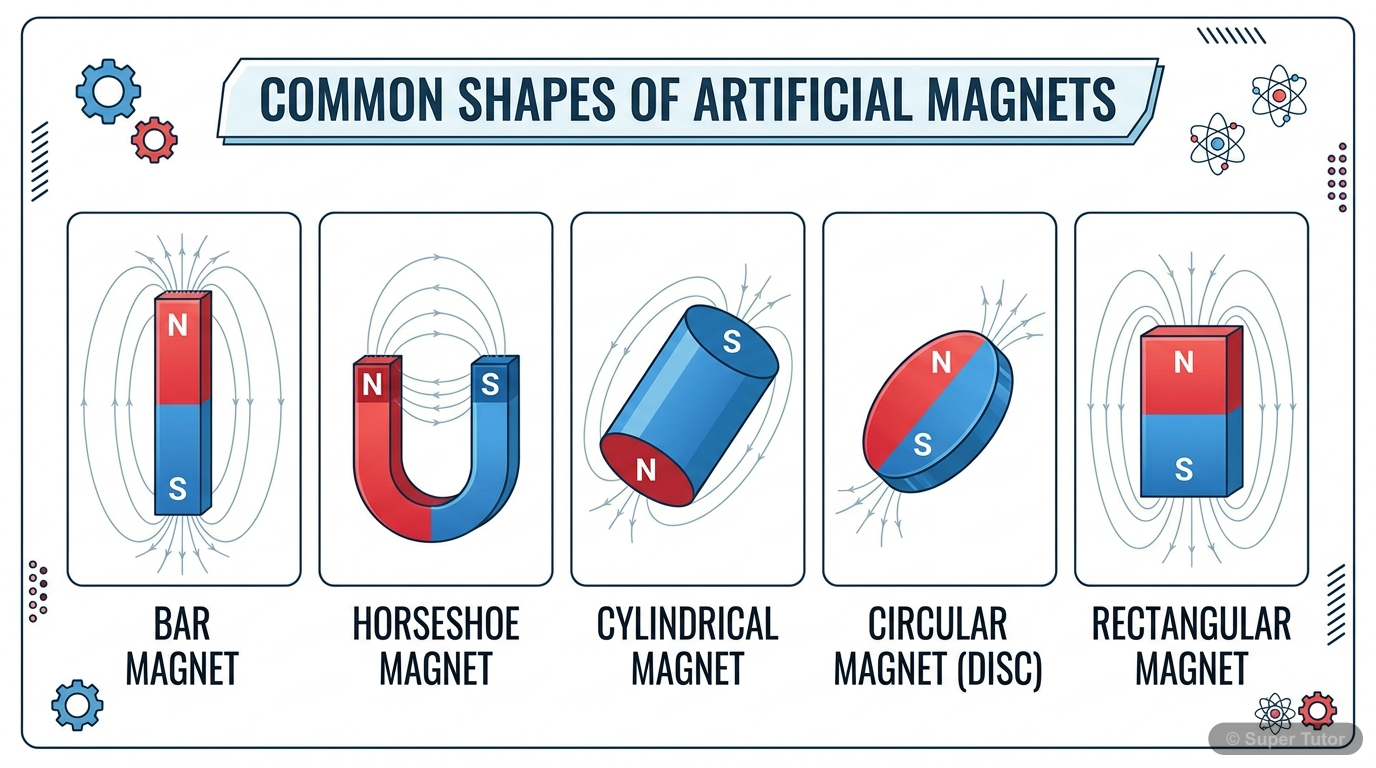
One of 18 illustrations for Magnetic Effect of Electric Current in Super Tutor — alongside flashcards, concept maps and practice questions.
Important Questions from Magnetic Effect of Electric Current
What is an electromagnet?
Show answer
A magnet that works only with electricity
Step 1: An electromagnet is a temporary magnet created by electric current. Step 2: It consists of a coil of wire (solenoid) often wound around an iron core. Step 3: When current flows through the coil, it creates a strong magnetic field. Step 4: When current stops, the magnetic field disappears. Step 5: This makes electromagnets controllable and useful in devices like electric bells, motors, and MRI machines.
Fleming's Left Hand Rule is used to find the direction of:
Show answer
Force on current-carrying conductor
Step 1: Fleming's Left Hand Rule determines force direction on current-carrying conductors in magnetic fields. Step 2: Thumb represents direction of force (F). Step 3: First finger represents direction of magnetic field (B). Step 4: Middle finger represents direction of current (I). Step 5: When these three fingers are perpendicular to each other, they show the relationship between force, field, and current in motors.
What is electromagnetic induction?
Show answer
Production of electricity from changing magnetic fields
Step 1: Electromagnetic induction converts changing magnetic fields into electric current. Step 2: When magnetic field through a coil changes, it induces EMF (voltage). Step 3: This EMF causes current to flow in a closed circuit. Step 4: The process was discovered by Michael Faraday in 1831. Step 5: This principle is used in generators, transformers, and many electrical devices to produce electricity from mechanical motion.
The frequency of AC supply in India is:
Show answer
50 Hz
Step 1: AC frequency is the number of complete cycles per second. Step 2: In India, the standard AC frequency is 50 Hz. Step 3: This means AC changes direction 100 times per second (50 cycles). Step 4: Different countries use different frequencies - USA uses 60 Hz. Step 5: The 50 Hz frequency is maintained across the entire Indian power grid for compatibility of all electrical appliances.
+39 more questions on Magnetic Effect of Electric Current (NIOS Class 10 Science & Tech)
Practise AllFrequently Asked Questions
What are the important topics in Magnetic Effect of Electric Current for NIOS Class 10 Science & Tech?
How many important questions are there in Magnetic Effect of Electric Current?
Sources & Official References
Content is aligned to the official syllabus. Refer to the board website for the latest curriculum.
More resources for Magnetic Effect of Electric Current
For serious students
Get the full Magnetic Effect of Electric Current chapter — start free.
Quizzes, flashcards, an AI doubt solver and a study plan for NIOS Class 10 Science & Tech. Free to start, no card needed.