Work and Energy — Important Questions
NIOS · Class 10 · Science & Tech
44 important questions from Work and Energy for NIOS Class 10 Science & Tech, with answers. Written for the board exams 2027.
Interactive on Super Tutor
Studying Work and Energy? Get the full interactive chapter.
Quizzes, flashcards, AI doubt-solver and a step-by-step study plan — built for important questions and more.
Free trial, no card needed.
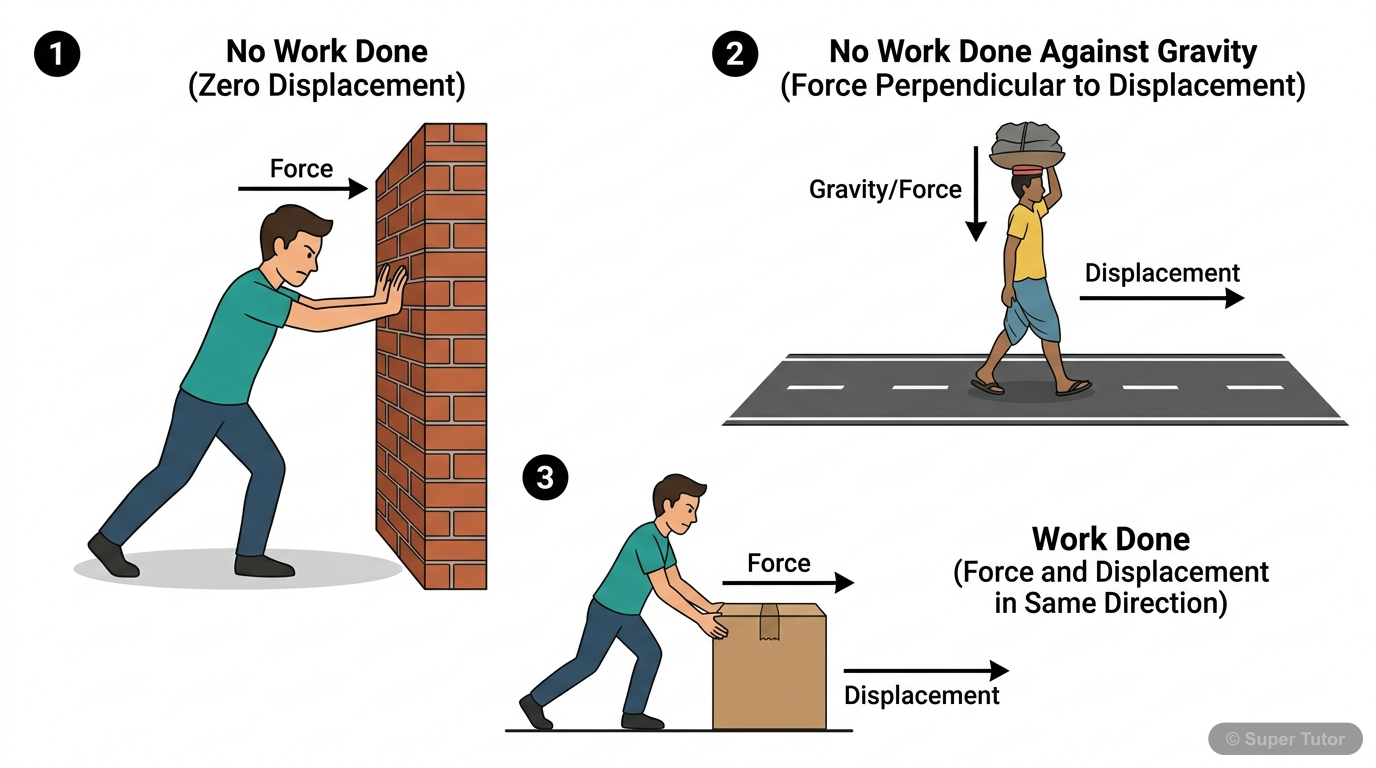
Learn better with visuals Super Tutor pairs illustrations like this with notes and quizzes for Work and Energy.
Important Questions from Work and Energy
Kinetic energy depends on:
Show answer
Both mass and velocity
Kinetic energy is given by the formula KE = ½mv², where m is mass and v is velocity. From this formula, we can see that kinetic energy depends on both mass and velocity. If mass increases (keeping velocity constant), kinetic energy increases. If velocity increases (keeping mass constant), kinetic energy increases even more rapidly since velocity is squared in the formula. Height affects potential energy, not kinetic energy.
Potential energy of a body depends on:
Show answer
Mass and height
Potential energy is given by the formula PE = mgh, where m is mass, g is acceleration due to gravity, and h is height above the reference point. From this formula, we can see that potential energy depends on both mass and height. A heavier object at the same height has more potential energy. The same object at a greater height also has more potential energy. Velocity affects kinetic energy, not potential energy.
Power is defined as:
Show answer
Work done per unit time
Power is defined as the rate of doing work, which means work done per unit time. The formula is P = W/t, where P is power, W is work done, and t is time taken. Power tells us how quickly work is being done. For example, a 100W bulb consumes 100J of energy every second. Two motors doing the same work but in different times have different power ratings - the faster one has higher power.
The SI unit of power is:
Show answer
Watt (W)
The SI unit of power is Watt (W). One watt is the power when 1 joule of work is done in 1 second. Since power = work/time, the unit becomes J/s = W. Joule is the unit of work and energy, Newton is the unit of force, and Horse power is a non-SI unit of power where 1 HP = 746 W. The unit watt is named after James Watt, who improved the steam engine.
+40 more questions on Work and Energy (NIOS Class 10 Science & Tech)
Practise AllFrequently Asked Questions
What are the important topics in Work and Energy for NIOS Class 10 Science & Tech?
How many important questions are there in Work and Energy?
Sources & Official References
Content is aligned to the official syllabus. Refer to the board website for the latest curriculum.
More resources for Work and Energy
Practice Quiz
Test yourself with a quick quiz
Revision Notes
Key points for last-minute revision
Formula Sheet
The chapter's formulas in one place
Chapter Summary
Understand the chapter at a glance
Concept Maps
See how topics connect
Study Plan
Step-by-step plan for this chapter
Flashcards
Quick-fire cards for active recall
Syllabus
What topics to cover
For serious students
Get the full Work and Energy chapter — start free.
Quizzes, flashcards, an AI doubt solver and a study plan for NIOS Class 10 Science & Tech. Free to start, no card needed.