Light Energy — Important Questions
NIOS · Class 10 · Science & Tech
41 important questions from Light Energy for NIOS Class 10 Science & Tech, with answers. Written for the board exams 2027.
Interactive on Super Tutor
Studying Light Energy? Get the full interactive chapter.
Quizzes, flashcards, AI doubt-solver and a step-by-step study plan — built for important questions and more.
Free trial, no card needed.
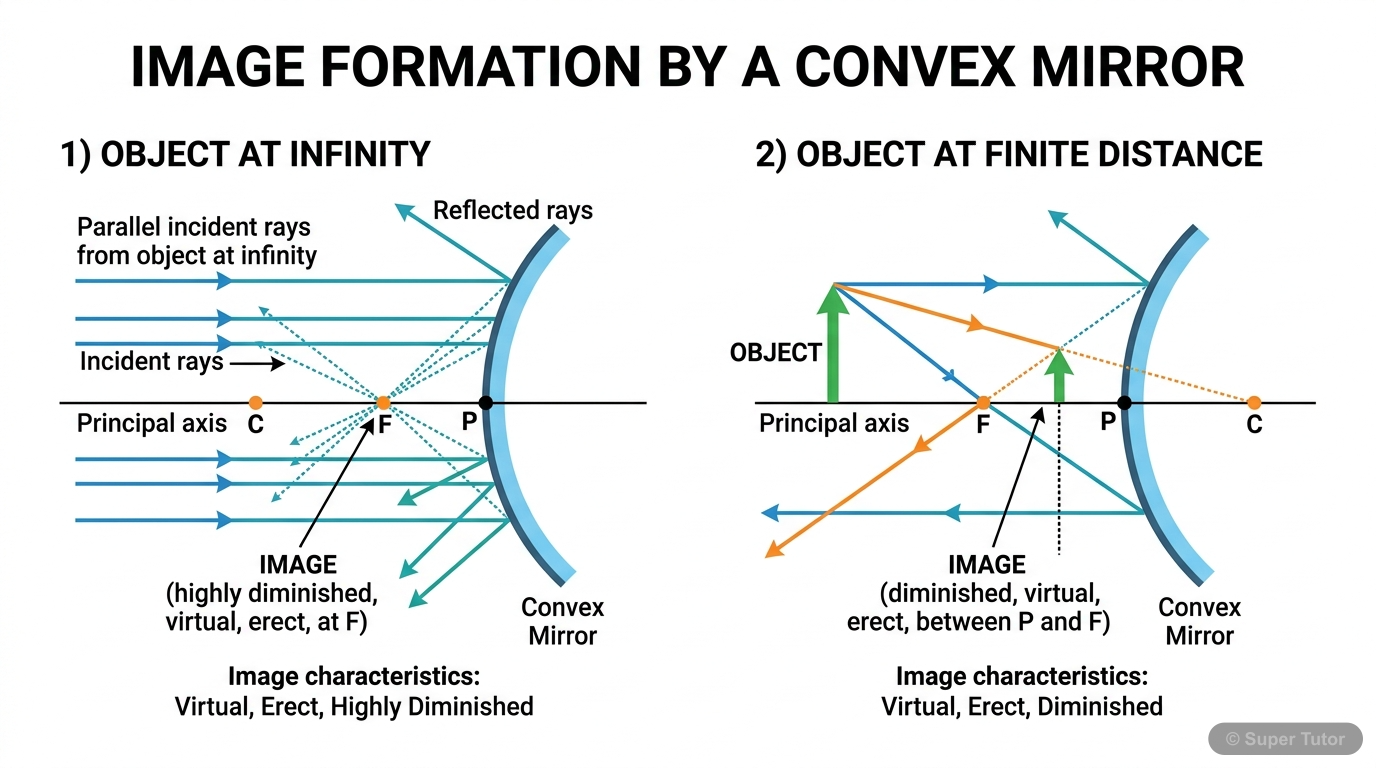
One of 18 illustrations for Light Energy in Super Tutor — alongside flashcards, concept maps and practice questions.
Important Questions from Light Energy
Which type of lens is used to correct myopia (short-sightedness)?
Show answer
Concave lens
Step 1: Understand myopia - the eye cannot see distant objects clearly because images form before the retina. Step 2: In myopia, the eye lens is too converging or the eyeball is too long. Step 3: A concave lens is diverging, which spreads out light rays before they enter the eye. Step 4: This diverging action ensures that when the eye lens converges the light, the image forms exactly on the retina. Step 5: This is why people with myopia wear glasses with negative power (concave lenses) to see distant objects clearly.
When white light passes through a prism, it splits into seven colors. This phenomenon is called:
Show answer
Dispersion
Step 1: Understand that white light contains all colors of the spectrum (VIBGYOR). Step 2: Different colors have different wavelengths and thus different refractive indices in the same medium. Step 3: When white light enters a prism, each color bends by a different amount due to different refractive indices. Step 4: This separation of white light into its constituent colors is called dispersion. Step 5: Rainbow formation is a natural example of dispersion when sunlight passes through water droplets in the atmosphere.
The speed of light in a medium is 2 × 10⁸ m/s. What is the refractive index of the medium?
Show answer
1.5
Step 1: Recall that refractive index n = speed of light in vacuum / speed of light in medium. Step 2: Speed of light in vacuum c = 3 × 10⁸ m/s (standard value). Step 3: Speed of light in the medium v = 2 × 10⁸ m/s (given). Step 4: Calculate n = (3 × 10⁸) / (2 × 10⁸) = 3/2 = 1.5. Step 5: This means light travels 1.5 times slower in this medium compared to vacuum, indicating it's denser than air.
Which mirror is commonly used as a rear-view mirror in vehicles?
Show answer
Convex mirror
Step 1: Understand the requirements for a rear-view mirror - it should provide a wide field of view to see more area behind the vehicle. Step 2: Convex mirrors always form virtual, erect, and diminished images regardless of object position. Step 3: The diminished images allow more objects to fit in the mirror's field of view. Step 4: This gives drivers a wider view of the road behind them, improving safety. Step 5: The warning 'Objects in mirror are closer than they appear' is because convex mirrors make things look smaller and farther than reality.
+37 more questions on Light Energy (NIOS Class 10 Science & Tech)
Practise AllFrequently Asked Questions
What are the important topics in Light Energy for NIOS Class 10 Science & Tech?
How many important questions are there in Light Energy?
Sources & Official References
Content is aligned to the official syllabus. Refer to the board website for the latest curriculum.
More resources for Light Energy
Practice Quiz
Test yourself with a quick quiz
Revision Notes
Key points for last-minute revision
Formula Sheet
The chapter's formulas in one place
Chapter Summary
Understand the chapter at a glance
Concept Maps
See how topics connect
Study Plan
Step-by-step plan for this chapter
Flashcards
Quick-fire cards for active recall
Syllabus
What topics to cover
For serious students
Get the full Light Energy chapter — start free.
Quizzes, flashcards, an AI doubt solver and a study plan for NIOS Class 10 Science & Tech. Free to start, no card needed.