Heredity — Important Questions
NIOS · Class 10 · Science & Tech
45 important questions from Heredity for NIOS Class 10 Science & Tech, with answers. Includes multiple choice, multiple correct and true false questions.
Interactive on Super Tutor
Studying Heredity? Get the full interactive chapter.
Quizzes, flashcards, AI doubt-solver and a step-by-step study plan — built for important questions and more.
Free trial, no card needed.
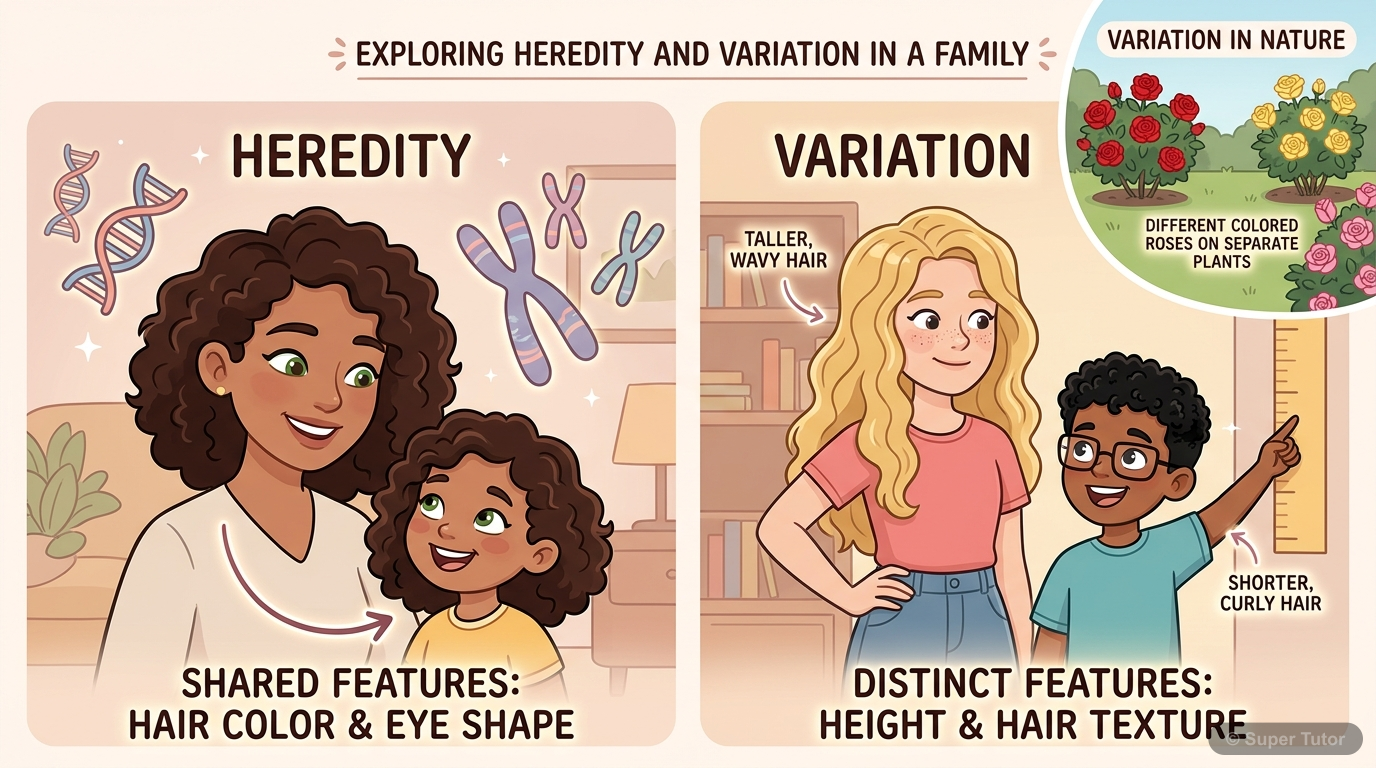
Learn better with visuals Super Tutor pairs illustrations like this with notes and quizzes for Heredity.
Important Questions from Heredity
What is DNA made of?
Show answer
Nucleotides
Step 1: DNA is a polynucleotide, meaning it's made of many nucleotides. Step 2: Each nucleotide has three components: nitrogenous base, sugar (deoxyribose), and phosphate. Step 3: The four types of nucleotides contain bases A, T, G, and C. Step 4: These nucleotides join together to form the DNA chain. Amino acids make proteins, fatty acids make fats, and carbohydrates are sugars - none form DNA.
Which blood group is called the universal donor?
Show answer
O
Step 1: Universal donor can give blood to all four blood groups (A, B, AB, O). Step 2: Blood group O has no A or B antigens on red blood cells. Step 3: This means O blood won't cause immune reactions in recipients of any blood group. Step 4: O negative is especially safe as it also lacks Rh factor. Groups A, B, and AB have specific antigens that can cause reactions in incompatible recipients.
In Mendel's law, what is a recessive trait?
Show answer
A trait that appears only when dominant trait is absent
Step 1: In a gene pair, one gene can be dominant and other recessive. Step 2: Dominant trait masks the expression of recessive trait. Step 3: Recessive trait appears only when both genes in the pair are recessive. Step 4: Example: In pea plants, dwarfness appears only when tallness gene is absent. The other options incorrectly describe dominant traits or inheritance patterns.
What is the diploid number of chromosomes in humans?
Show answer
46
Step 1: Diploid means having chromosomes in pairs (2n). Step 2: Humans have 23 pairs of chromosomes, totaling 46 chromosomes. Step 3: This diploid number is found in all body cells except gametes. Step 4: Gametes have haploid number (23) which becomes diploid after fertilization. Options 23, 44, and 22 represent different chromosome counts but not the human diploid number.
+41 more questions on Heredity (NIOS Class 10 Science & Tech)
Practise AllFrequently Asked Questions
What are the important topics in Heredity for NIOS Class 10 Science & Tech?
How many important questions are there in Heredity?
Sources & Official References
Content is aligned to the official syllabus. Refer to the board website for the latest curriculum.
More resources for Heredity
Practice Quiz
Test yourself with a quick quiz
Revision Notes
Key points for last-minute revision
Formula Sheet
The chapter's formulas in one place
Chapter Summary
Understand the chapter at a glance
Concept Maps
See how topics connect
Study Plan
Step-by-step plan for this chapter
Flashcards
Quick-fire cards for active recall
Syllabus
What topics to cover
For serious students
Get the full Heredity chapter — start free.
Quizzes, flashcards, an AI doubt solver and a study plan for NIOS Class 10 Science & Tech. Free to start, no card needed.