History of Life on Earth — Practice Quiz
NIOS · Class 10 · Science & Tech
Try a 4-question quiz on History of Life on Earth for NIOS Class 10 Science & Tech: tap an answer to check it and see why.
Interactive on Super Tutor
Studying History of Life on Earth? Get the full interactive chapter.
Quizzes, flashcards, AI doubt-solver and a step-by-step study plan — built for practice quiz and more.
Free trial, no card needed.
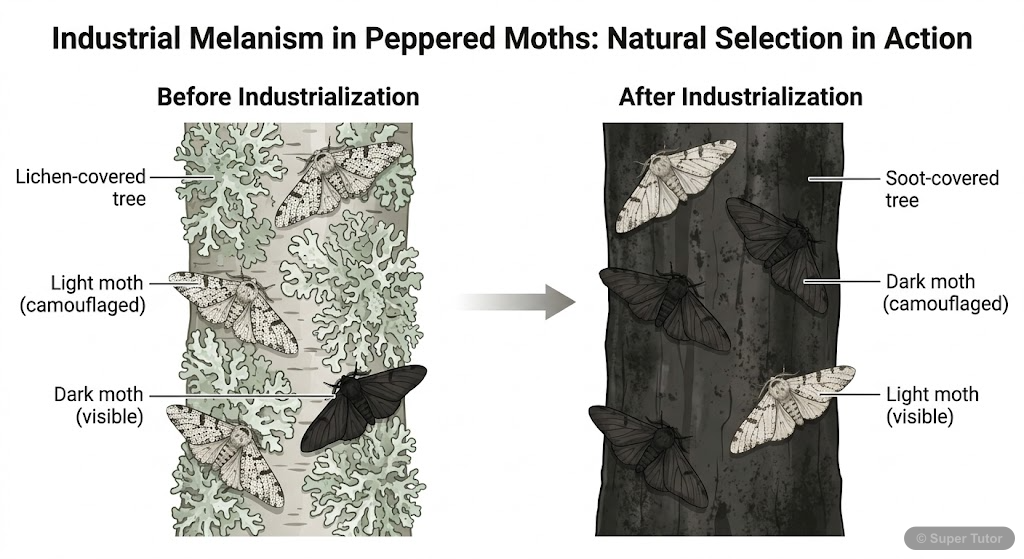
One of 9 illustrations for History of Life on Earth in Super Tutor — alongside flashcards, concept maps and practice questions.
Quick Quiz: History of Life on Earth
0/4Tap an answer to check it instantly. No sign-up needed for these 4.
When did Earth come into existence according to scientific estimates?
What was the composition of primitive Earth's atmosphere?
Who proposed the theory of life originating in a 'primordial soup'?
What is the 'Cambrian explosion'?
Sample Questions
According to Darwin, what is the mechanism of evolution?
Show answer
Natural Selection
Step 1: Charles Darwin proposed Natural Selection as the primary mechanism driving evolution. Step 2: Natural selection means 'survival of the fittest' - organisms with advantageous traits survive and reproduce more. Step 3: Those with less favorable traits are eliminated over time through the 'struggle for existence'. Step 4: This process leads to gradual changes in populations over generations. Step 5: Darwin observed this during his voyage on HMS Beagle, particularly studying finches on the Galapagos Islands.
What is Neo-Darwinism?
Show answer
Darwin's theory modified with Mendelian genetics
Step 1: Darwin didn't know how heritable variations arose or were passed to offspring. Step 2: Mendel's principles of genetics were discovered around the same time but Darwin wasn't aware of them. Step 3: Later scientists incorporated Mendelian genetics into Darwin's theory. Step 4: This combination became known as Neo-Darwinism or the Modern Synthetic Theory of Evolution. Step 5: It explains both how variations occur (through genes/mutations) and how they're inherited (through Mendel's laws).
When did human evolution begin?
Show answer
1.5-2 million years ago
Step 1: Fossil evidence shows human evolution began approximately 1.5-2 million years ago. Step 2: This coincided with climate changes and glaciation that reduced forest cover. Step 3: Human ancestors had to adapt from tree-dwelling to ground-walking lifestyle. Step 4: The first human-like ancestor was Australopithecus, including the famous fossil 'Lucy'. Step 5: Modern humans (Homo sapiens sapiens) evolved only about 50,000 years ago.
What is the scientific name of modern humans?
Show answer
Homo sapiens sapiens
Step 1: Modern humans are scientifically classified as Homo sapiens sapiens. Step 2: 'Homo' refers to the genus (human), 'sapiens' means wise. Step 3: The double 'sapiens' distinguishes modern humans from earlier Homo sapiens like Neanderthals. Step 4: This classification reflects our advanced cognitive abilities and cultural development. Step 5: Modern humans evolved about 50,000 years ago and have remained largely unchanged biologically since then.
+40 more questions on History of Life on Earth (NIOS Class 10 Science & Tech)
Practise AllFrequently Asked Questions
What are the important topics in History of Life on Earth for NIOS Class 10 Science & Tech?
How many practice questions are there for History of Life on Earth?
Sources & Official References
Content is aligned to the official syllabus. Refer to the board website for the latest curriculum.
More resources for History of Life on Earth
Important Questions
Exam-style questions with answers
Revision Notes
Key points for last-minute revision
Formula Sheet
The chapter's formulas in one place
Chapter Summary
Understand the chapter at a glance
Concept Maps
See how topics connect
Study Plan
Step-by-step plan for this chapter
Flashcards
Quick-fire cards for active recall
Syllabus
What topics to cover
For serious students
Get the full History of Life on Earth chapter — start free.
Quizzes, flashcards, an AI doubt solver and a study plan for NIOS Class 10 Science & Tech. Free to start, no card needed.