Atoms and Molecules — Practice Quiz
NIOS · Class 10 · Science & Tech
Try a 4-question quiz on Atoms and Molecules for NIOS Class 10 Science & Tech: tap an answer to check it and see why.
Interactive on Super Tutor
Studying Atoms and Molecules? Get the full interactive chapter.
Quizzes, flashcards, AI doubt-solver and a step-by-step study plan — built for practice quiz and more.
Free trial, no card needed.
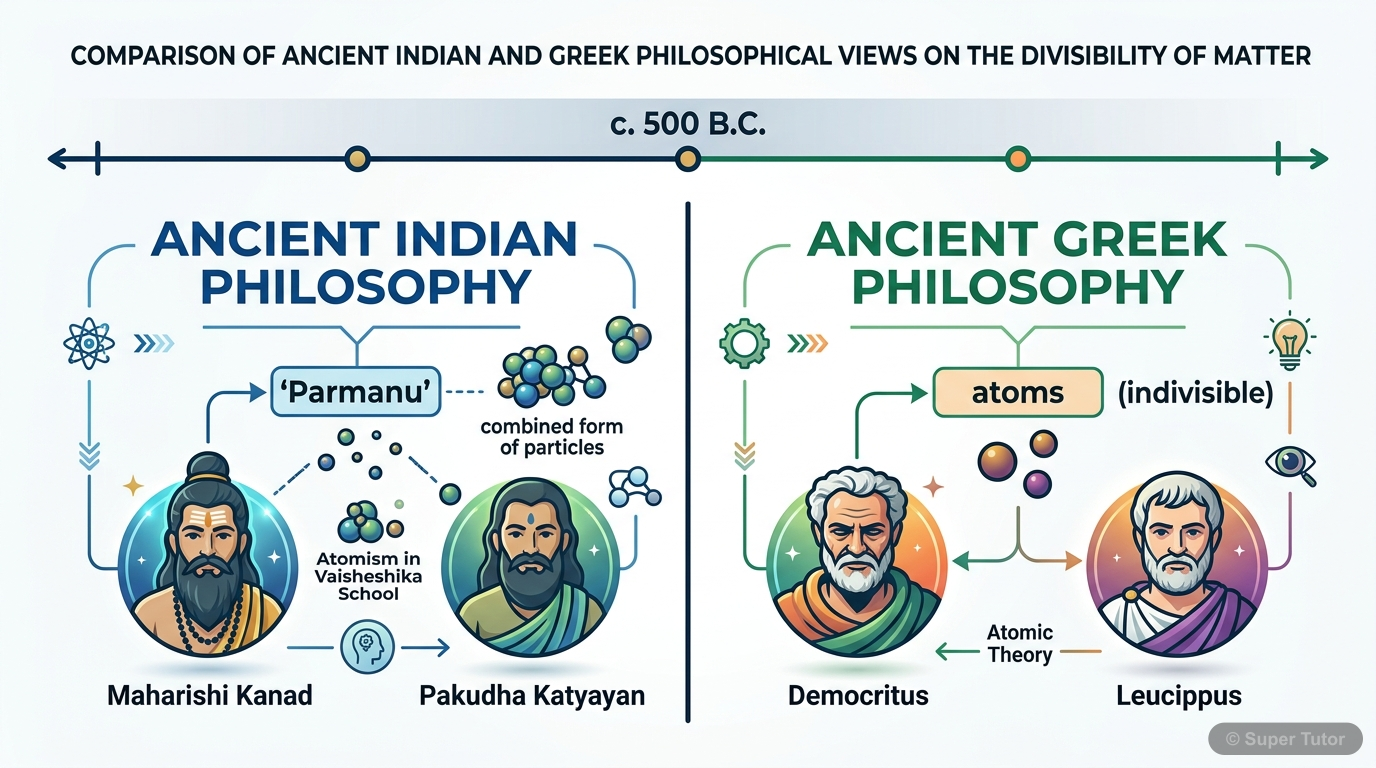
One of 13 illustrations for Atoms and Molecules in Super Tutor — alongside flashcards, concept maps and practice questions.
Quick Quiz: Atoms and Molecules
0/4Tap an answer to check it instantly. No sign-up needed for these 4.
According to Dalton's atomic theory, what is the smallest indivisible particle of an element?
What is the atomic number of an element?
Which scientist proposed the law of conservation of mass?
What is the molecular formula of water?
Sample Questions
How many atoms are present in exactly 12 grams of carbon-12?
Show answer
6.02 × 10²³
Step 1: The mole is defined as the amount of substance containing as many particles as there are atoms in exactly 12g of carbon-12. Step 2: This number of atoms in 12g of carbon-12 is experimentally determined to be 6.02 × 10²³. Step 3: This number is called Avogadro's number and represents one mole of any substance. Step 4: Therefore, exactly 12g of carbon-12 contains 6.02 × 10²³ atoms by definition. Other options are either too large or too small for this fundamental constant.
What is the valency of oxygen?
Show answer
2
Step 1: Valency is the combining capacity of an element with other elements. Step 2: Oxygen typically forms two bonds with other atoms to achieve a stable configuration. Step 3: In compounds like H2O, oxygen combines with 2 hydrogen atoms, and in CO2, oxygen needs 2 bonds with carbon. Step 4: Therefore, oxygen has a valency of 2. Valencies of 1, 3, or 4 would not match oxygen's typical bonding pattern in common compounds.
Which of the following represents isotopes of hydrogen?
Show answer
¹H, ²H, ³H
Step 1: Isotopes are atoms of the same element with the same atomic number but different mass numbers. Step 2: Hydrogen has atomic number 1 (1 proton) but can have different numbers of neutrons. Step 3: ¹H (protium) has 0 neutrons, ²H (deuterium) has 1 neutron, and ³H (tritium) has 2 neutrons. Step 4: All have 1 proton, making them hydrogen isotopes. H, He, Li are different elements; H⁺, H⁻, H are ions and atom; H₂, H₃, H₄ represent molecules, not isotopes.
What is the mass number of an atom?
Show answer
Number of protons + neutrons
Step 1: Mass number (A) represents the total number of particles in the nucleus of an atom. Step 2: The nucleus contains only protons and neutrons, which are called nucleons. Step 3: Both protons and neutrons have approximately the same mass (about 1 atomic mass unit each). Step 4: Therefore, mass number = number of protons + number of neutrons. Electrons have negligible mass compared to nucleons and are not included in mass number calculation.
+89 more questions on Atoms and Molecules (NIOS Class 10 Science & Tech)
Practise AllFrequently Asked Questions
What are the important topics in Atoms and Molecules for NIOS Class 10 Science & Tech?
How many practice questions are there for Atoms and Molecules?
Sources & Official References
Content is aligned to the official syllabus. Refer to the board website for the latest curriculum.
More resources for Atoms and Molecules
Important Questions
Exam-style questions with answers
Revision Notes
Key points for last-minute revision
Formula Sheet
The chapter's formulas in one place
Chapter Summary
Understand the chapter at a glance
Concept Maps
See how topics connect
Study Plan
Step-by-step plan for this chapter
Flashcards
Quick-fire cards for active recall
Syllabus
What topics to cover
For serious students
Get the full Atoms and Molecules chapter — start free.
Quizzes, flashcards, an AI doubt solver and a study plan for NIOS Class 10 Science & Tech. Free to start, no card needed.