Chemical Reaction and Equations — Practice Quiz
NIOS · Class 10 · Science & Tech
Try a 4-question quiz on Chemical Reaction and Equations for NIOS Class 10 Science & Tech: tap an answer to check it and see why.
Interactive on Super Tutor
Studying Chemical Reaction and Equations? Get the full interactive chapter.
Quizzes, flashcards, AI doubt-solver and a step-by-step study plan — built for practice quiz and more.
Free trial, no card needed.
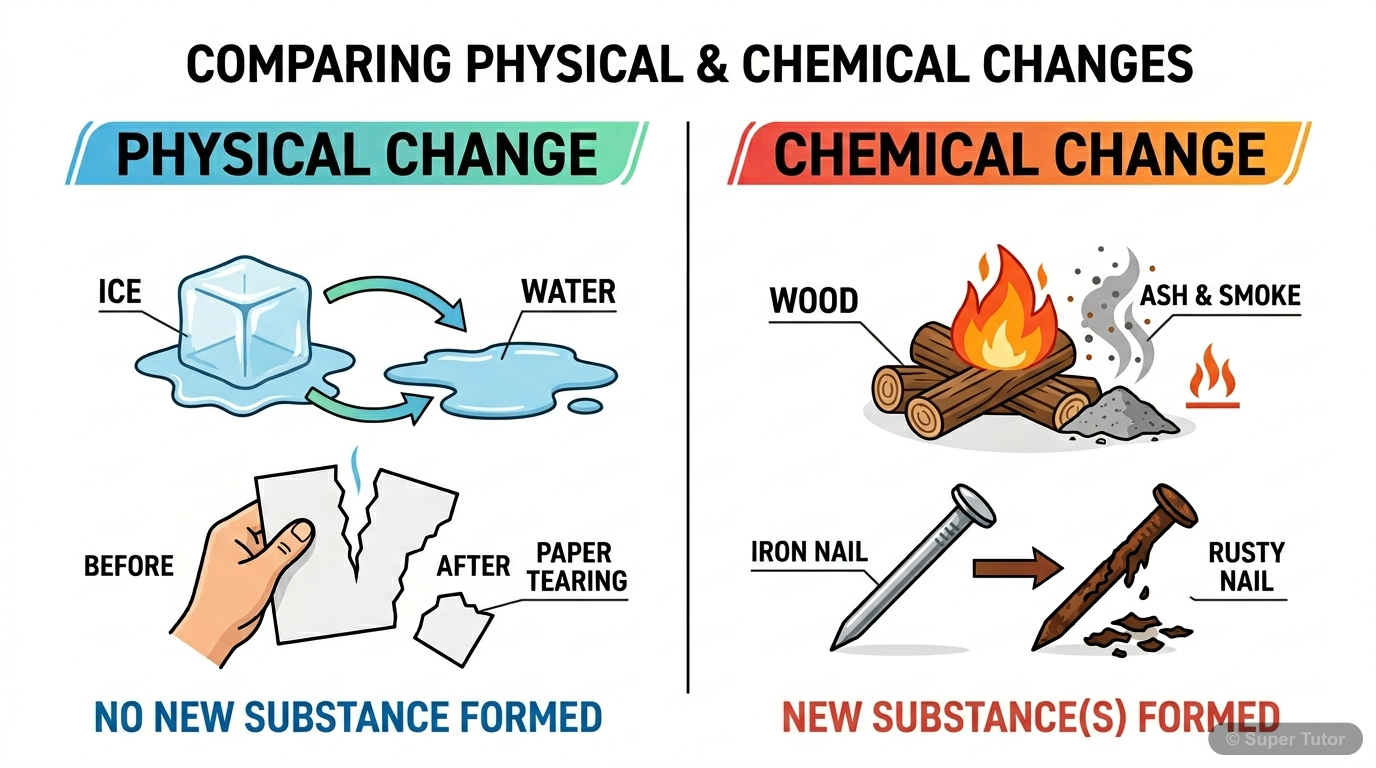
Learn better with visuals Super Tutor pairs illustrations like this with notes and quizzes for Chemical Reaction and Equations.
Quick Quiz: Chemical Reaction and Equations
0/4Tap an answer to check it instantly. No sign-up needed for these 4.
What is the balanced chemical equation for the reaction between magnesium and oxygen to form magnesium oxide?
Which type of reaction is represented by CaCO₃ → CaO + CO₂?
In the reaction Zn + CuSO₄ → ZnSO₄ + Cu, which element is displaced?
What happens when iron reacts with dilute hydrochloric acid?
Sample Questions
Which of the following represents an exothermic reaction?
Show answer
Burning of coal
Step 1: Understand that exothermic reactions release heat energy to surroundings. Step 2: Analyze each option - melting, boiling, and sublimation all require heat input (endothermic). Step 3: Burning of coal involves combustion with oxygen, releasing heat and light. Step 4: This heat energy is what we use for cooking, heating homes, and running steam engines. Step 5: The reaction C + O₂ → CO₂ + heat energy clearly shows heat as a product, making it exothermic.
In the reaction 2H₂ + O₂ → 2H₂O, what is oxidized?
Show answer
Hydrogen
Step 1: Identify oxidation as the gain of oxygen or loss of electrons. Step 2: Observe that hydrogen (H₂) combines with oxygen to form water. Step 3: Hydrogen gains oxygen in this process, meeting the definition of oxidation. Step 4: Oxygen is reduced as it combines with hydrogen (reduction is opposite of oxidation). Step 5: This is the fundamental reaction in fuel cells and rocket engines, where hydrogen acts as fuel by getting oxidized.
What is the main cause of corrosion of iron?
Show answer
Oxygen and moisture
Step 1: Understand that corrosion is an oxidation process requiring specific conditions. Step 2: Recognize that pure oxygen alone cannot cause rusting without water. Step 3: Similarly, water alone without oxygen cannot cause rusting. Step 4: Both oxygen (from air) and moisture (water) must be present together. Step 5: This explains why iron objects in dry desert air or underwater (low oxygen) rust much slower, and why painting prevents both air and moisture contact.
Which process is used to prevent rusting by coating iron with zinc?
Show answer
Galvanization
Step 1: Identify that zinc coating on iron is specifically called galvanization. Step 2: Understand that zinc is more reactive than iron and gets oxidized preferentially. Step 3: This means zinc corrodes first, protecting the underlying iron. Step 4: The process involves dipping iron objects in molten zinc to form a protective layer. Step 5: Common examples include galvanized iron sheets used for roofing and galvanized buckets that resist rusting much longer than plain iron.
+41 more questions on Chemical Reaction and Equations (NIOS Class 10 Science & Tech)
Practise AllFrequently Asked Questions
What are the important topics in Chemical Reaction and Equations for NIOS Class 10 Science & Tech?
How many practice questions are there for Chemical Reaction and Equations?
Sources & Official References
Content is aligned to the official syllabus. Refer to the board website for the latest curriculum.
More resources for Chemical Reaction and Equations
Important Questions
Exam-style questions with answers
Revision Notes
Key points for last-minute revision
Formula Sheet
The chapter's formulas in one place
Chapter Summary
Understand the chapter at a glance
Concept Maps
See how topics connect
Study Plan
Step-by-step plan for this chapter
Flashcards
Quick-fire cards for active recall
Syllabus
What topics to cover
For serious students
Get the full Chemical Reaction and Equations chapter — start free.
Quizzes, flashcards, an AI doubt solver and a study plan for NIOS Class 10 Science & Tech. Free to start, no card needed.