Building Blocks of Life Cell and Tissues — Practice Quiz
NIOS · Class 10 · Science & Tech
Try a 4-question quiz on Building Blocks of Life Cell and Tissues for NIOS Class 10 Science & Tech: tap an answer to check it and see why.
Interactive on Super Tutor
Studying Building Blocks of Life Cell and Tissues? Get the full interactive chapter.
Quizzes, flashcards, AI doubt-solver and a step-by-step study plan — built for practice quiz and more.
Free trial, no card needed.
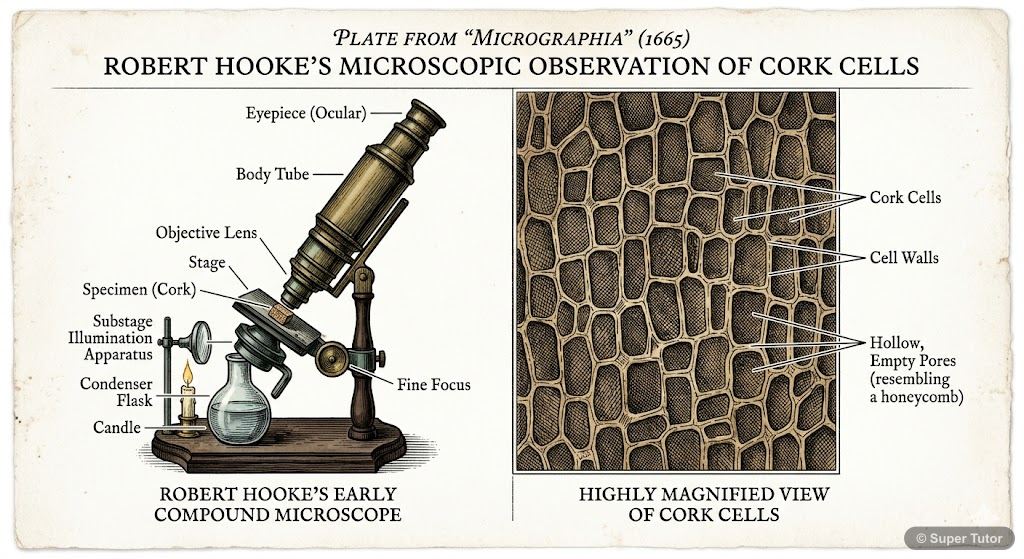
Learn better with visuals Super Tutor pairs illustrations like this with notes and quizzes for Building Blocks of Life Cell and Tissues.
Quick Quiz: Building Blocks of Life Cell and Tissues
0/4Tap an answer to check it instantly. No sign-up needed for these 4.
Who discovered the cell and in which year?
What is the main difference between prokaryotic and eukaryotic cells?
Which organelle is known as the 'powerhouse of the cell'?
What type of cell division is responsible for growth and repair in organisms?
Sample Questions
Which tissue is found at the growing tips of roots and shoots in plants?
Show answer
Meristematic tissue
Step 1: Meristematic tissue is found at the growing points of plants, especially at root and shoot tips. Step 2: These tissues consist of actively dividing cells that can multiply indefinitely. Step 3: The cells are small, thin-walled, and have large nuclei with dense cytoplasm. Step 4: They lack intercellular spaces and are compactly arranged to support continuous division. Step 5: This tissue is responsible for the primary growth of plants, making stems longer and roots deeper by adding new cells at the tips.
What is the function of xylem in plants?
Show answer
Transport of water and minerals from roots to leaves
Step 1: Xylem is a conducting tissue that forms part of the plant's vascular system. Step 2: Its primary function is to transport water and dissolved minerals absorbed from the soil by the roots. Step 3: This transport occurs in an upward direction, from roots through stems to leaves. Step 4: The water is essential for photosynthesis and maintaining plant structure through turgor pressure. Step 5: Xylem is located towards the center of the stem and consists of specialized cells that form continuous tubes for efficient water transport.
Which type of muscle tissue is found in the heart?
Show answer
Cardiac muscle
Step 1: Cardiac muscle is the specialized muscle tissue found exclusively in the heart. Step 2: These muscles show striations (bands) like skeletal muscles but are involuntary like smooth muscles. Step 3: Cardiac muscle fibers are short, branched, and connected by special junctions called intercalated discs. Step 4: They contract and relax rhythmically and continuously without getting tired, from embryonic stage until death. Step 5: This unique property enables the heart to pump blood throughout life without voluntary control, making it essential for circulation.
What is the main function of ribosomes in a cell?
Show answer
Protein synthesis
Step 1: Ribosomes are small granular organelles responsible for protein synthesis in cells. Step 2: They read the genetic instructions from messenger RNA (mRNA) and translate them into proteins. Step 3: Ribosomes can be found free in the cytoplasm or attached to the endoplasmic reticulum. Step 4: They link amino acids together in the correct sequence to form proteins according to genetic code. Step 5: Since proteins are essential for all cellular functions, ribosomes are often called 'protein factories' of the cell.
+37 more questions on Building Blocks of Life Cell and Tissues (NIOS Class 10 Science & Tech)
Practise AllFrequently Asked Questions
What are the important topics in Building Blocks of Life Cell and Tissues for NIOS Class 10 Science & Tech?
How many practice questions are there for Building Blocks of Life Cell and Tissues?
Sources & Official References
Content is aligned to the official syllabus. Refer to the board website for the latest curriculum.
More resources for Building Blocks of Life Cell and Tissues
Important Questions
Exam-style questions with answers
Revision Notes
Key points for last-minute revision
Chapter Summary
Understand the chapter at a glance
Concept Maps
See how topics connect
Study Plan
Step-by-step plan for this chapter
Flashcards
Quick-fire cards for active recall
Syllabus
What topics to cover
For serious students
Get the full Building Blocks of Life Cell and Tissues chapter — start free.
Quizzes, flashcards, an AI doubt solver and a study plan for NIOS Class 10 Science & Tech. Free to start, no card needed.