Sound and Communication — Practice Quiz
NIOS · Class 10 · Science & Tech
Try a 4-question quiz on Sound and Communication for NIOS Class 10 Science & Tech: tap an answer to check it and see why.
Interactive on Super Tutor
Studying Sound and Communication? Get the full interactive chapter.
Quizzes, flashcards, AI doubt-solver and a step-by-step study plan — built for practice quiz and more.
Free trial, no card needed.
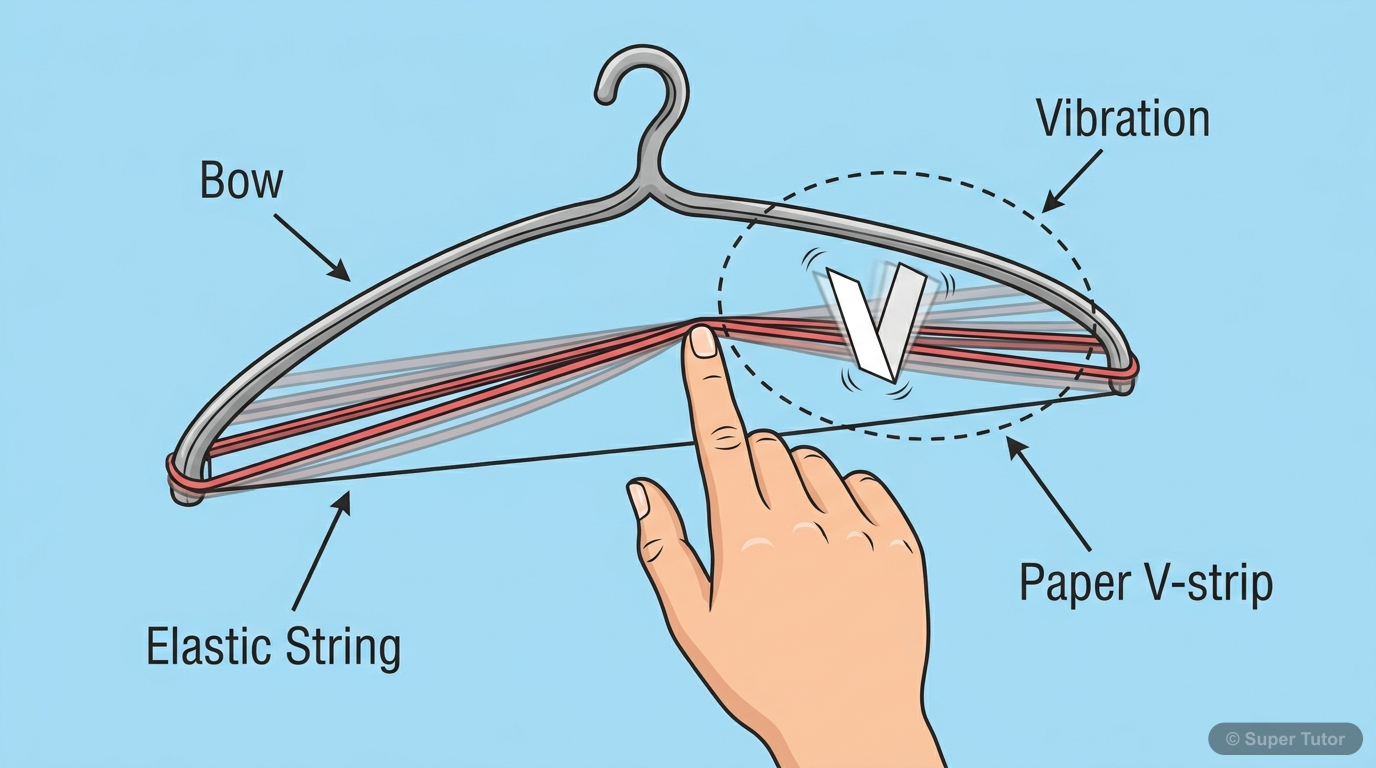
One of 13 illustrations for Sound and Communication in Super Tutor — alongside flashcards, concept maps and practice questions.
Quick Quiz: Sound and Communication
0/4Tap an answer to check it instantly. No sign-up needed for these 4.
What is the unit used to measure the loudness of sound?
Which of the following is the correct relationship between wave velocity, frequency, and wavelength?
Sound waves require a medium to travel. This is because sound waves are:
What is the approximate range of frequencies that humans can hear?
Sample Questions
SONAR works on the principle of:
Show answer
Reflection of sound waves
Step 1: SONAR stands for Sound Navigation and Ranging, which uses sound waves to detect objects. Step 2: It works by transmitting sound waves (usually ultrasonic) into water or other media. Step 3: When these sound waves hit an object (like a ship, submarine, or sea floor), they reflect back to the source. Step 4: By measuring the time taken for the echo to return, we can calculate the distance to the object. Step 5: This principle is similar to how we hear echoes in valleys - the sound bounces back from distant hills.
In which medium does sound travel fastest?
Show answer
Steel (solid)
Step 1: Sound speed depends on how tightly packed the molecules are in the medium. Step 2: In solids like steel, molecules are very closely packed and strongly connected, allowing vibrations to transfer quickly. Step 3: In liquids like water, molecules are less tightly packed than solids, so sound travels slower than in solids. Step 4: In gases like air, molecules are far apart, making sound travel slowest among the three states. Step 5: Sound cannot travel in vacuum at all because there are no particles to carry the vibrations.
What is the main difference between noise and music?
Show answer
Music has regular patterns while noise is random
Step 1: Music consists of sounds that have regular, repeating patterns and rhythms that are pleasing to hear. Step 2: Musical sounds have periodic wave patterns that repeat at regular intervals, creating harmony. Step 3: Noise consists of random, irregular sound waves without any pattern or rhythm. Step 4: Both music and noise can have the same loudness, frequency range, or speed - these don't determine the difference. Step 5: The key difference is the regularity: music follows patterns while noise is chaotic and often irritating.
A microphone converts:
Show answer
Sound waves to electrical signals
Step 1: A microphone is an input device that captures sound from the environment. Step 2: When sound waves reach the microphone, they cause a diaphragm inside to vibrate. Step 3: This vibration is converted into corresponding electrical signals through various methods (like capacitor changes or magnetic induction). Step 4: These electrical signals can then be amplified, recorded, or transmitted to other devices. Step 5: A speaker does the opposite job - it converts electrical signals back to sound waves for us to hear.
+39 more questions on Sound and Communication (NIOS Class 10 Science & Tech)
Practise AllFrequently Asked Questions
What are the important topics in Sound and Communication for NIOS Class 10 Science & Tech?
How many practice questions are there for Sound and Communication?
Sources & Official References
Content is aligned to the official syllabus. Refer to the board website for the latest curriculum.
More resources for Sound and Communication
Important Questions
Exam-style questions with answers
Revision Notes
Key points for last-minute revision
Formula Sheet
The chapter's formulas in one place
Chapter Summary
Understand the chapter at a glance
Concept Maps
See how topics connect
Study Plan
Step-by-step plan for this chapter
Flashcards
Quick-fire cards for active recall
Syllabus
What topics to cover
For serious students
Get the full Sound and Communication chapter — start free.
Quizzes, flashcards, an AI doubt solver and a study plan for NIOS Class 10 Science & Tech. Free to start, no card needed.