Classification of Living Organisms — Practice Quiz
NIOS · Class 10 · Science & Tech
Try a 4-question quiz on Classification of Living Organisms for NIOS Class 10 Science & Tech: tap an answer to check it and see why.
Interactive on Super Tutor
Studying Classification of Living Organisms? Get the full interactive chapter.
Quizzes, flashcards, AI doubt-solver and a step-by-step study plan — built for practice quiz and more.
Free trial, no card needed.
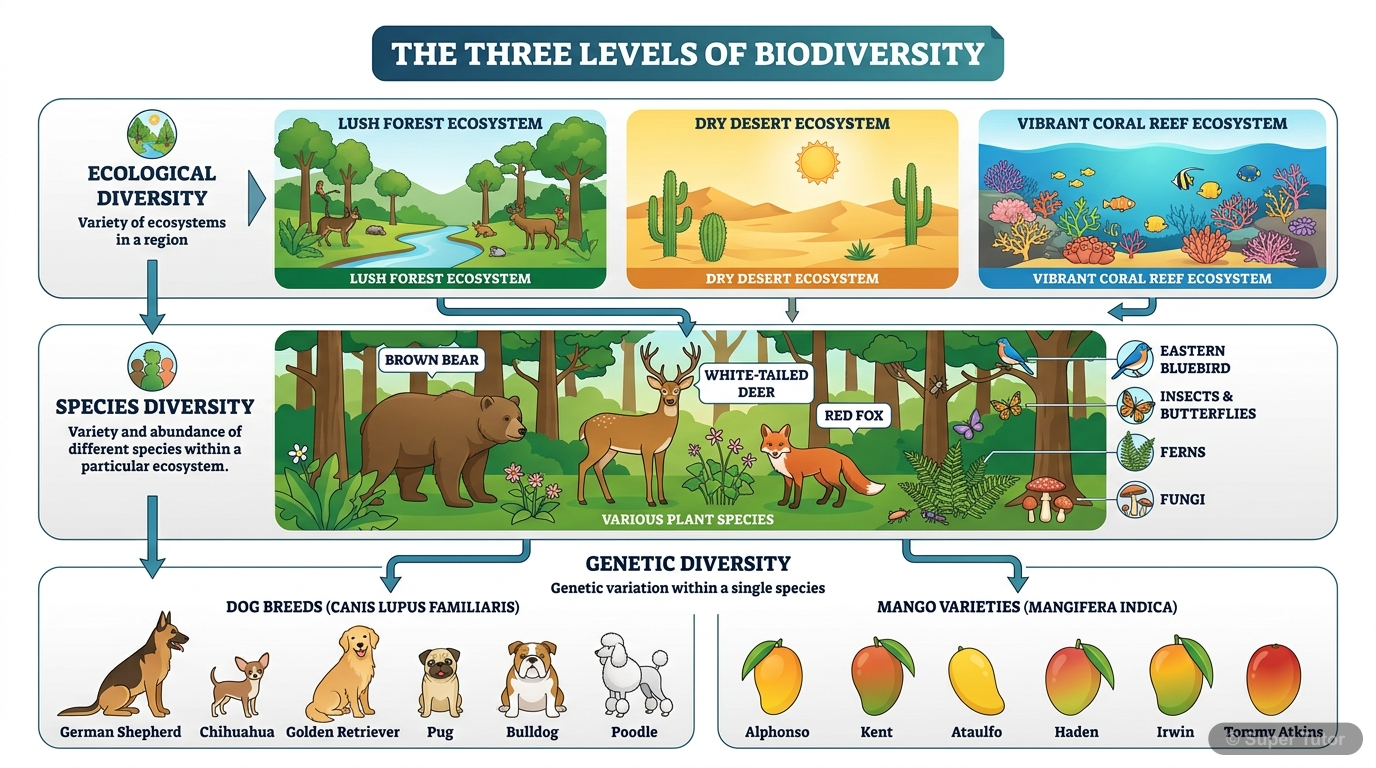
Learn better with visuals Super Tutor pairs illustrations like this with notes and quizzes for Classification of Living Organisms.
Quick Quiz: Classification of Living Organisms
0/4Tap an answer to check it instantly. No sign-up needed for these 4.
What does the term 'biodiversity' mean?
How many kingdoms are there in the five kingdom classification system?
What is the scientific name for humans?
Which kingdom includes organisms that feed on dead and decaying matter?
Sample Questions
What are the three levels of biodiversity?
Show answer
Ecosystem, species, genetic
The three recognized levels of biodiversity are ecosystem diversity, species diversity, and genetic diversity. Step 1: Ecosystem diversity refers to the variety of different ecosystems like forests, deserts, oceans where organisms live. Step 2: Species diversity means the variety of different species living in a particular area. Step 3: Genetic diversity refers to the variety of genes within species populations. Step 4: These three levels work together to maintain the overall biodiversity on Earth. The other options represent geographical scales, organism types, or habitat types, not biodivers
Which domain includes organisms with well-formed nucleus?
Show answer
Eukarya
Domain Eukarya includes all organisms with well-formed nucleus in their cells. Step 1: The word 'Eukarya' comes from 'eu' meaning true and 'karyon' meaning nucleus. Step 2: These organisms have their genetic material enclosed within a membrane-bound nucleus. Step 3: This domain includes plants, animals, fungi, and protists. Step 4: The other two domains (Archaea and Bacteria) are prokaryotes without well-formed nucleus. Bacteria and Archaea have their genetic material freely floating in the cell without a nuclear membrane.
What is the part of Earth that supports life called?
Show answer
Biosphere
The biosphere is the part of Earth where life exists and can be supported. Step 1: The biosphere extends from about 8 km high in the atmosphere to about 5 km below sea level. Step 2: It includes all living organisms and their physical environment where they interact. Step 3: This zone contains diverse ecosystems like forests, oceans, deserts, and mountains. Step 4: All biodiversity exists within the biosphere. The atmosphere is just the air layer, lithosphere is the rocky layer, and hydrosphere is only the water bodies.
Who introduced the binomial system of nomenclature?
Show answer
Carolus Linnaeus
Carolus Linnaeus, a Swedish naturalist of the 18th century, introduced the binomial system of nomenclature. Step 1: Linnaeus developed this two-name system to give each organism a unique scientific name. Step 2: The first name represents the genus and the second represents the species. Step 3: This system is used worldwide and helps scientists communicate clearly about organisms. Step 4: His work laid the foundation for modern taxonomy. Darwin is known for evolution theory, Mendel for genetics, and Whittaker for the five kingdom classification.
+40 more questions on Classification of Living Organisms (NIOS Class 10 Science & Tech)
Practise AllFrequently Asked Questions
What are the important topics in Classification of Living Organisms for NIOS Class 10 Science & Tech?
How many practice questions are there for Classification of Living Organisms?
Sources & Official References
Content is aligned to the official syllabus. Refer to the board website for the latest curriculum.
More resources for Classification of Living Organisms
Important Questions
Exam-style questions with answers
Revision Notes
Key points for last-minute revision
Chapter Summary
Understand the chapter at a glance
Concept Maps
See how topics connect
Study Plan
Step-by-step plan for this chapter
Flashcards
Quick-fire cards for active recall
Syllabus
What topics to cover
For serious students
Get the full Classification of Living Organisms chapter — start free.
Quizzes, flashcards, an AI doubt solver and a study plan for NIOS Class 10 Science & Tech. Free to start, no card needed.