Life Processes-1 Nutrition, Transportation and Excretion — Practice Quiz
NIOS · Class 10 · Science & Tech
Try a 4-question quiz on Life Processes-1 Nutrition, Transportation and Excretion for NIOS Class 10 Science & Tech: tap an answer to check it and see why.
Interactive on Super Tutor
Studying Life Processes-1 Nutrition, Transportation and Excretion? Get the full interactive chapter.
Quizzes, flashcards, AI doubt-solver and a step-by-step study plan — built for practice quiz and more.
Free trial, no card needed.
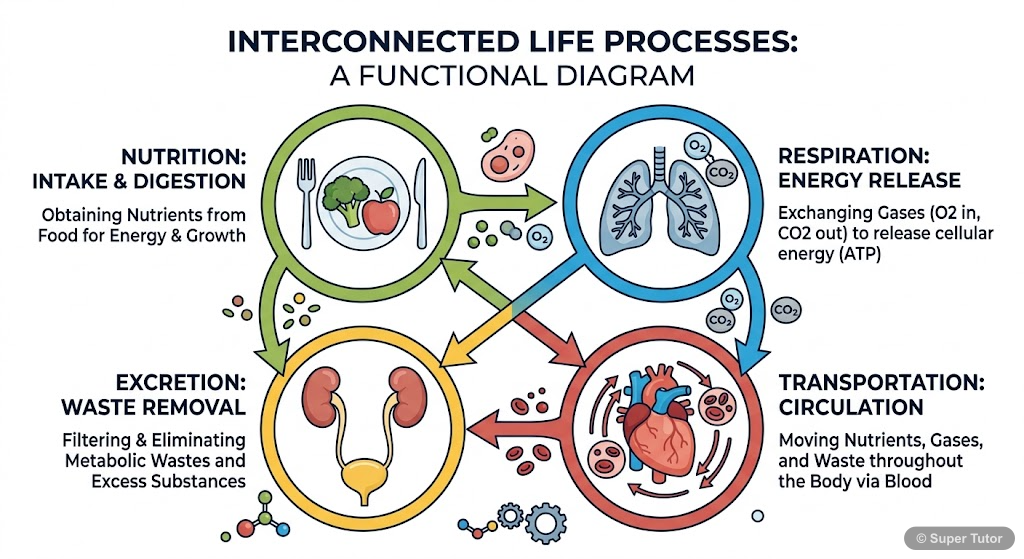
One of 20 illustrations for Life Processes-1 Nutrition, Transportation and Excretion in Super Tutor — alongside flashcards, concept maps and practice questions.
Quick Quiz: Life Processes-1 Nutrition, Transportation and Excretion
0/4Tap an answer to check it instantly. No sign-up needed for these 4.
Which of the following is the process by which green plants make their own food using sunlight, carbon dioxide, and water?
What is the main function of haemoglobin in red blood cells?
Which organ in humans is responsible for filtering blood and removing waste products?
In which part of the digestive system does most absorption of digested food take place?
Sample Questions
Which gas is released as a by-product during photosynthesis?
Show answer
Oxygen
Step 1: Photosynthesis equation is 6CO₂ + 12H₂O → C₆H₁₂O₆ + 6H₂O + 6O₂. Step 2: Plants use carbon dioxide and water as raw materials. Step 3: Through light reactions, water molecules are split to release oxygen. Step 4: The oxygen produced is not needed by the plant for photosynthesis. Step 5: This oxygen is released into atmosphere through stomata as a beneficial by-product. Carbon dioxide is consumed, not released; nitrogen and hydrogen are not directly involved in photosynthesis.
What is the muscular sheet that separates the chest cavity from the abdominal cavity and helps in breathing?
Show answer
Diaphragm
Step 1: Diaphragm is a dome-shaped muscular sheet located below the lungs. Step 2: It separates thoracic (chest) cavity from abdominal cavity. Step 3: During inhalation, diaphragm contracts and flattens, increasing chest cavity volume. Step 4: During exhalation, diaphragm relaxes and becomes dome-shaped, decreasing chest cavity volume. Step 5: This movement creates pressure changes that help air flow in and out of lungs. Ribs also help in breathing but don't separate cavities; lungs are organs for gas exchange; trachea is the windpipe.
Which enzyme in saliva helps break down starch into sugar?
Show answer
Salivary amylase
Step 1: Saliva is produced by salivary glands and contains the enzyme salivary amylase. Step 2: Starch is a complex carbohydrate made of many glucose units joined together. Step 3: Salivary amylase breaks the bonds between glucose units in starch. Step 4: This converts starch into simpler sugars like maltose. Step 5: You can taste this sweetness when you chew bread for a long time. Pepsin digests proteins in stomach, trypsin digests proteins in small intestine, and lipase breaks down fats.
How many chambers does the human heart have?
Show answer
Four
Step 1: Human heart is divided into four chambers. Step 2: The upper two chambers are called atria (right atrium and left atrium). Step 3: The lower two chambers are called ventricles (right ventricle and left ventricle). Step 4: Right side chambers handle deoxygenated blood, left side chambers handle oxygenated blood. Step 5: This four-chambered structure prevents mixing of oxygenated and deoxygenated blood, making circulation more efficient. Fish have 2 chambers, amphibians have 3, but mammals like humans have 4 chambers.
+38 more questions on Life Processes-1 Nutrition, Transportation and Excretion (NIOS Class 10 Science & Tech)
Practise AllFrequently Asked Questions
What are the important topics in Life Processes-1 Nutrition, Transportation and Excretion for NIOS Class 10 Science & Tech?
How many practice questions are there for Life Processes-1 Nutrition, Transportation and Excretion?
Sources & Official References
Content is aligned to the official syllabus. Refer to the board website for the latest curriculum.
More resources for Life Processes-1 Nutrition, Transportation and Excretion
Important Questions
Exam-style questions with answers
Revision Notes
Key points for last-minute revision
Chapter Summary
Understand the chapter at a glance
Concept Maps
See how topics connect
Study Plan
Step-by-step plan for this chapter
Flashcards
Quick-fire cards for active recall
Syllabus
What topics to cover
For serious students
Get the full Life Processes-1 Nutrition, Transportation and Excretion chapter — start free.
Quizzes, flashcards, an AI doubt solver and a study plan for NIOS Class 10 Science & Tech. Free to start, no card needed.