Acids, Bases and Salts — Practice Quiz
NIOS · Class 10 · Science & Tech
Try a 4-question quiz on Acids, Bases and Salts for NIOS Class 10 Science & Tech: tap an answer to check it and see why.
Interactive on Super Tutor
Studying Acids, Bases and Salts? Get the full interactive chapter.
Quizzes, flashcards, AI doubt-solver and a step-by-step study plan — built for practice quiz and more.
Free trial, no card needed.
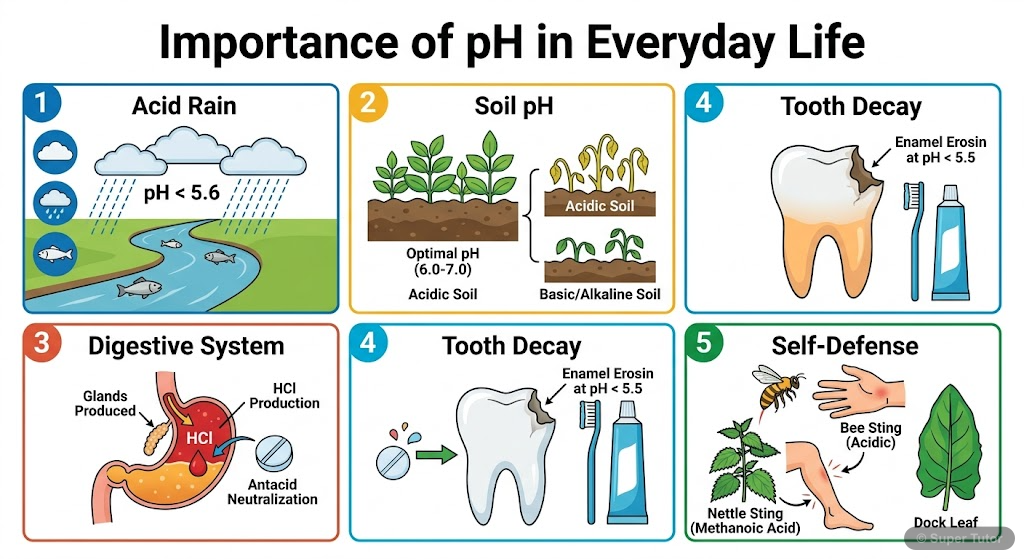
Learn better with visuals Super Tutor pairs illustrations like this with notes and quizzes for Acids, Bases and Salts.
Quick Quiz: Acids, Bases and Salts
0/4Tap an answer to check it instantly. No sign-up needed for these 4.
Which of the following substances turns blue litmus paper to red?
What gas is evolved when zinc reacts with dilute hydrochloric acid?
Which of the following has a pH value of 7?
The chemical formula of baking soda is:
Sample Questions
What happens when an acid reacts with a metal carbonate?
Show answer
Salt, water and carbon dioxide are formed
Step 1: When acids react with metal carbonates, a characteristic pattern is followed. Step 2: The general reaction is: Metal carbonate + Acid → Salt + Water + Carbon dioxide. Step 3: For example: CaCO₃ + 2HCl → CaCl₂ + H₂O + CO₂. Step 4: The carbon dioxide gas can be identified by passing it through lime water, which turns milky. Step 5: This reaction is different from acid-metal reactions which produce hydrogen gas instead of CO₂.
Which indicator shows pink color in basic solution?
Show answer
Phenolphthalein
Step 1: Different indicators show specific colors in acidic and basic solutions. Step 2: Phenolphthalein is colorless in acidic and neutral solutions but turns pink in basic solutions. Step 3: Litmus turns blue (not pink) in basic solutions and red in acidic solutions. Step 4: Methyl orange turns yellow in basic solutions and red in acidic solutions. Step 5: Universal indicator shows various colors depending on pH, not specifically pink for all basic solutions.
Plaster of Paris is chemically:
Show answer
CaSO₄.½H₂O
Step 1: Plaster of Paris is calcium sulfate hemihydrate, meaning it has half a water molecule per formula unit. Step 2: Its formula is CaSO₄.½H₂O or 2CaSO₄.H₂O (both represent the same compound). Step 3: It is made by heating gypsum (CaSO₄.2H₂O) at about 100°C to remove 1.5 water molecules. Step 4: CaCO₃ is calcium carbonate (limestone) and Ca(OH)₂ is calcium hydroxide (slaked lime). Step 5: When mixed with water, it reforms gypsum and hardens, making it useful for casts and construction.
The process of reaction between an acid and a base is called:
Show answer
Neutralization
Step 1: When an acid reacts with a base, they neutralize each other's properties. Step 2: This reaction is called neutralization because the acidic and basic properties are neutralized. Step 3: The general reaction is: Acid + Base → Salt + Water. Step 4: For example: HCl + NaOH → NaCl + H₂O. Step 5: The resulting solution becomes neutral (pH = 7) when equivalent amounts of acid and base react completely.
+39 more questions on Acids, Bases and Salts (NIOS Class 10 Science & Tech)
Practise AllFrequently Asked Questions
What are the important topics in Acids, Bases and Salts for NIOS Class 10 Science & Tech?
How many practice questions are there for Acids, Bases and Salts?
Sources & Official References
Content is aligned to the official syllabus. Refer to the board website for the latest curriculum.
More resources for Acids, Bases and Salts
Important Questions
Exam-style questions with answers
Revision Notes
Key points for last-minute revision
Formula Sheet
The chapter's formulas in one place
Chapter Summary
Understand the chapter at a glance
Concept Maps
See how topics connect
Study Plan
Step-by-step plan for this chapter
Flashcards
Quick-fire cards for active recall
Syllabus
What topics to cover
For serious students
Get the full Acids, Bases and Salts chapter — start free.
Quizzes, flashcards, an AI doubt solver and a study plan for NIOS Class 10 Science & Tech. Free to start, no card needed.