Thermal Energy — Practice Quiz
NIOS · Class 10 · Science & Tech
Try a 4-question quiz on Thermal Energy for NIOS Class 10 Science & Tech: tap an answer to check it and see why. 41 questions in the full chapter test.
Interactive on Super Tutor
Studying Thermal Energy? Get the full interactive chapter.
Quizzes, flashcards, AI doubt-solver and a step-by-step study plan — built for practice quiz and more.
Free trial, no card needed.
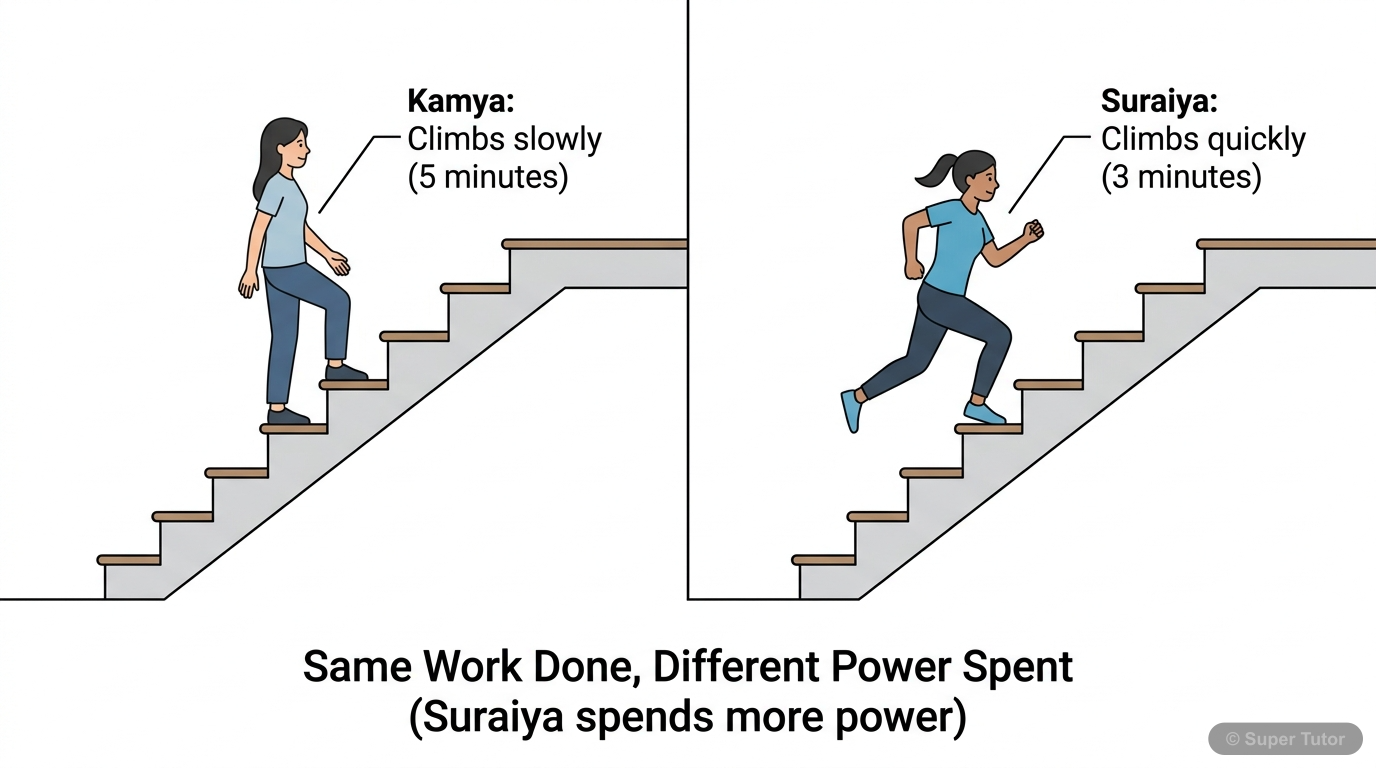
One of 11 illustrations for Thermal Energy in Super Tutor — alongside flashcards, concept maps and practice questions.
Quick Quiz: Thermal Energy
0/4Tap an answer to check it instantly. No sign-up needed for these 4.
What is the SI unit of temperature?
Which liquid is commonly used in thermometers and why?
At what temperature do the Celsius and Fahrenheit scales show the same numerical value?
What happens to the volume of most substances when heated?
Sample Questions
Which state of matter shows the maximum thermal expansion?
Show answer
Gases
Gases show the maximum thermal expansion among all states of matter. Step 1: In solids, atoms are tightly bound and can only vibrate slightly, leading to small expansion. Step 2: In liquids, molecules are less tightly bound than solids, allowing moderate expansion. Step 3: In gases, molecules are widely spaced and move freely, allowing maximum expansion when heated. Step 4: The expansion follows the order: gases > liquids > solids. Step 5: This is why gas thermometers are very sensitive to temperature changes.
What is the melting point of pure water?
Show answer
0°C
Pure water melts (ice melts) at 0°C under standard atmospheric pressure. Step 1: The melting point is the temperature at which a solid changes to liquid state. Step 2: For pure water, this occurs at exactly 0°C (or 32°F or 273 K). Step 3: This is used as the lower fixed point in the Celsius temperature scale. Step 4: At this temperature, ice and water can coexist in equilibrium. Step 5: 100°C is the boiling point, not melting point, while 32°C and 273°C are incorrect values.
During melting, what happens to the temperature of a substance?
Show answer
It remains constant
During melting, the temperature remains constant even though heat is being supplied. Step 1: When a solid reaches its melting point, additional heat energy doesn't increase temperature. Step 2: Instead, this heat energy (called latent heat of fusion) breaks the bonds holding the solid structure together. Step 3: The energy is used to overcome intermolecular forces, not to increase kinetic energy of molecules. Step 4: Only after complete melting does further heating increase temperature again. Step 5: This constant temperature during phase change is a characteristic property of pure substances.
Which has higher specific heat capacity: water or copper?
Show answer
Water
Water has a much higher specific heat capacity than copper. Step 1: Water's specific heat capacity is 4200 J/kg/K, while copper's is only 380 J/kg/K. Step 2: This means water requires about 11 times more energy than copper to raise the same mass by 1°C. Step 3: Water's high specific heat is due to hydrogen bonding between molecules, which requires extra energy to break. Step 4: This property makes water excellent for cooling systems and climate moderation near large water bodies. Step 5: Metals like copper generally have lower specific heat capacities than water.
+37 more questions on Thermal Energy (NIOS Class 10 Science & Tech)
Practise AllFrequently Asked Questions
What are the important topics in Thermal Energy for NIOS Class 10 Science & Tech?
How many practice questions are there for Thermal Energy?
Sources & Official References
Content is aligned to the official syllabus. Refer to the board website for the latest curriculum.
More resources for Thermal Energy
Important Questions
Exam-style questions with answers
Revision Notes
Key points for last-minute revision
Formula Sheet
The chapter's formulas in one place
Chapter Summary
Understand the chapter at a glance
Concept Maps
See how topics connect
Study Plan
Step-by-step plan for this chapter
Flashcards
Quick-fire cards for active recall
Syllabus
What topics to cover
For serious students
Get the full Thermal Energy chapter — start free.
Quizzes, flashcards, an AI doubt solver and a study plan for NIOS Class 10 Science & Tech. Free to start, no card needed.