Force and Motion — Practice Quiz
NIOS · Class 10 · Science & Tech
Try a 4-question quiz on Force and Motion for NIOS Class 10 Science & Tech: tap an answer to check it and see why. 92 questions in the full chapter test.
Interactive on Super Tutor
Studying Force and Motion? Get the full interactive chapter.
Quizzes, flashcards, AI doubt-solver and a step-by-step study plan — built for practice quiz and more.
Free trial, no card needed.
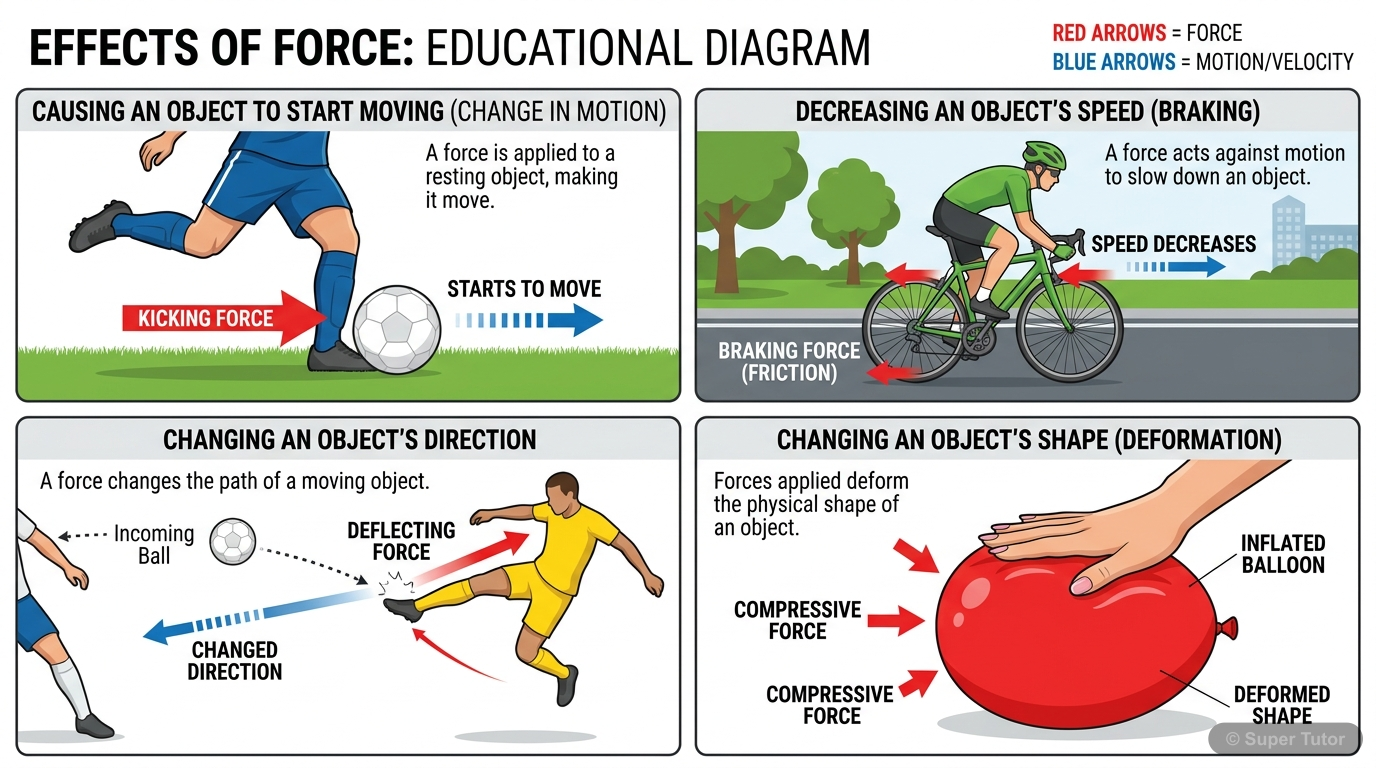
One of 23 illustrations for Force and Motion in Super Tutor — alongside flashcards, concept maps and practice questions.
Quick Quiz: Force and Motion
0/4Tap an answer to check it instantly. No sign-up needed for these 4.
What is the tendency of objects to resist a change in their state of motion called?
According to Newton's Second Law of Motion, force is equal to:
What is momentum?
Which type of friction is less?
Sample Questions
What happens to the shape of a balloon when equal forces are applied from opposite sides?
Show answer
Its shape changes
Step 1: When equal forces act from opposite sides, they form balanced forces. Step 2: Balanced forces do not cause motion because they cancel each other out. Step 3: However, balanced forces can still change the shape of deformable objects. Step 4: The balloon gets compressed because both forces push inward, changing its shape from round to flattened. Step 5: This demonstrates that balanced forces don't cause motion but can cause deformation in flexible objects.
The SI unit of force is:
Show answer
Newton
Step 1: The SI unit of force is the Newton (N), named after Sir Isaac Newton. Step 2: One Newton is defined as the force that gives a mass of 1 kg an acceleration of 1 m/s². Step 3: From F = ma, we get 1 N = 1 kg × 1 m/s² = 1 kg⋅m/s². Step 4: To feel what 1 N is like, hold a 100g mass in your palm - that's approximately 1 N of force. Step 5: Other units are: kg for mass, Pascal for pressure, and Joule for energy.
Why do passengers fall backward when a bus starts suddenly?
Show answer
Due to inertia of rest
Step 1: Initially, both the bus and passengers are at rest. Step 2: When the bus starts suddenly, the floor moves forward with the bus. Step 3: The passengers' feet, in contact with the floor, also start moving forward. Step 4: However, the upper body of passengers tends to remain at rest due to inertia of rest. Step 5: This causes the passengers to fall backward relative to the bus. This is a classic example of Newton's First Law in action.
What is pressure?
Show answer
Force ÷ Area
Step 1: Pressure is defined as force per unit area, or Pressure = Force ÷ Area. Step 2: This means the same force applied over a smaller area creates higher pressure. Step 3: For example, a nail has a pointed tip to concentrate force over a tiny area, creating high pressure to penetrate wood. Step 4: The SI unit of pressure is N/m² or Pascal (Pa). Step 5: Understanding this helps explain why broad straps are comfortable (distribute force over larger area, reducing pressure) while thin straps are uncomfortable.
+88 more questions on Force and Motion (NIOS Class 10 Science & Tech)
Practise AllFrequently Asked Questions
What are the important topics in Force and Motion for NIOS Class 10 Science & Tech?
How many practice questions are there for Force and Motion?
Sources & Official References
Content is aligned to the official syllabus. Refer to the board website for the latest curriculum.
More resources for Force and Motion
Important Questions
Exam-style questions with answers
Revision Notes
Key points for last-minute revision
Formula Sheet
The chapter's formulas in one place
Chapter Summary
Understand the chapter at a glance
Concept Maps
See how topics connect
Study Plan
Step-by-step plan for this chapter
Flashcards
Quick-fire cards for active recall
Syllabus
What topics to cover
For serious students
Get the full Force and Motion chapter — start free.
Quizzes, flashcards, an AI doubt solver and a study plan for NIOS Class 10 Science & Tech. Free to start, no card needed.