Building Blocks of Life Cell and Tissues — Flashcards
NIOS · Class 10 · Science & Tech
40 flashcards for Building Blocks of Life Cell and Tissues (NIOS Class 10 Science & Tech) to test yourself on key terms and facts.
Interactive on Super Tutor
Studying Building Blocks of Life Cell and Tissues? Get the full interactive chapter.
Quizzes, flashcards, AI doubt-solver and a step-by-step study plan — built for flashcards and more.
Free trial, no card needed.
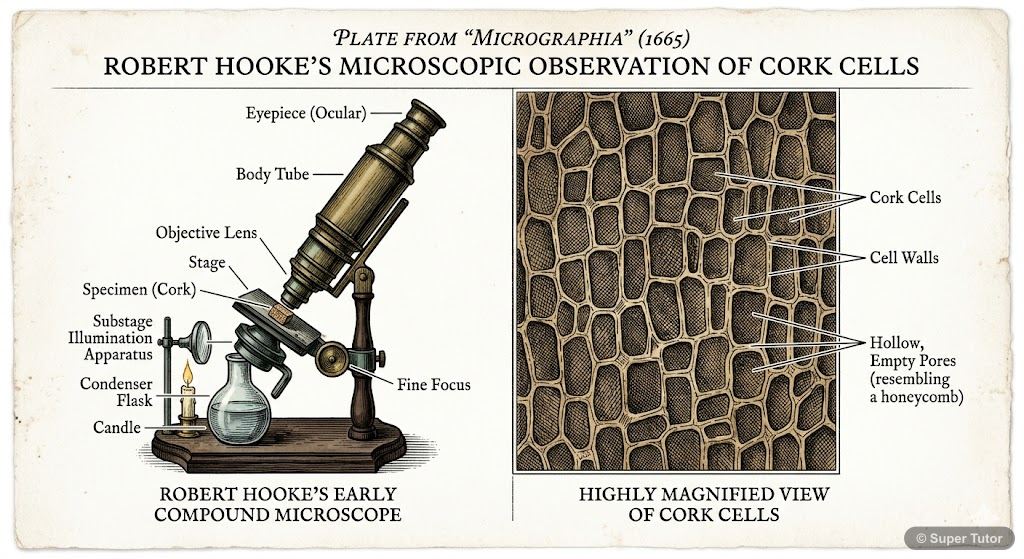
Learn better with visuals Super Tutor pairs illustrations like this with notes and quizzes for Building Blocks of Life Cell and Tissues.
Who discovered the cell, and in which year?
Answer
Robert Hooke discovered the cell in 1665 by observing a thin piece of cork under a simple microscope. He named the compartments cells.
What is the cell theory?
Answer
The cell theory states that: 1) the cell is the structural and functional unit of all living beings, 2) all new cells arise by division of pre-existing cells, and 3) the functions of an organism are t…
Why is the cell called the structural and functional unit of life?
Answer
Every living body is made of cells, and all life processes take place in cells. Cells build tissues, tissues build organs, and organs work together to form an organism.
What are the three basic parts of all cells?
Answer
All cells have three basic parts: cell membrane, cytoplasm, and DNA, which may be enclosed in a nucleus in eukaryotic cells.
How are prokaryotic cells different from eukaryotic cells?
Answer
Prokaryotic cells do not have a well-organized nucleus or membrane-bound organelles like mitochondria, lysosomes, ER, chloroplast, and nucleolus. Eukaryotic cells have a nuclear membrane and membrane-…
Which are examples of prokaryotic cells and eukaryotic cells?
Answer
Bacteria and blue-green algae are prokaryotic cell examples. Cells of plants, fungi, protozoa, and animals are eukaryotic cell examples.
Why is the cell membrane called selectively permeable?
Answer
The cell membrane allows only selected substances to pass in and out of the cell. It helps protect the cell and maintain its shape.
What is the nucleus and why is it called the master of the cell?
Answer
The nucleus is a cell organelle bound by a nuclear membrane and containing chromatin or DNA. It coordinates all metabolic and other activities of the cell, so it is called the master of the cell.
+32 more flashcards
Practise AllFrequently Asked Questions
What are the important topics in Building Blocks of Life Cell and Tissues for NIOS Class 10 Science & Tech?
How many flashcards are available for Building Blocks of Life Cell and Tissues?
How should I revise Building Blocks of Life Cell and Tissues for the NIOS Class 10 board exam?
Sources & Official References
Content is aligned to the official syllabus. Refer to the board website for the latest curriculum.
More resources for Building Blocks of Life Cell and Tissues
Practice Quiz
Test yourself with a quick quiz
Important Questions
Exam-style questions with answers
Revision Notes
Key points for last-minute revision
Chapter Summary
Understand the chapter at a glance
Concept Maps
See how topics connect
Study Plan
Step-by-step plan for this chapter
Syllabus
What topics to cover
For serious students
Get the full Building Blocks of Life Cell and Tissues chapter — start free.
Quizzes, flashcards, an AI doubt solver and a study plan for NIOS Class 10 Science & Tech. Free to start, no card needed.