Building Blocks of Life Cell and Tissues — Chapter Summary
NIOS · Class 10 · Science & Tech
Summary of Building Blocks of Life Cell and Tissues for NIOS Class 10 Science & Tech. Part of the NIOS Class 10 Science & Tech syllabus.
Interactive on Super Tutor
Studying Building Blocks of Life Cell and Tissues? Get the full interactive chapter.
Quizzes, flashcards, AI doubt-solver and a step-by-step study plan — built for chapter summary and more.
Free trial, no card needed.
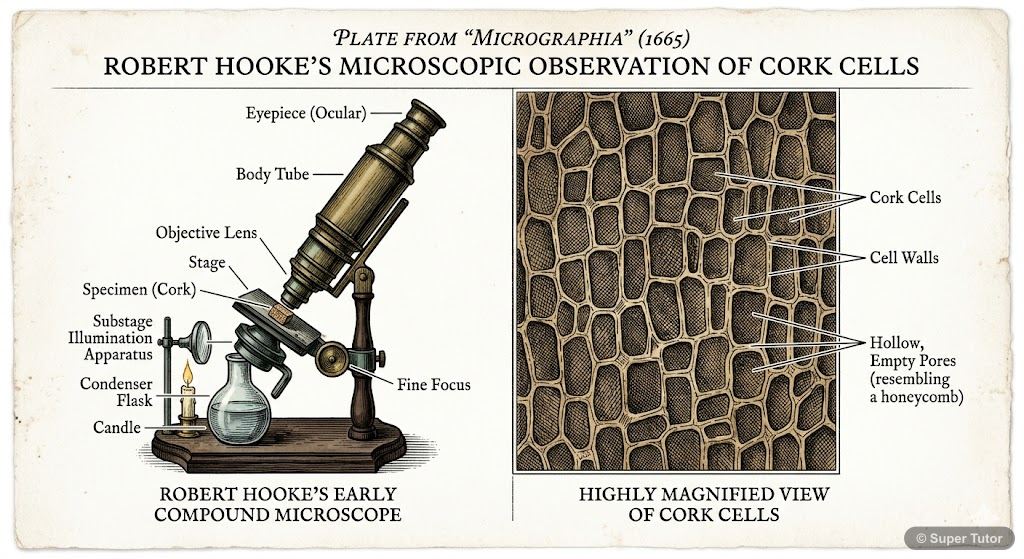
Learn better with visuals Super Tutor pairs illustrations like this with notes and quizzes for Building Blocks of Life Cell and Tissues.
Overview
Cells are the basic building blocks of living organisms. A cell is the structural and functional unit of living organisms and is capable of independent existence. Cells combine to form tissues, tissues combine to form organs, and organs work together to form complete living beings. The chapter expla
Key Concepts
Robert Hooke discovered the cell
Robert Hooke discovered the cell in 1665 by observing cork under a simple microscope. The cell theory was formulated by M J Schleiden and T Schwann. I
Prokaryotic cells do not have
Prokaryotic cells do not have a well-organized nucleus, nuclear membrane, or membrane-bound organelles such as mitochondria, lysosomes, endoplasmic re
The cell membrane is thin
The cell membrane is thin and selectively permeable, so it allows only selected substances to enter and leave the cell. Cytoplasm is the semi-fluid ma
Endoplasmic reticulum helps in intracellular transport
Endoplasmic reticulum helps in intracellular transport and synthesis of proteins and fats. Ribosomes are the sites of protein synthesis. Mitochondria
Plant cells have a cell wall
Plant cells have a cell wall made of cellulose, large vacuoles, plastids, and dictyosomes. Plastids are of three types: chloroplasts for photosynthesi
Learning Objectives
- Recognize the cell as the basic structural and functional unit of life
- State the cell theory and the history of cell discovery
- Differentiate between prokaryotic and eukaryotic cells
- Compare plant cells and animal cells
- Describe the main cell organelles and their functions
Frequently Asked Questions
What are the important topics in Building Blocks of Life Cell and Tissues for NIOS Class 10 Science & Tech?
How should I revise Building Blocks of Life Cell and Tissues for the NIOS Class 10 board exam?
Sources & Official References
Content is aligned to the official syllabus. Refer to the board website for the latest curriculum.
More resources for Building Blocks of Life Cell and Tissues
For serious students
Get the full Building Blocks of Life Cell and Tissues chapter — start free.
Quizzes, flashcards, an AI doubt solver and a study plan for NIOS Class 10 Science & Tech. Free to start, no card needed.