Metals and Non-Metals
NIOS · Class 10 · Science & Tech
Flashcards for Metals and Non-Metals — NIOS Class 10 Science & Tech. Quick Q&A cards covering key concepts, definitions, and formulas.
Interactive on Super Tutor
Studying Metals and Non-Metals? Get the full interactive chapter.
Quizzes, flashcards, AI doubt-solver and a step-by-step study plan — built for flashcards and more.
1,000+ Class 10 students started this chapter today
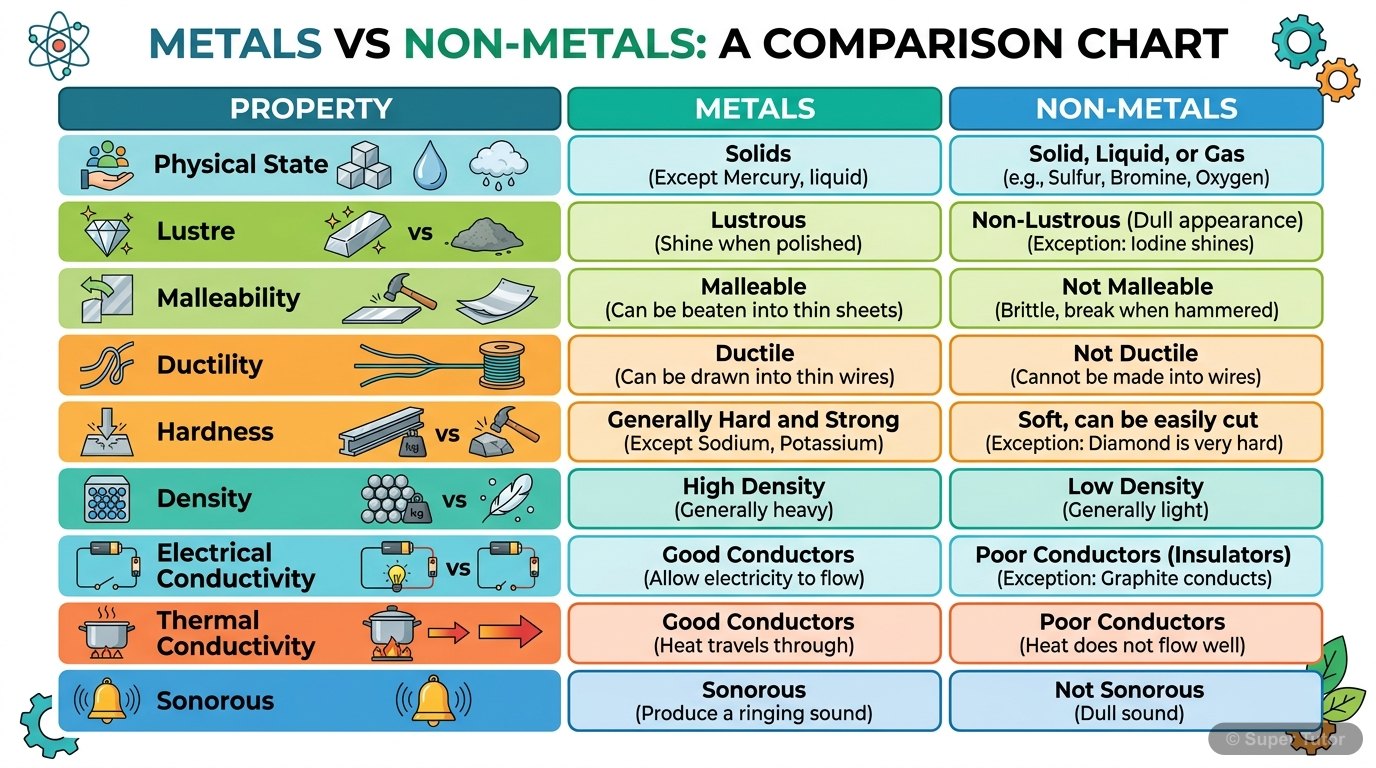
Super Tutor has 9+ illustrations like this for Metals and Non-Metals alone — flashcards, concept maps, and step-by-step visuals.
See them allWhat are metals and non-metals?
Answer
Metals are electropositive elements that usually lose 1, 2, or 3 electrons to form cations. They are generally malleable, ductile, lustrous, sonorous, dense, and good conductors of heat and electricit…
Why are metals usually good conductors of electricity?
Answer
Metals have free electrons that can move through the metal and carry electric charge. This is why metals are used for electrical wires and many electrical parts.
Why are non-metals usually poor conductors of electricity?
Answer
Non-metals generally do not have freely moving electrons. Because charge cannot move easily through them, they are usually poor conductors of electricity. Graphite is an exception because it conducts …
Which element is the only metal that exists in liquid state at room temperature?
Answer
Mercury is the only metal that exists in liquid state at room temperature. It is a low-reactivity metal found near the bottom of the activity series.
Which element is the only non-metal that exists in liquid state at room temperature?
Answer
Bromine is the only non-metal that exists in liquid state at room temperature.
How do sodium and gold show special physical properties?
Answer
Sodium is soft like wax and can be cut with a knife. Gold is one of the most malleable and ductile metals. Pure gold is 24 carat, but 22 carat gold is used for jewellery because pure gold is too soft.
Why are cooking utensils often made from metals?
Answer
Cooking utensils are made of metals such as iron, aluminium, zinc, and copper because metals are strong and conduct heat well. This helps in cooking food efficiently.
Why are storage containers sometimes made from plastics and glass?
Answer
Plastics and glass are non-metals and are useful for storage containers because they do not behave like reactive metals. They are suitable for holding many materials safely.
+26 more flashcards available
Practice AllFrequently Asked Questions
What are the important topics in Metals and Non-Metals for NIOS Class 10 Science & Tech?
How to score full marks in Metals and Non-Metals — NIOS Class 10 Science & Tech?
How many flashcards are available for Metals and Non-Metals?
Sources & Official References
Content is aligned to the official syllabus. Refer to the board website for the latest curriculum.
More resources for Metals and Non-Metals
Practice Quiz
Test yourself with a quick quiz
Important Questions
Practice with board exam-style questions
Revision Notes
Key points for last-minute revision
Formula Sheet
All formulas in one place
Chapter Summary
Understand the chapter at a glance
Concept Maps
See how topics connect visually
Study Plan
Step-by-step plan to ace this chapter
Syllabus
What topics to cover
NCERT Solutions
Every textbook question solved step by step
For serious students
Get the full Metals and Non-Metals chapter — for free.
Quizzes, flashcards, AI doubt-solver and a step-by-step study plan for NIOS Class 10 Science & Tech.