Bio-Diversity
NIOS · Class 10 · Social Studies
Most important questions from Bio-Diversity for NIOS Class 10 Social Studies board exam 2026. MCQs, short answer, and long answer questions with marks.
Interactive on Super Tutor
Studying Bio-Diversity? Get the full interactive chapter.
Quizzes, flashcards, AI doubt-solver and a step-by-step study plan — built for important questions and more.
1,000+ Class 10 students started this chapter today
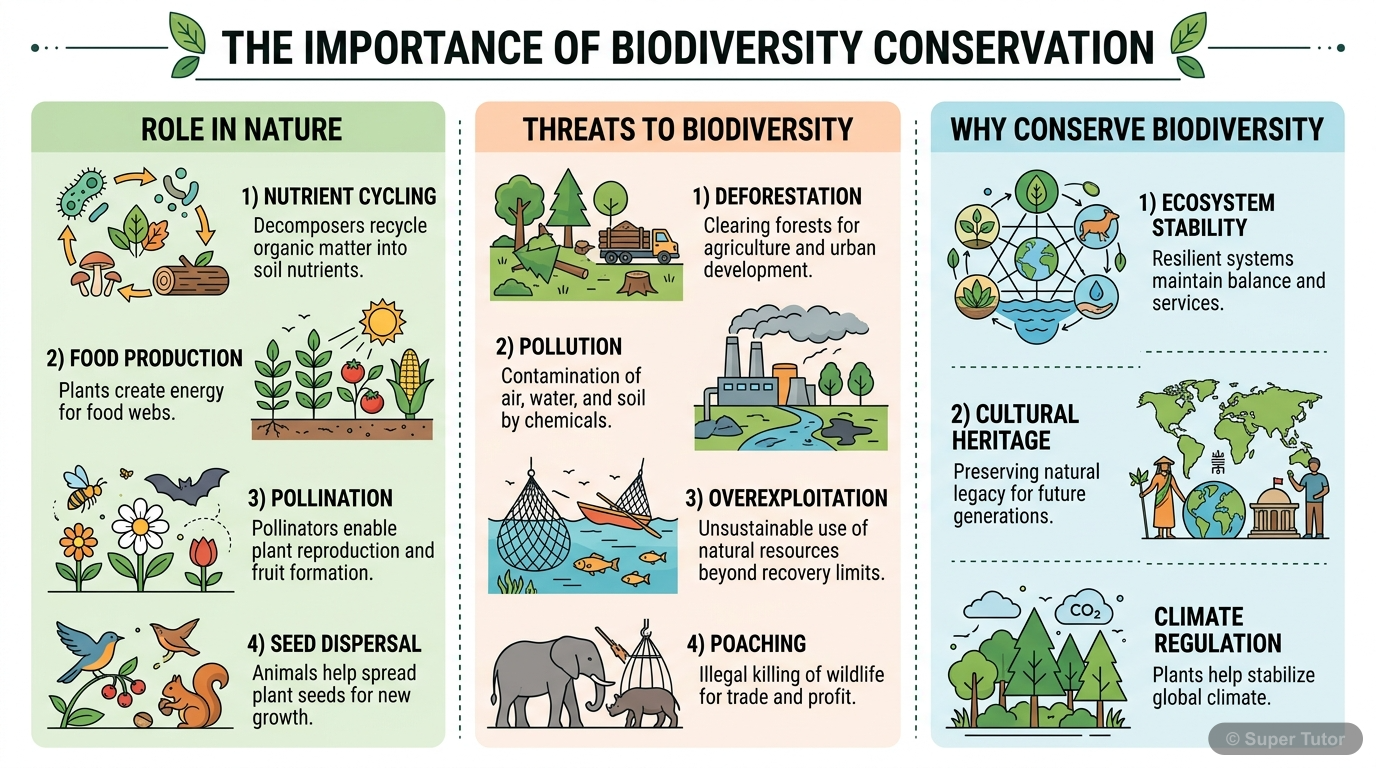
This is just one of 8+ visuals inside Super Tutor's Bio-Diversity chapter
Explore the full setSample Questions
Project Tiger was launched in which year?
Show answer
1973
Project Tiger was launched in 1973 to protect and conserve tigers in India. This was a special conservation scheme initiated due to the declining tiger population. The project aimed at ensuring viable tiger populations in their natural habitats. 1972 was when the Wildlife Protection Act was enacted, not when Project Tiger started. Project Elephant was launched later in 1992. The project has been successful in increasing tiger numbers in many reserves across India.
Kaziranga National Park in Assam is famous for which animal?
Show answer
Indian Rhinoceros
Kaziranga National Park in Assam is world-famous for the Indian One-horned Rhinoceros. It houses about two-thirds of the world's population of this endangered species. The park's grasslands and wetlands provide ideal habitat for rhinos. While tigers and elephants are also found there, the park is specifically known for rhinoceros conservation. Lions are found in Gir National Park in Gujarat, not in Kaziranga. The park's success in rhino conservation makes it a UNESCO World Heritage Site.
How many Biosphere Reserves are there in India currently?
Show answer
15
India currently has 15 Biosphere Reserves that protect larger areas of natural habitat and preserve genetic diversity in representative ecosystems. These reserves include buffer zones for economic activities and protect both flora, fauna, and human communities. Examples include Nilgiri, Sundarbans, Nanda Devi, and Gulf of Mannar. These are different from the 96 National Parks and 551 Wildlife Sanctuaries. Biosphere Reserves serve multiple purposes including conservation, research, education, and sustainable development.
Which forests are characterized by trees shedding their leaves once a year?
Show answer
Deciduous forests
Tropical Deciduous Forests are characterized by trees that shed their leaves once a year, usually during the dry season. This adaptation helps trees conserve water during periods of low rainfall. These are the most widespread forests in India, found in areas receiving 75-200 cm annual rainfall. Evergreen forests retain their leaves throughout the year, thorn forests have small thick leaves to minimize water loss, and tidal forests have thick leathery leaves adapted to saline conditions.
+84 more questions available
Practice AllFrequently Asked Questions
What are the important topics in Bio-Diversity for NIOS Class 10 Social Studies?
How to score full marks in Bio-Diversity — NIOS Class 10 Social Studies?
How many important questions are there in Bio-Diversity?
Sources & Official References
Content is aligned to the official syllabus. Refer to the board website for the latest curriculum.
More resources for Bio-Diversity
Practice Quiz
Test yourself with a quick quiz
Revision Notes
Key points for last-minute revision
Formula Sheet
All formulas in one place
Chapter Summary
Understand the chapter at a glance
Concept Maps
See how topics connect visually
Study Plan
Step-by-step plan to ace this chapter
Flashcards
Quick-fire cards for active recall
Syllabus
What topics to cover
NCERT Solutions
Every textbook question solved step by step
For serious students
Get the full Bio-Diversity chapter — for free.
Quizzes, flashcards, AI doubt-solver and a step-by-step study plan for NIOS Class 10 Social Studies.