Bio-Diversity — Syllabus
NIOS · Class 10 · Social Studies
What Bio-Diversity covers in NIOS Class 10 Social Studies: 4 topics, for the 2026-27 session. Part of the NIOS Class 10 Social Studies syllabus.
Interactive on Super Tutor
Studying Bio-Diversity? Get the full interactive chapter.
Quizzes, flashcards, AI doubt-solver and a step-by-step study plan — built for syllabus and more.
Free trial, no card needed.
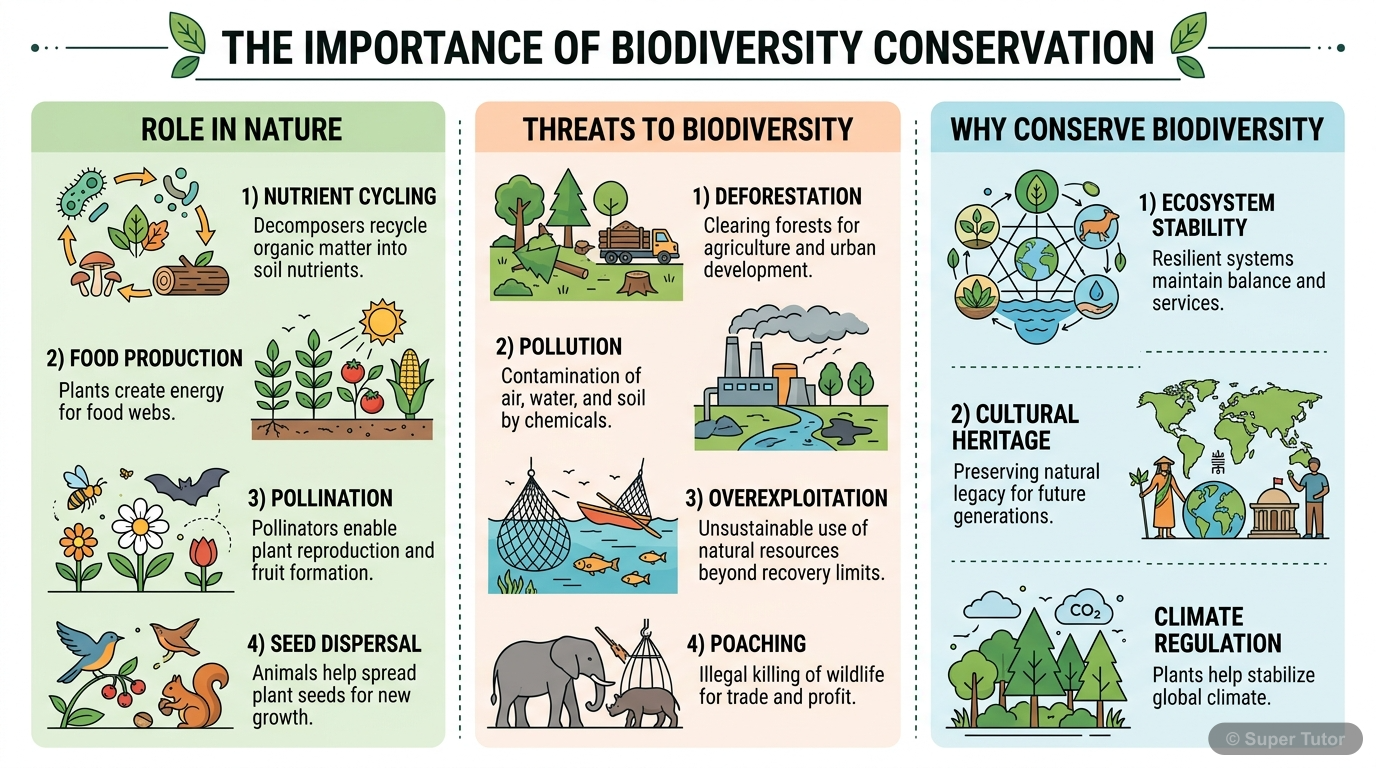
Learn better with visuals Super Tutor pairs illustrations like this with notes and quizzes for Bio-Diversity.
Topics in Bio-Diversity
1. Meaning and Components of Biodiversity
- Biodiversity is short for biological diversity.
- It describes the variety of life on Earth and includes physical environment factors such as temperature, soil and water.
- Biodiversity has three main components: genetic diversity, species diversity and ecosystem diversity.
2. Biodiversity in India
- India lies between 8°4′ North and 37°6′ North latitudes and 68°7′ East and 97°25′ East longitude.
- India has 2.4% of the world's land area but contributes about 8% of the world's total biodiversity.
- About 45,000 plant species, comprising about 12% of the world's flora, are found in Indian forests.
3. Significance and Loss of Biodiversity
- Biodiversity is fundamental to life on Earth.
- Living things in an ecosystem are interdependent and interrelated.
- Vegetation affects animal life, and changes in vegetation affect humans too.
4. Natural Vegetation of India
- Natural vegetation in India depends on climate, physiography and soil.
- India has tropical evergreen forests, tropical deciduous forests, thorn forests, tidal forests and Himalayan vegetation.
- Tropical Evergreen Forests occur in areas with more than 200 cm rainfall and a short dry season.
Key Concepts
Central concept: Bio-Diversity
Work through every topic in Bio-Diversity with notes and quizzes
Start This ChapterFrequently Asked Questions
What are the important topics in Bio-Diversity for NIOS Class 10 Social Studies?
How should I revise Bio-Diversity for the NIOS Class 10 board exam?
Sources & Official References
Content is aligned to the official syllabus. Refer to the board website for the latest curriculum.
More resources for Bio-Diversity
Practice Quiz
Test yourself with a quick quiz
Important Questions
Exam-style questions with answers
Revision Notes
Key points for last-minute revision
Chapter Summary
Understand the chapter at a glance
Concept Maps
See how topics connect
Study Plan
Step-by-step plan for this chapter
Flashcards
Quick-fire cards for active recall
For serious students
Get the full Bio-Diversity chapter — start free.
Quizzes, flashcards, an AI doubt solver and a study plan for NIOS Class 10 Social Studies. Free to start, no card needed.