Constitutional Values And Political System In India
NIOS · Class 10 · Social Studies
Most important questions from Constitutional Values And Political System In India for NIOS Class 10 Social Studies board exam 2026. MCQs, short answer, and long answer questions with marks.
Interactive on Super Tutor
Studying Constitutional Values And Political System In India? Get the full interactive chapter.
Quizzes, flashcards, AI doubt-solver and a step-by-step study plan — built for important questions and more.
1,000+ Class 10 students started this chapter today
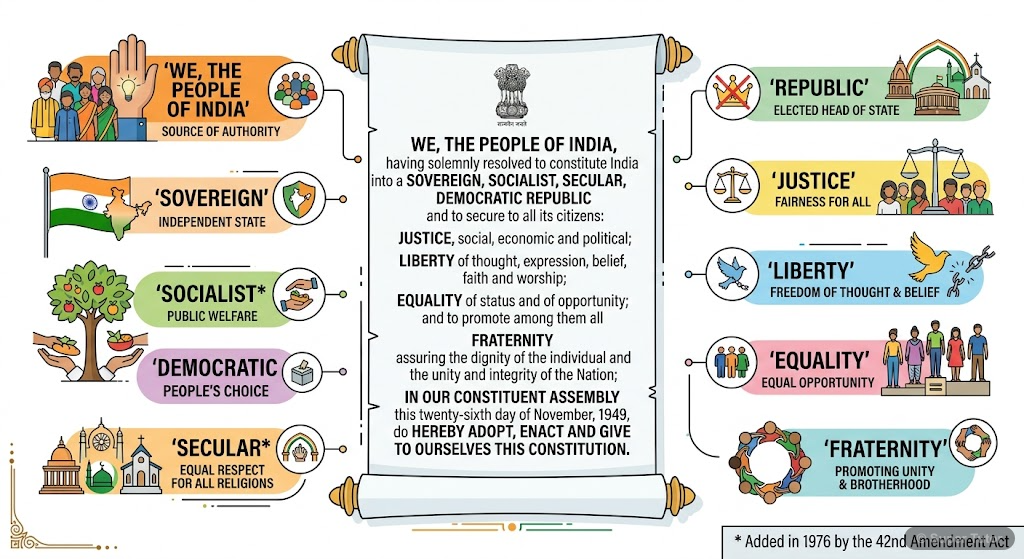
Super Tutor has 6+ illustrations like this for Constitutional Values And Political System In India alone — flashcards, concept maps, and step-by-step visuals.
See them allSample Questions
What does 'Universal Adult Franchise' mean?
Show answer
Every Indian citizen above 18 years can vote without discrimination
Universal Adult Franchise means every Indian citizen after attaining 18 years of age has the right to vote without any discrimination based on religion, race, caste, sex, descent, place of birth or residence. This reflects the constitutional values of equality and justice. Option A is incorrect because education is not a requirement for voting. Option C is wrong as both men and women can vote equally. Option D is incorrect as property ownership is not a voting requirement - this would be contrary to the principle of equality.
India is called a 'Union of States' in the Constitution. What does this indicate about the Indian federal system?
Show answer
Central government has more power than states
The term 'Union of States' instead of 'federation of states' indicates that the Indian federal system has a strong center. The central government has sole power over the territory of India and can even alter state boundaries or create new states. Parliament can form new states, alter boundaries, or change names of states (with some safeguards). This makes India 'federal in form but unitary in spirit.' Option A is wrong as states are not completely independent. Option C is incorrect as powers are not equally distributed. Option D is wrong as the center has significant powers over states.
Who is the real executive in the Indian parliamentary system?
Show answer
Prime Minister and Council of Ministers
In the Indian parliamentary system, the Prime Minister and Council of Ministers form the real executive. Though all executive powers are theoretically vested in the President, in practice these powers are exercised by the Prime Minister and Council of Ministers. The President acts only on their advice and is the nominal/formal executive. The Speaker of Lok Sabha (option C) presides over the lower house but is not part of the executive. The Chief Justice (option D) heads the judiciary, which is separate from the executive branch.
How many lists are there for division of powers between Center and States?
Show answer
Three lists
The Constitution divides powers between Center and States through three lists: Union List (97 subjects of national importance like Defence, Railways), State List (66 subjects of local interest like Public Health, Police), and Concurrent List (47 subjects like Education, Electricity where both can legislate). Additionally, subjects not mentioned in any list fall under Residuary Powers of the Union government. Two lists (option A) would be insufficient for proper federal division. Four or five lists (options C and D) don't exist in the Indian Constitution.
+81 more questions available
Practice AllFrequently Asked Questions
What are the important topics in Constitutional Values And Political System In India for NIOS Class 10 Social Studies?
How to score full marks in Constitutional Values And Political System In India — NIOS Class 10 Social Studies?
How many important questions are there in Constitutional Values And Political System In India?
Sources & Official References
Content is aligned to the official syllabus. Refer to the board website for the latest curriculum.
More resources for Constitutional Values And Political System In India
Practice Quiz
Test yourself with a quick quiz
Revision Notes
Key points for last-minute revision
Formula Sheet
All formulas in one place
Chapter Summary
Understand the chapter at a glance
Concept Maps
See how topics connect visually
Study Plan
Step-by-step plan to ace this chapter
Flashcards
Quick-fire cards for active recall
Syllabus
What topics to cover
NCERT Solutions
Every textbook question solved step by step
For serious students
Get the full Constitutional Values And Political System In India chapter — for free.
Quizzes, flashcards, AI doubt-solver and a step-by-step study plan for NIOS Class 10 Social Studies.