Socio-economic Development And Empowerment Of Disadvantaged Groups — Practice Quiz
NIOS · Class 10 · Social Studies
Try a 4-question quiz on Socio-economic Development And Empowerment Of Disadvantaged Groups for NIOS Class 10 Social Studies: tap an answer to check it.
Interactive on Super Tutor
Studying Socio-economic Development And Empowerment Of Disadvantaged Groups? Get the full interactive chapter.
Quizzes, flashcards, AI doubt-solver and a step-by-step study plan — built for practice quiz and more.
Free trial, no card needed.
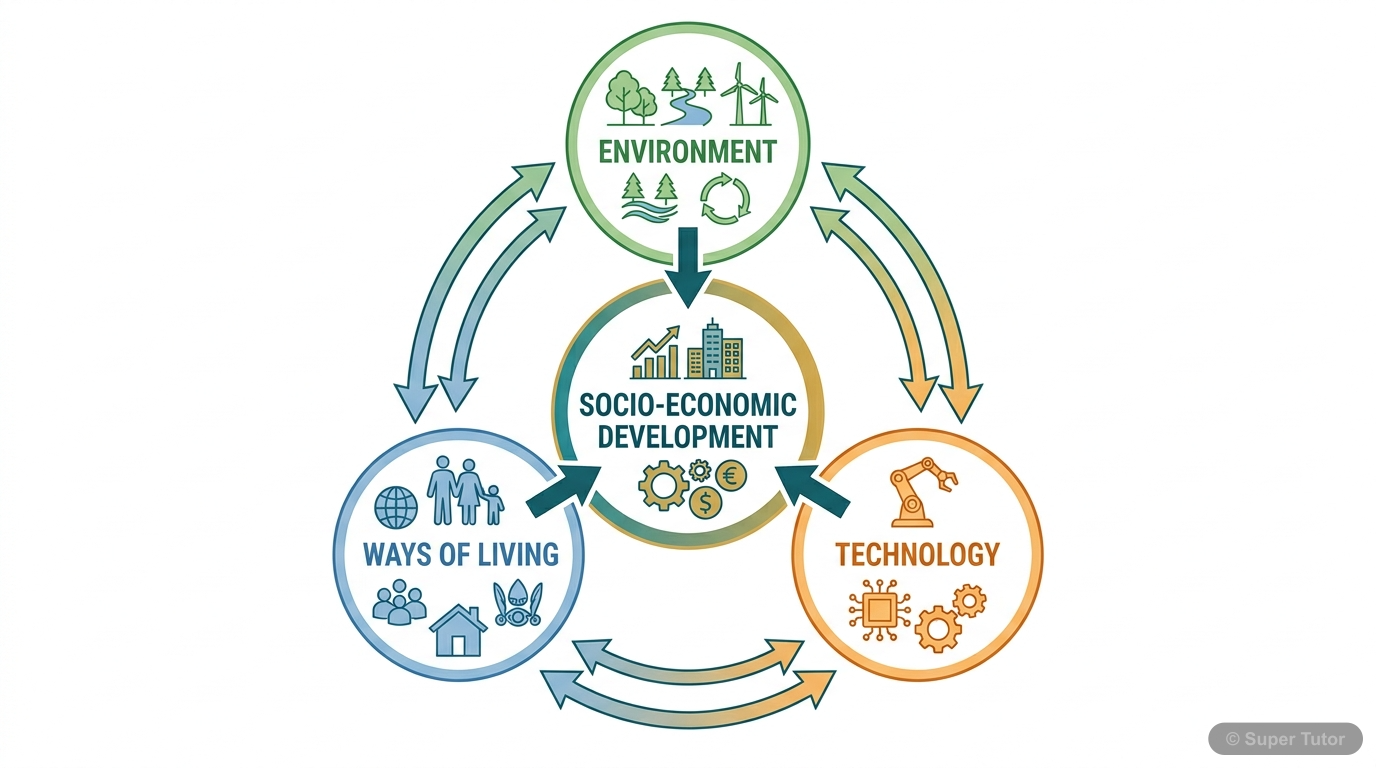
Learn better with visuals Super Tutor pairs illustrations like this with notes and quizzes for Socio-economic Development And Empowerment Of Disadvantaged Groups.
Quick Quiz: Socio-economic Development And Empowerment Of Disadvantaged Groups
0/4Tap an answer to check it instantly. No sign-up needed for these 4.
What is the main focus of Human Development as compared to traditional economic development?
Which three components make up the Human Development Index (HDI)?
What is the difference between regional diversity and regional disparities?
According to the 2001 Census, what percentage of India's population do Scheduled Castes constitute?
Sample Questions
What does sustainable development mean?
Show answer
Development that meets present needs without compromising future generations
Sustainable development is defined as 'development that meets the needs of the present without compromising the ability of future generations to meet their own needs'. It is not just about environmental issues but includes economic development, social development, individual development, and environmental development. The concept emerged because we are using natural resources carelessly, and many minerals like coal and petroleum may last only a few decades at the current rate of consumption. Sustainable development ensures that development benefits are available both now and in the future.
Which state has the highest literacy rate in India according to Census 2001?
Show answer
Kerala
According to Census 2001, Kerala has the highest literacy rate at 90.92%, while Bihar has the lowest at 47.53%. The all-India average literacy rate was 65.38%. This shows significant regional disparities in educational development across Indian states. Kerala's high literacy rate is due to its historical emphasis on education, government policies promoting universal education, and social movements that encouraged learning. This high literacy rate has contributed to Kerala's better performance in human development indicators.
What is the main objective of Sarva Shiksha Abhiyan?
Show answer
Universalization of elementary education
Sarva Shiksha Abhiyan (SSA) was launched in 2001 as an ambitious program for achieving universalization of elementary education. Its main goals include: enrolling all 6-14 age group children in schools by 2005, bridging gender and social category gaps, achieving universal retention by 2010, and focusing on elementary education of satisfactory quality with emphasis on education for life. The program aims to provide free and compulsory education to all children in the elementary age group as mandated by the Constitution.
Which Constitutional Amendments provided 33.3% reservation for women in local bodies?
Show answer
73rd and 74th Amendments
The 73rd and 74th Constitutional Amendments (1993) served as a breakthrough for women's political empowerment by providing 33.3% reservation of seats for women in rural and urban local bodies respectively. The 73rd Amendment deals with Panchayati Raj institutions (rural local bodies), while the 74th Amendment deals with urban local bodies or municipalities. These amendments have played a central role in enhancing women's participation in public life and decision-making at the grassroots level.
+79 more questions on Socio-economic Development And Empowerment Of Disadvantaged Groups (NIOS Class 10 Social Studies)
Practise AllFrequently Asked Questions
What are the important topics in Socio-economic Development And Empowerment Of Disadvantaged Groups for NIOS Class 10 Social Studies?
How many practice questions are there for Socio-economic Development And Empowerment Of Disadvantaged Groups?
Sources & Official References
Content is aligned to the official syllabus. Refer to the board website for the latest curriculum.
More resources for Socio-economic Development And Empowerment Of Disadvantaged Groups
Important Questions
Exam-style questions with answers
Revision Notes
Key points for last-minute revision
Chapter Summary
Understand the chapter at a glance
Concept Maps
See how topics connect
Study Plan
Step-by-step plan for this chapter
Flashcards
Quick-fire cards for active recall
Syllabus
What topics to cover
For serious students
Get the full Socio-economic Development And Empowerment Of Disadvantaged Groups chapter — start free.
Quizzes, flashcards, an AI doubt solver and a study plan for NIOS Class 10 Social Studies. Free to start, no card needed.