People’s Participation In The Democratic Process — Practice Quiz
NIOS · Class 10 · Social Studies
Try a 4-question quiz on People’s Participation In The Democratic Process for NIOS Class 10 Social Studies: tap an answer to check it and see why.
Interactive on Super Tutor
Studying People’s Participation In The Democratic Process? Get the full interactive chapter.
Quizzes, flashcards, AI doubt-solver and a step-by-step study plan — built for practice quiz and more.
Free trial, no card needed.
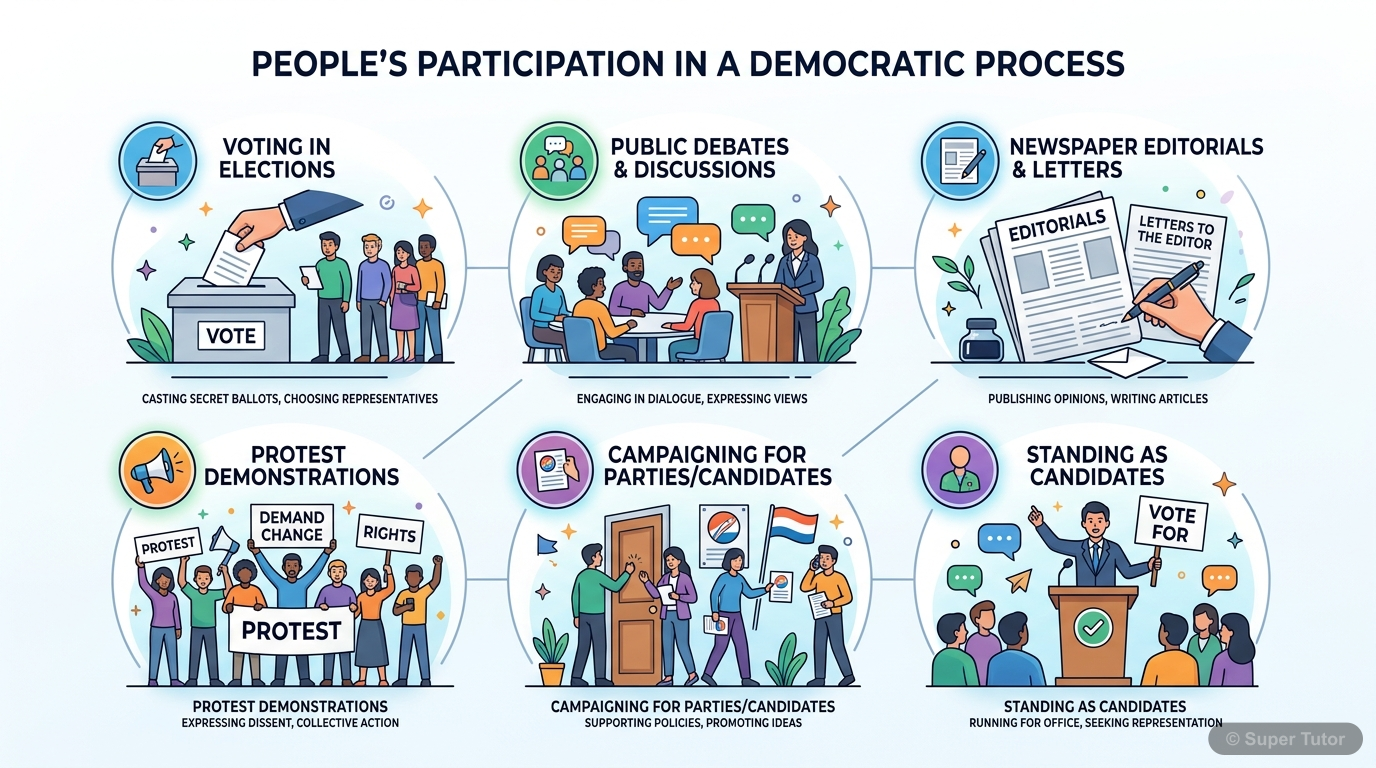
One of 12 illustrations for People’s Participation In The Democratic Process in Super Tutor — alongside flashcards, concept maps and practice questions.
Quick Quiz: People’s Participation In The Democratic Process
0/4Tap an answer to check it instantly. No sign-up needed for these 4.
What is the minimum age for voting in India?
Which constitutional body conducts elections in India?
What does EVM stand for?
Who appoints the Chief Election Commissioner of India?
Sample Questions
Which type of election is held when a sitting member dies or resigns?
Show answer
Bye-election
A bye-election is held in a particular constituency when there's a vacancy due to death, resignation, or when a member's election is set aside by the judiciary. The elected member serves for the remaining term of the legislature. General Elections (Option A) are held for the entire country after the full term expires. Mid-term Elections (Option B) occur when the legislature is dissolved before completing its term. Special Election (Option D) is not a recognized term in the Indian electoral system. Bye-elections ensure continuous representation of constituencies.
What is the full form of NOTA?
Show answer
None of the Above
NOTA stands for 'None of the Above.' It's an option provided to voters when they don't want to vote for any of the candidates contesting in their constituency. This option was introduced by the Supreme Court in 2013 to enable voters to express their dissatisfaction with all candidates. Options B, C, and D are incorrect expansions. NOTA allows voters to participate in the democratic process while rejecting all available choices, though NOTA votes don't affect the election outcome - the candidate with the highest votes still wins.
Which agency is most effective in forming public opinion through audio-visual means?
Show answer
Electronic Media
Electronic Media (television, radio, cinema, and now digital platforms) is the most effective in forming public opinion through audio-visual means. It can reach even remote areas and present information in engaging formats that combine sound, visuals, and motion. Print Media (Option A) lacks audio-visual elements, using only text and static images. Political Parties (Option C) use electronic media but aren't a media agency themselves. Educational Institutions (Option D) contribute to opinion formation but primarily through direct teaching rather than mass audio-visual communication. Electronic
In which year were the first General Elections held in independent India?
Show answer
1952
The first General Elections in independent India were held in 1952. These elections were conducted over several months from October 1951 to February 1952, but are officially referred to as the 1952 elections. This was a massive undertaking involving 176 million eligible voters and marked the beginning of India's democratic journey. Option A (1950) is when the Constitution came into effect. Option B (1951) is when the elections began but they're not named after this year. Option D (1953) is after the elections concluded. These elections established the precedent for regular democratic governanc
+82 more questions on People’s Participation In The Democratic Process (NIOS Class 10 Social Studies)
Practise AllFrequently Asked Questions
What are the important topics in People’s Participation In The Democratic Process for NIOS Class 10 Social Studies?
How many practice questions are there for People’s Participation In The Democratic Process?
Sources & Official References
Content is aligned to the official syllabus. Refer to the board website for the latest curriculum.
More resources for People’s Participation In The Democratic Process
Important Questions
Exam-style questions with answers
Revision Notes
Key points for last-minute revision
Chapter Summary
Understand the chapter at a glance
Concept Maps
See how topics connect
Study Plan
Step-by-step plan for this chapter
Flashcards
Quick-fire cards for active recall
Syllabus
What topics to cover
For serious students
Get the full People’s Participation In The Democratic Process chapter — start free.
Quizzes, flashcards, an AI doubt solver and a study plan for NIOS Class 10 Social Studies. Free to start, no card needed.