Population Our Greatest Resource — Practice Quiz
NIOS · Class 10 · Social Studies
Try a 4-question quiz on Population Our Greatest Resource for NIOS Class 10 Social Studies: tap an answer to check it and see why.
Interactive on Super Tutor
Studying Population Our Greatest Resource? Get the full interactive chapter.
Quizzes, flashcards, AI doubt-solver and a step-by-step study plan — built for practice quiz and more.
Free trial, no card needed.
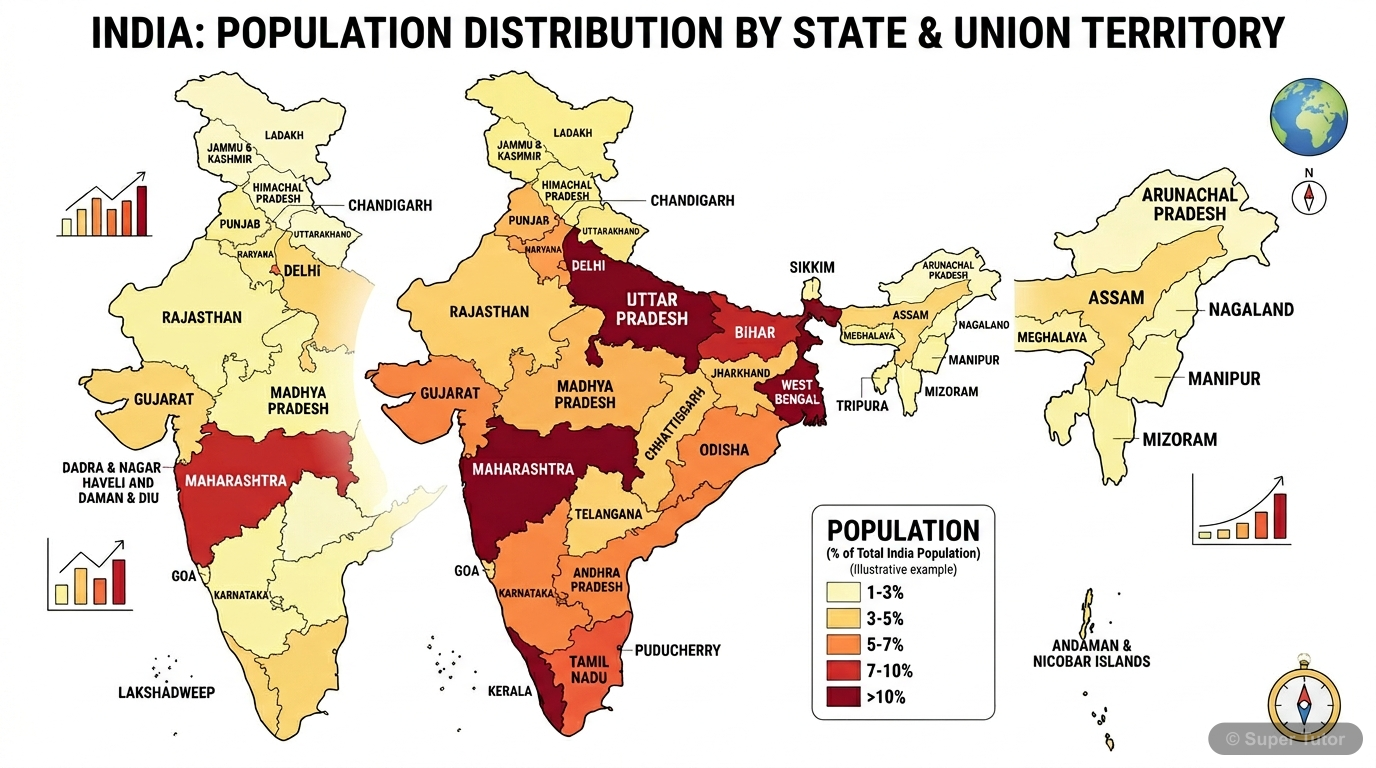
One of 20 illustrations for Population Our Greatest Resource in Super Tutor — alongside flashcards, concept maps and practice questions.
Quick Quiz: Population Our Greatest Resource
0/4Tap an answer to check it instantly. No sign-up needed for these 4.
What is the formula for calculating population density?
According to Census 2011, which state/UT has the highest population density in India?
What does the term 'human resource' mean in the context of population?
Which physical factor most significantly affects population distribution in India?
Sample Questions
What is the natural growth rate if birth rate is 25 per thousand and death rate is 8 per thousand?
Show answer
17 per thousand
Natural growth rate is calculated by subtracting death rate from birth rate. So, 25 - 8 = 17 per thousand. This means for every 1000 people, there is a net increase of 17 people per year due to natural factors (births minus deaths). Option A (33) would be if we added birth and death rates, which is incorrect. Option C (200) would be if we multiplied them. Option D (3.1) would be if we divided birth rate by death rate, which is not the correct formula for natural growth rate.
According to Census 2001, what is the sex ratio of India?
Show answer
933 females per 1000 males
According to Census 2001, India's sex ratio was 933 females per 1000 males. This indicates an unfavorable sex ratio as it shows fewer females than males in the population. The declining sex ratio from 972 in 1901 to 933 in 2001 reflects discrimination against females in Indian society. Option A (943) is incorrect census data. Option C (950) is also incorrect. Option D (1000) would represent an equal sex ratio, which India has not achieved. The unfavorable sex ratio is due to factors like female infanticide, neglect of female children, and preference for male children.
Which age group constitutes the 'dependent population'?
Show answer
0-14 years and 60+ years
Dependent population consists of both children (0-14 years) and elderly (60+ years) who typically depend on the working population for their needs. Children depend on adults for care, education, and support, while elderly often need support for healthcare and living expenses. The working population (15-60 years) supports both these groups. Option A is incomplete as it excludes elderly. Option B is incomplete as it excludes children. Option D represents the working population, not dependent population. A high dependency ratio means more resources are needed for non-productive population segment
What was the main objective of India's National Population Policy 2000?
Show answer
To improve quality of life and stabilize population
The National Population Policy 2000 aimed to improve the quality of life of people and stabilize population for sustainable development. It focused on addressing unmet needs for contraception, healthcare infrastructure, and providing integrated reproductive and child healthcare services. Option A is opposite to the policy's intent. Option C is unrealistic as immediate zero growth is not feasible or desirable. Option D is too narrow - the policy had broader objectives beyond just family planning, including health, education, and women's empowerment. The policy recognized that improving quality
+72 more questions on Population Our Greatest Resource (NIOS Class 10 Social Studies)
Practise AllFrequently Asked Questions
What are the important topics in Population Our Greatest Resource for NIOS Class 10 Social Studies?
How many practice questions are there for Population Our Greatest Resource?
Sources & Official References
Content is aligned to the official syllabus. Refer to the board website for the latest curriculum.
More resources for Population Our Greatest Resource
Important Questions
Exam-style questions with answers
Revision Notes
Key points for last-minute revision
Formula Sheet
The chapter's formulas in one place
Chapter Summary
Understand the chapter at a glance
Concept Maps
See how topics connect
Study Plan
Step-by-step plan for this chapter
Flashcards
Quick-fire cards for active recall
Syllabus
What topics to cover
For serious students
Get the full Population Our Greatest Resource chapter — start free.
Quizzes, flashcards, an AI doubt solver and a study plan for NIOS Class 10 Social Studies. Free to start, no card needed.