Peace And Security — Practice Quiz
NIOS · Class 10 · Social Studies
Try a 4-question quiz on Peace And Security for NIOS Class 10 Social Studies: tap an answer to check it and see why. 82 questions in the full chapter test.
Interactive on Super Tutor
Studying Peace And Security? Get the full interactive chapter.
Quizzes, flashcards, AI doubt-solver and a step-by-step study plan — built for practice quiz and more.
Free trial, no card needed.
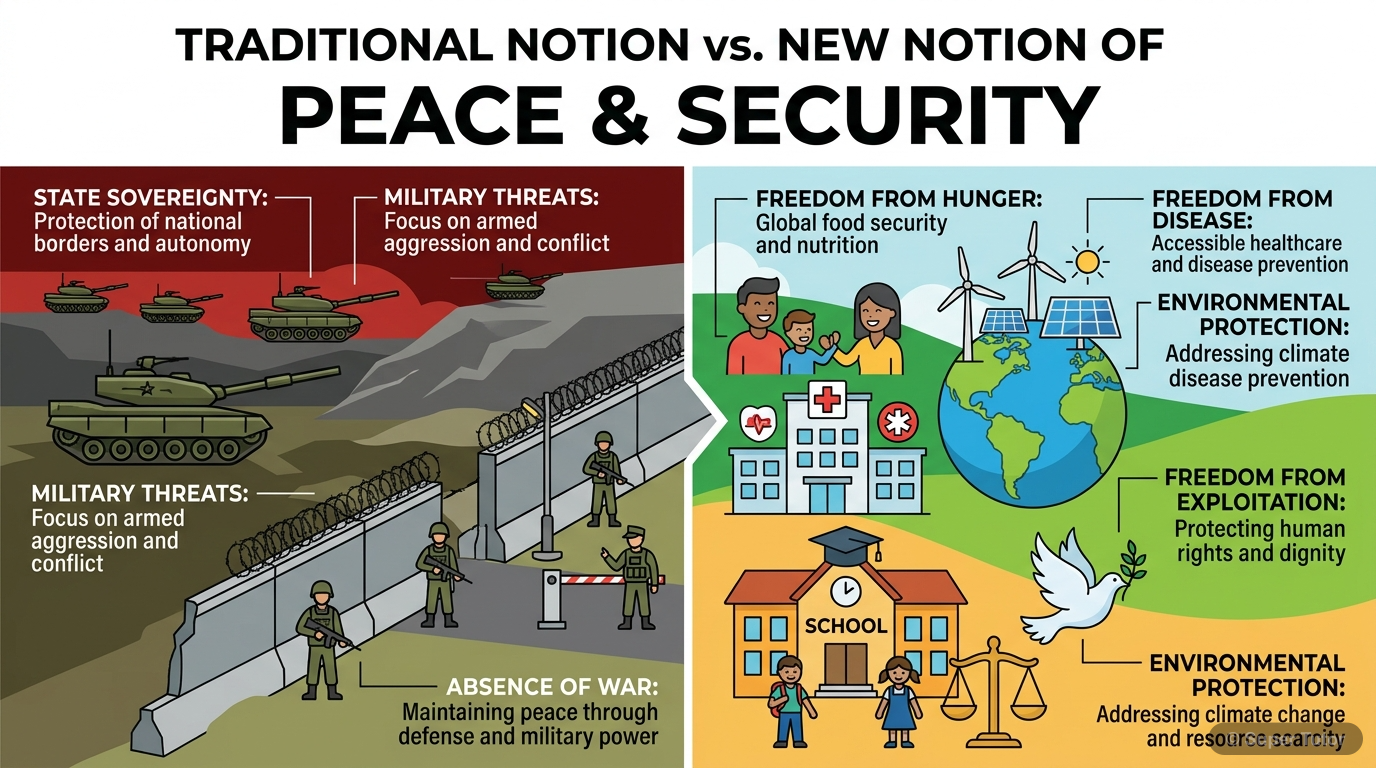
Learn better with visuals Super Tutor pairs illustrations like this with notes and quizzes for Peace And Security.
Quick Quiz: Peace And Security
0/4Tap an answer to check it instantly. No sign-up needed for these 4.
What does peace mean according to the lesson?
Which of the following is an example of the new or non-traditional concept of security?
What is the relationship between democracy, development, and peace & security?
Which Article of the Indian Constitution mentions India's commitment to international peace and security?
Sample Questions
What is terrorism according to the lesson?
Show answer
Criminal acts to inflict injury on civilians and create fear for political purposes
Terrorism is defined as criminal acts committed to inflict dramatic and deadly injury on civilians and create an atmosphere of fear, generally for political or ideological purposes. While terrorism involves criminal acts, it goes beyond mere criminality due to its political motivations and systematic nature of creating terror. Option A is incorrect as terrorism has political, not personal motives. Option C is wrong as peaceful protests are democratic rights, not terrorism. Option D is incorrect as government military action, when lawful, is not terrorism.
The Naxalite movement began in which state of India?
Show answer
West Bengal
The Naxalite movement began in March 1967 in Naxalbari village in West Bengal when revolutionaries led by Charu Mazumdar and Kanu Sanyal launched a peasant uprising. The movement started when tribals retaliated against local landlords over land disputes. Although the movement later spread to other states like Bihar, Jharkhand, Odisha, Chhattisgarh, etc., its origin was specifically in West Bengal. The name 'Naxalite' itself comes from the village Naxalbari where it originated.
What was India's foreign policy during the Cold War period?
Show answer
Non-alignment
During the Cold War when the world was divided between the USA-led Western bloc and Soviet Union-led Eastern bloc, India adopted the policy of Non-alignment. This meant not joining any military alliance but maintaining independence in foreign affairs and taking stands on international issues based on merit. Non-alignment was neither neutrality nor isolationism, but an active policy that allowed India to maintain sovereignty and freedom of action. India, along with leaders like Nehru, Tito, and Nasser, helped establish the Non-Aligned Movement (NAM).
Who are considered the founding fathers of the Non-Aligned Movement?
Show answer
Nehru, Tito, and Nasser
Jawaharlal Nehru of India, President Tito of Yugoslavia, and Nasser of Egypt are regarded as the founding fathers of the Non-Aligned Movement (NAM). These three leaders developed special relationships and worked together to establish NAM as a group of newly independent states that refused to accept the dictates of former colonial masters. Option A includes Gandhi and Patel who were important for India's independence but not NAM founders. Option C mentions other leaders but not the core founding trio. Option D includes leaders who were aligned with the Soviet bloc, not non-aligned.
+78 more questions on Peace And Security (NIOS Class 10 Social Studies)
Practise AllFrequently Asked Questions
What are the important topics in Peace And Security for NIOS Class 10 Social Studies?
How many practice questions are there for Peace And Security?
Sources & Official References
Content is aligned to the official syllabus. Refer to the board website for the latest curriculum.
More resources for Peace And Security
Important Questions
Exam-style questions with answers
Revision Notes
Key points for last-minute revision
Chapter Summary
Understand the chapter at a glance
Concept Maps
See how topics connect
Study Plan
Step-by-step plan for this chapter
Flashcards
Quick-fire cards for active recall
Syllabus
What topics to cover
For serious students
Get the full Peace And Security chapter — start free.
Quizzes, flashcards, an AI doubt solver and a study plan for NIOS Class 10 Social Studies. Free to start, no card needed.