Political Parties And Pressure Groups — Practice Quiz
NIOS · Class 10 · Social Studies
Try a 4-question quiz on Political Parties And Pressure Groups for NIOS Class 10 Social Studies: tap an answer to check it and see why.
Interactive on Super Tutor
Studying Political Parties And Pressure Groups? Get the full interactive chapter.
Quizzes, flashcards, AI doubt-solver and a step-by-step study plan — built for practice quiz and more.
Free trial, no card needed.
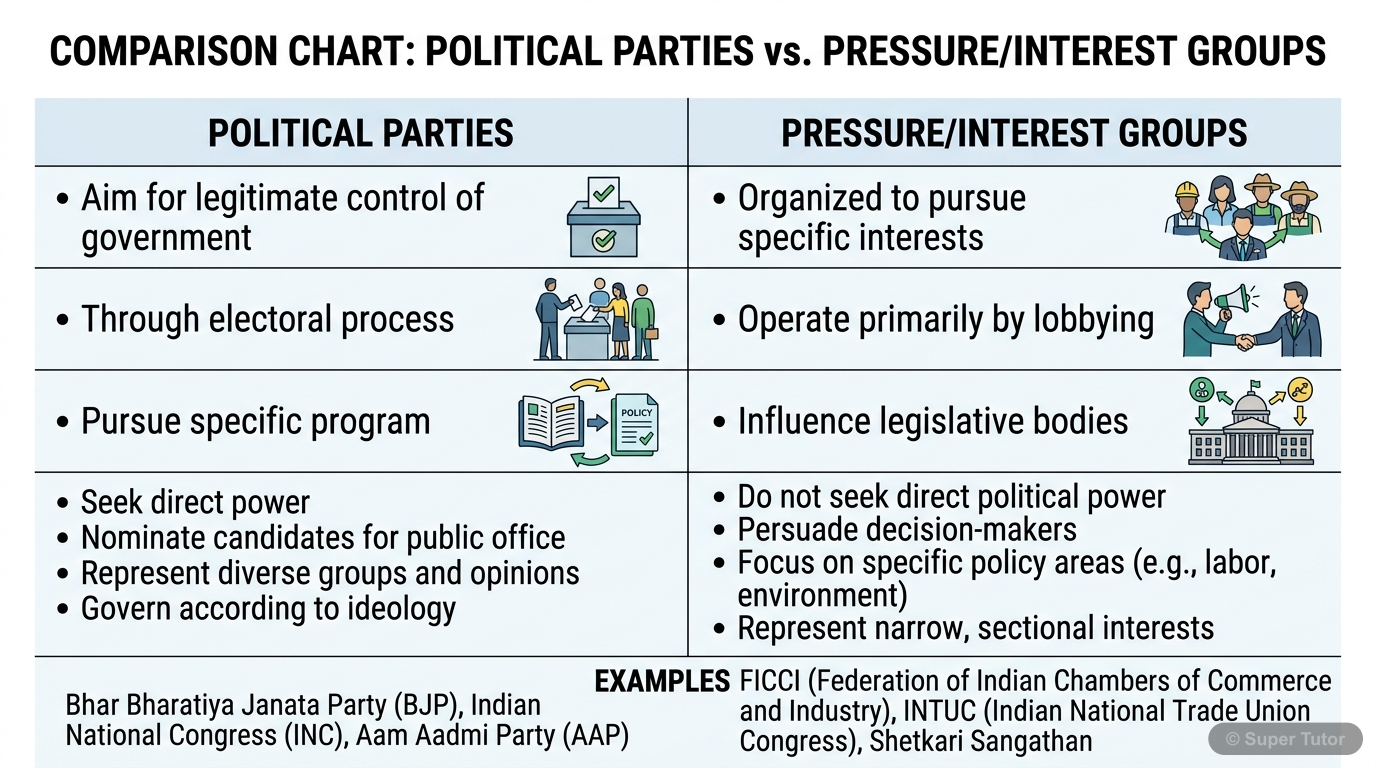
Learn better with visuals Super Tutor pairs illustrations like this with notes and quizzes for Political Parties And Pressure Groups.
Quick Quiz: Political Parties And Pressure Groups
0/4Tap an answer to check it instantly. No sign-up needed for these 4.
What is the primary purpose of a political party in a democracy?
Which of the following is NOT a characteristic of a political party?
The Indian National Congress was founded in which year?
Which political party system existed in India from 1947 to 1967?
Sample Questions
How many recognized national political parties were there in India after the 2009 elections?
Show answer
7
After the 2009 elections, India had 7 recognized national political parties. Step 1: The Election Commission classifies parties based on their performance and spread across states. Step 2: The seven national parties were: Indian National Congress (INC), Bharatiya Janata Party (BJP), Communist Party of India (CPI), Communist Party of India (Marxist), Bahujan Samaj Party (BSP), Nationalist Congress Party (NCP), and Rashtriya Janata Dal (RJD). Step 3: These parties met the criteria of being recognized in four or more states or winning a certain percentage of votes/seats. Step 4: The number can ch
Which of the following is a regional political party?
Show answer
Trinamool Congress
Trinamool Congress is a regional political party primarily based in West Bengal. Step 1: Regional parties have influence limited to particular states, unlike national parties which operate across the country. Step 2: Trinamool Congress was formed by Mamata Banerjee and has its main base in West Bengal. Step 3: The BJP, Congress, and CPI are national parties with presence across multiple states. Step 4: Regional parties play important roles in their respective states and often support national parties to form coalition governments at the center.
What is the main difference between a pressure group and a political party?
Show answer
Political parties seek direct power
The main difference is that political parties seek direct power to form governments, while pressure groups only try to influence those in power. Step 1: Political parties contest elections with the goal of winning seats and forming governments. Step 2: They seek direct control over governmental power and decision-making. Step 3: Pressure groups, on the other hand, do not contest elections or seek to form governments. Step 4: Instead, pressure groups try to influence government policies and decisions from outside to serve their specific interests. The other options are incorrect because pressur
Which method is commonly used by pressure groups to influence government policies?
Show answer
Organizing demonstrations
Pressure groups commonly organize demonstrations to influence government policies. Step 1: Pressure groups use various peaceful and constitutional methods to pressurize the government. Step 2: Demonstrations are a common tactic where groups gather publicly to show their support for or opposition to certain policies. Step 3: Other methods include strikes, petitions, lobbying, and media campaigns. Step 4: Pressure groups do not contest elections, form governments, or appoint ministers - these are functions of political parties. Their role is to influence policy from outside the government struct
+76 more questions on Political Parties And Pressure Groups (NIOS Class 10 Social Studies)
Practise AllFrequently Asked Questions
What are the important topics in Political Parties And Pressure Groups for NIOS Class 10 Social Studies?
How many practice questions are there for Political Parties And Pressure Groups?
Sources & Official References
Content is aligned to the official syllabus. Refer to the board website for the latest curriculum.
More resources for Political Parties And Pressure Groups
Important Questions
Exam-style questions with answers
Revision Notes
Key points for last-minute revision
Chapter Summary
Understand the chapter at a glance
Concept Maps
See how topics connect
Study Plan
Step-by-step plan for this chapter
Flashcards
Quick-fire cards for active recall
Syllabus
What topics to cover
For serious students
Get the full Political Parties And Pressure Groups chapter — start free.
Quizzes, flashcards, an AI doubt solver and a study plan for NIOS Class 10 Social Studies. Free to start, no card needed.