Modern World-I — Practice Quiz
NIOS · Class 10 · Social Studies
Try a 4-question quiz on Modern World-I for NIOS Class 10 Social Studies: tap an answer to check it and see why. 88 questions in the full chapter test.
Interactive on Super Tutor
Studying Modern World-I? Get the full interactive chapter.
Quizzes, flashcards, AI doubt-solver and a step-by-step study plan — built for practice quiz and more.
Free trial, no card needed.
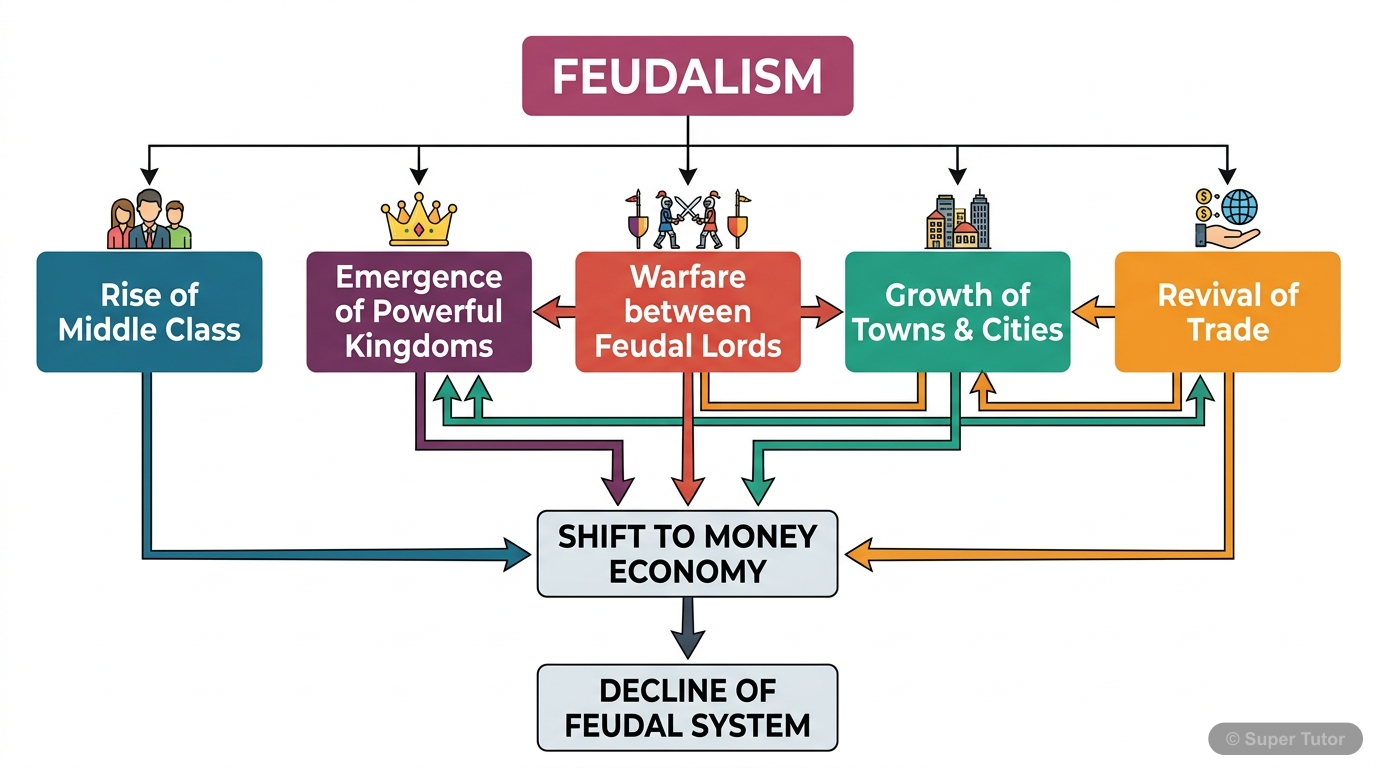
One of 8 illustrations for Modern World-I in Super Tutor — alongside flashcards, concept maps and practice questions.
Quick Quiz: Modern World-I
0/4Tap an answer to check it instantly. No sign-up needed for these 4.
What does the term 'Renaissance' literally mean?
In which country did the Renaissance begin?
Who was the German priest who first challenged the authority of the Roman Catholic Church in 1517 AD?
Which famous explorer discovered the sea route to India?
Sample Questions
The Industrial Revolution began in which country around 1750 AD?
Show answer
England
The Industrial Revolution began in England around 1750 AD. England was ideally suited for this revolution because English merchants had accumulated huge wealth through overseas trade and colonies. The colonies provided raw materials and acted as markets for finished goods. England also had abundant natural resources like coal and iron, which were essential for running industries. Additionally, England had a stable political system and a growing population that provided both workers and consumers. France, Germany, and Italy industrialized later, following England's lead.
How many colonies did America have when they declared independence from Britain?
Show answer
13
America had 13 colonies when they declared independence from Britain in 1776. These 13 colonies had formed around the 16th century when Europeans settled in America due to religious persecution and economic opportunities. Each colony had local assemblies to manage their affairs. The colonies were suffering under British economic policies and taxation without representation in the British Parliament. The representatives of these 13 colonies met in the Continental Congress and declared independence, forming what is now the United States of America.
Who was known as the 'Iron Chancellor' during German unification?
Show answer
Otto von Bismarck
Otto von Bismarck was known as the 'Iron Chancellor' during German unification. He earned this nickname because of his 'Blood and Iron' policy, which emphasized the use of military force to achieve German unification. As Prime Minister under Kaiser William I, Bismarck modernized the Prussian army and used it strategically to unite German states under Prussian leadership. He defeated Denmark, Austria, and France in successive wars to achieve complete German unification by 1871. Kaiser William I was the King who became Emperor, Napoleon III was the French ruler, and Garibaldi was involved in Ita
The French society before the French Revolution was divided into how many estates?
Show answer
Three
French society before the French Revolution was divided into three estates. The First Estate consisted of the Clergy or Church officials, the Second Estate included the Nobility, and the Third Estate comprised the Commoners including peasantry, city workers, and the middle class. The first two estates enjoyed many privileges and were exempt from most taxes, while the Third Estate, which formed the majority of the population, bore the heavy burden of taxation. This unequal system was one of the major causes of the French Revolution as the Third Estate demanded equality and an end to special pri
+84 more questions on Modern World-I (NIOS Class 10 Social Studies)
Practise AllFrequently Asked Questions
What are the important topics in Modern World-I for NIOS Class 10 Social Studies?
How many practice questions are there for Modern World-I?
Sources & Official References
Content is aligned to the official syllabus. Refer to the board website for the latest curriculum.
More resources for Modern World-I
Important Questions
Exam-style questions with answers
Revision Notes
Key points for last-minute revision
Chapter Summary
Understand the chapter at a glance
Concept Maps
See how topics connect
Study Plan
Step-by-step plan for this chapter
Flashcards
Quick-fire cards for active recall
Syllabus
What topics to cover
For serious students
Get the full Modern World-I chapter — start free.
Quizzes, flashcards, an AI doubt solver and a study plan for NIOS Class 10 Social Studies. Free to start, no card needed.