Ancient World — Practice Quiz
NIOS · Class 10 · Social Studies
Try a 4-question quiz on Ancient World for NIOS Class 10 Social Studies: tap an answer to check it and see why. 83 questions in the full chapter test.
Interactive on Super Tutor
Studying Ancient World? Get the full interactive chapter.
Quizzes, flashcards, AI doubt-solver and a step-by-step study plan — built for practice quiz and more.
Free trial, no card needed.
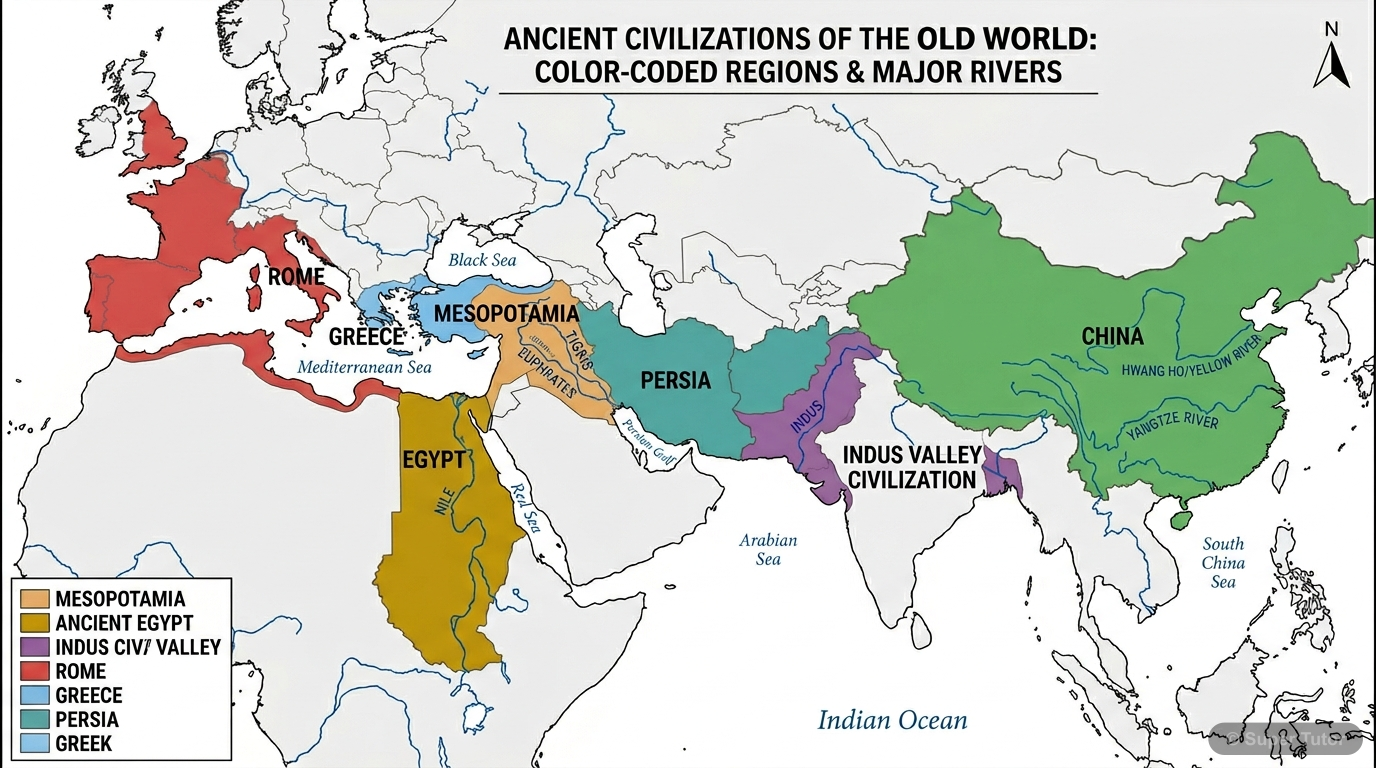
Learn better with visuals Super Tutor pairs illustrations like this with notes and quizzes for Ancient World.
Quick Quiz: Ancient World
0/4Tap an answer to check it instantly. No sign-up needed for these 4.
Which metal was first used by humans before the Bronze Age?
The Mesopotamian civilization developed between which two rivers?
What is the ancient Egyptian script called?
Which city was the capital of the Harappan civilization's major site in Sindh?
Sample Questions
Which Greek philosopher was the teacher of Alexander the Great?
Show answer
Aristotle
Aristotle was the famous Greek philosopher who tutored Alexander the Great. Aristotle was a student of Plato, who in turn was a student of Socrates, forming the famous chain of Greek philosophers. Democritus was known for his atomic theory but was not Alexander's teacher.
The Roman Empire was divided into how many parts for better governance?
Show answer
Two
In 395 AD, the huge Roman Empire was divided into two halves for better governance - the Western Roman Empire and the Eastern Roman Empire. The Eastern part had its capital at Byzantium (later Constantinople) and survived much longer than the Western Empire, which fell in 476 AD to barbarian invasions.
Who founded the religion of Zoroastrianism in Persia?
Show answer
Zoroaster
Zoroaster was the religious preacher who founded Zoroastrianism in ancient Persia. He taught about Ahura-Mazda, the Lord of Heaven and Light, and presented life as a constant struggle between good (light) and evil (darkness). Cyrus, Darius, and Xerxes were Persian kings, not religious founders.
Which Veda was composed first during the Early Vedic period?
Show answer
Rig Veda
The Rig Veda was the first Veda to be composed and is our main source of information about the Early Vedic period. The other three Vedas - Sama Veda, Yajur Veda, and Atharva Veda - were composed during the Later Vedic period along with their commentaries called Brahmanas, Aranyakas, and Upanishads.
+79 more questions on Ancient World (NIOS Class 10 Social Studies)
Practise AllFrequently Asked Questions
What are the important topics in Ancient World for NIOS Class 10 Social Studies?
How many practice questions are there for Ancient World?
Sources & Official References
Content is aligned to the official syllabus. Refer to the board website for the latest curriculum.
More resources for Ancient World
Important Questions
Exam-style questions with answers
Revision Notes
Key points for last-minute revision
Chapter Summary
Understand the chapter at a glance
Concept Maps
See how topics connect
Study Plan
Step-by-step plan for this chapter
Flashcards
Quick-fire cards for active recall
Syllabus
What topics to cover
For serious students
Get the full Ancient World chapter — start free.
Quizzes, flashcards, an AI doubt solver and a study plan for NIOS Class 10 Social Studies. Free to start, no card needed.