Applications of Semiconductor Devices — Chapter Summary
NIOS · Class 12 · Physics
Summary of Applications of Semiconductor Devices for NIOS Class 12 Physics. Key concepts: A half, A full and A Zener diode connected.
Interactive on Super Tutor
Studying Applications of Semiconductor Devices? Get the full interactive chapter.
Quizzes, flashcards, AI doubt-solver and a step-by-step study plan — built for chapter summary and more.
Free trial, no card needed.
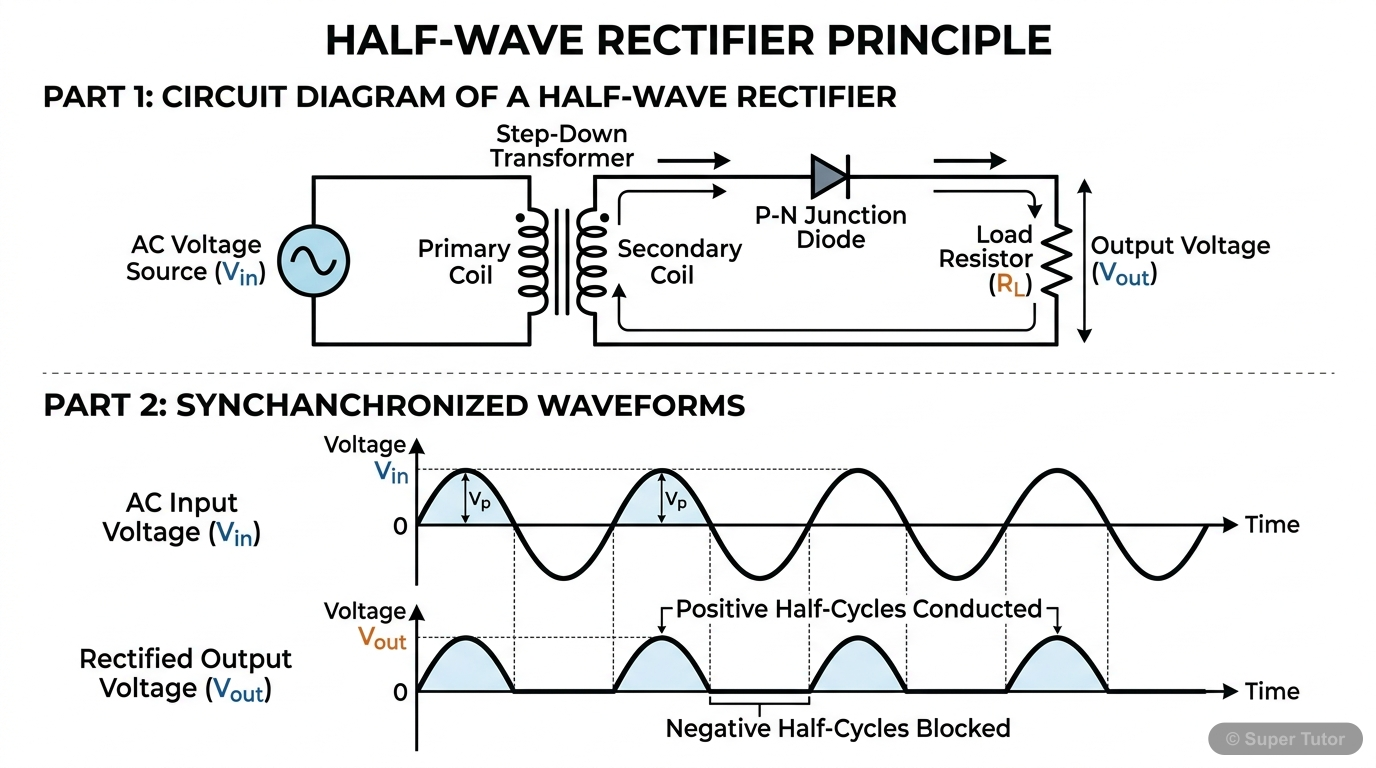
One of 4 illustrations for Applications of Semiconductor Devices in Super Tutor — alongside flashcards, concept maps and practice questions.
Overview
Semiconductor devices like p-n junction diodes, Zener diodes, and transistors have revolutionized modern electronics. From simple household appliances like gas lighters and emergency lights to complex systems like computers, aeroplanes, and satellites — all rely on semiconductor devices. In this cha
Key Concepts
A half
A half-wave rectifier uses a single p-n junction diode in series with a load resistance RL and a step-down transformer. During the positive half cycle
A full
A full-wave rectifier uses a centre-tapped step-down transformer and two diodes D1 and D2. The centre tap is connected to one end of RL, and the other
A Zener diode connected in reverse
A Zener diode connected in reverse bias operates in the breakdown region. After breakdown, the voltage across it stays nearly constant (Vz) regardless
An n
An n-p-n transistor in CE (Common Emitter) mode is used as an amplifier. The collector is reverse biased through load resistance RL by battery VCC. A
A transistor operates as a switch
A transistor operates as a switch by using two extreme regions of its characteristics: Cut-off region and Saturation region. In the cut-off region: ba
Learning Objectives
- Explain the use of a p-n junction diode as a half-wave and full-wave rectifier
- Understand the role of a filter capacitor in smoothing rectified output
- Explain how a Zener diode acts as a voltage regulator in a power supply circuit
- Describe the working of a transistor as an amplifier and derive the voltage gain formula
- Understand how a transistor works as an electronic switch using cut-off and saturation regions
Frequently Asked Questions
What are the important topics in Applications of Semiconductor Devices for NIOS Class 12 Physics?
How should I revise Applications of Semiconductor Devices for the NIOS Class 12 board exam?
Sources & Official References
Content is aligned to the official syllabus. Refer to the board website for the latest curriculum.
More resources for Applications of Semiconductor Devices
Practice Quiz
Test yourself with a quick quiz
Important Questions
Exam-style questions with answers
Revision Notes
Key points for last-minute revision
Formula Sheet
The chapter's formulas in one place
Concept Maps
See how topics connect
Study Plan
Step-by-step plan for this chapter
Flashcards
Quick-fire cards for active recall
Syllabus
What topics to cover
For serious students
Get the full Applications of Semiconductor Devices chapter — start free.
Quizzes, flashcards, an AI doubt solver and a study plan for NIOS Class 12 Physics. Free to start, no card needed.