Applications of Semiconductor Devices — Flashcards
NIOS · Class 12 · Physics
39 flashcards for Applications of Semiconductor Devices (NIOS Class 12 Physics) to test yourself on key terms and facts.
Interactive on Super Tutor
Studying Applications of Semiconductor Devices? Get the full interactive chapter.
Quizzes, flashcards, AI doubt-solver and a step-by-step study plan — built for flashcards and more.
Free trial, no card needed.
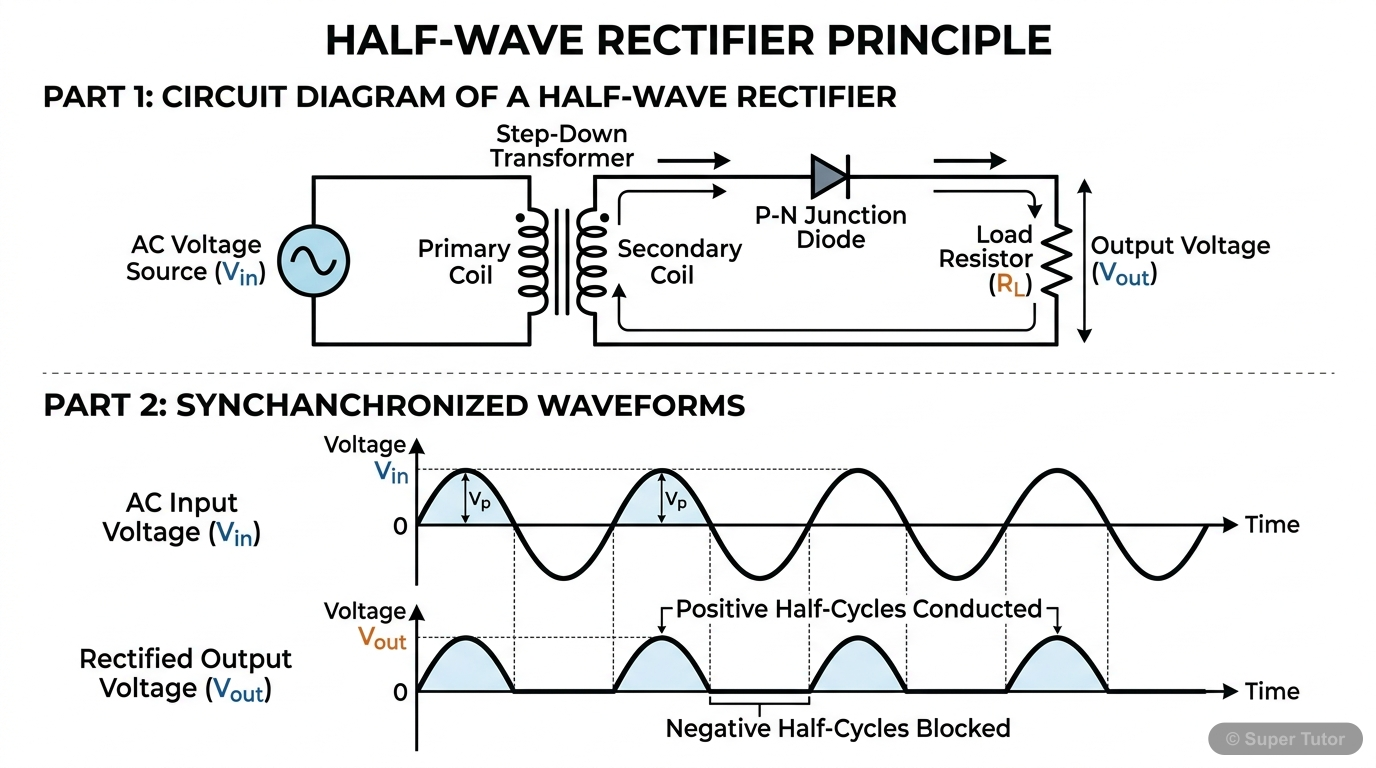
One of 4 illustrations for Applications of Semiconductor Devices in Super Tutor — alongside flashcards, concept maps and practice questions.
What is rectification? Why is it needed in everyday electronics?
Answer
Rectification is the process of converting an alternating current (AC) signal into a direct current (DC) signal. Why needed: • Most household appliances (phones, laptops, TVs) require DC to operate.
Explain how a p-n junction diode acts as a half-wave rectifier. What happens during positive and negative half cycles?
Answer
Half-Wave Rectifier Working: • AC input is applied to the diode through a step-down transformer. Positive Half Cycle (0 to T/2): → Diode is FORWARD BIASED. → Current flows through load resistance R_…
A half-wave rectifier has a peak input voltage of 15.7 V. Calculate the DC output voltage.
Answer
Given: V_m (peak voltage) = 15.7 V Formula for half-wave rectifier: V_dc = V_m / π Step 1: Substitute values V_dc = 15.7 / π V_dc = 15.7 / 3.14 Step 2: Calculate V_dc = 5 V Answer: V_dc = 5 V Not…
State the formula for DC output voltage and DC current in a half-wave rectifier.
Answer
Key Formulas – Half-Wave Rectifier: 1. DC Voltage: V_dc = V_m / π 2. DC Current: I_dc = V_dc / R_L = V_m / (π × R_L) Where: • V_m = Peak (maximum) AC voltage (in Volts) • R_L = Load resistanc…
What is Peak Inverse Voltage (PIV) of a diode? Why is it important in selecting a diode for a rectifier?
Answer
Peak Inverse Voltage (PIV): • It is the MAXIMUM reverse voltage that a diode can withstand without breaking down. In a half-wave rectifier: • During the negative half cycle, the entire peak AC voltag…
How does a full-wave rectifier work? What is the role of a centre-tapped transformer?
Answer
Full-Wave Rectifier Working: Components: 2 diodes (D1 and D2), centre-tapped step-down transformer, load R_L. Centre-tapped transformer: • Has two identical secondary windings in series with a centr…
A full-wave rectifier has a peak input voltage of 31.4 V and load resistance of 500 Ω. Find the DC output voltage and current.
Answer
Given: V_m = 31.4 V R_L = 500 Ω Formula for full-wave rectifier: V_dc = 2 × V_m / π I_dc = V_dc / R_L Step 1: Calculate V_dc V_dc = 2 × 31.4 / π V_dc = 62.8 / 3.14 V_dc = 20 V Step 2: Calculate I_d…
State the formulas for DC voltage and current in a full-wave rectifier. How do they differ from a half-wave rectifier?
Answer
Full-Wave Rectifier Formulas: 1. DC Voltage: V_dc = 2V_m / π 2. DC Current: I_dc = 2V_m / (π × R_L) Comparison with Half-Wave: | Parameter | Half-Wave | Full-Wave | |-----------|-----------|…
+31 more flashcards
Practise AllFrequently Asked Questions
What are the important topics in Applications of Semiconductor Devices for NIOS Class 12 Physics?
How many flashcards are available for Applications of Semiconductor Devices?
How should I revise Applications of Semiconductor Devices for the NIOS Class 12 board exam?
Sources & Official References
Content is aligned to the official syllabus. Refer to the board website for the latest curriculum.
More resources for Applications of Semiconductor Devices
Practice Quiz
Test yourself with a quick quiz
Important Questions
Exam-style questions with answers
Revision Notes
Key points for last-minute revision
Formula Sheet
The chapter's formulas in one place
Chapter Summary
Understand the chapter at a glance
Concept Maps
See how topics connect
Study Plan
Step-by-step plan for this chapter
Syllabus
What topics to cover
For serious students
Get the full Applications of Semiconductor Devices chapter — start free.
Quizzes, flashcards, an AI doubt solver and a study plan for NIOS Class 12 Physics. Free to start, no card needed.