Applications of Semiconductor Devices — Formula Sheet
NIOS · Class 12 · Physics
22 formulas from Applications of Semiconductor Devices (NIOS Class 12 Physics) on one page, grouped by topic. Part of the NIOS Class 12 Physics syllabus.
Interactive on Super Tutor
Studying Applications of Semiconductor Devices? Get the full interactive chapter.
Quizzes, flashcards, AI doubt-solver and a step-by-step study plan — built for formula sheet and more.
Free trial, no card needed.
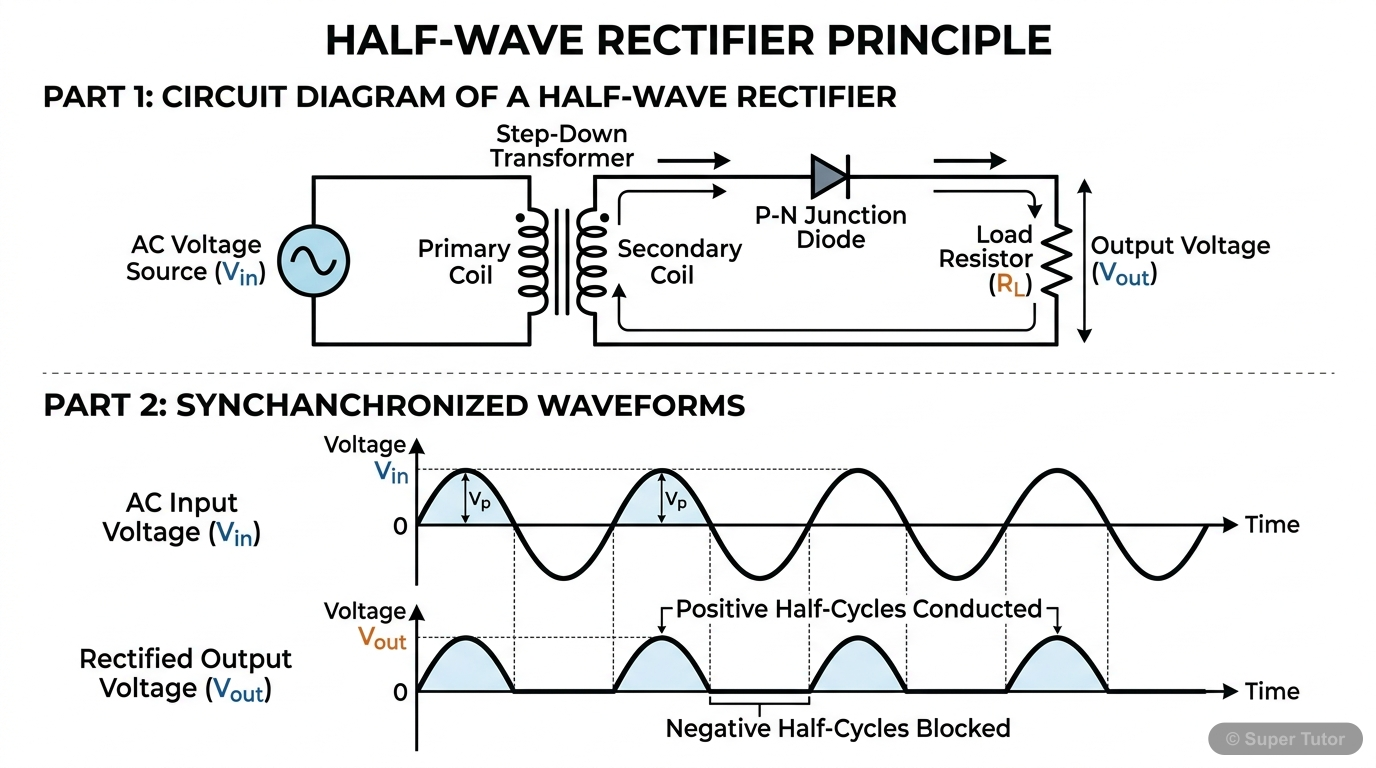
One of 4 illustrations for Applications of Semiconductor Devices in Super Tutor — alongside flashcards, concept maps and practice questions.
Formulas and Key Relations
p-n Junction Diode as Rectifier
V_dc = V_m / π
I_dc = V_dc / R_L = V_m / (π × R_L)
V_dc = 2V_m / π
I_dc = 2V_m / (π × R_L)
Zener Diode as Voltage Regulator
I_s = (V_i - V_z) / R_s
I_s = I_z + I_L
I_z = I_s - I_L
P_d = V_z × I_z
Transistor as Amplifier
A_V = V_0 / V_i
A_V = -β × R_L / r_i
A_V = -g_m × R_L
A_I = i_0 / i_i = β
A_P = A_I × A_V = β × A_V
Transistor as Switch and Oscillator
I_C = V_CC / R_L (at saturation)
I_B = (V_BB - V_BE) / R_B
Aβ = 1 (condition for sustained oscillations)
Transistor as a Switch
CUT-OFF region
Base current I_B = 0 (or negative). Transistor does not conduct. Collector current I_C ≈ 0. Output voltage V_CE = V_CC (switch is OFF).
SATURATION region
Base current I_B > saturation value. Transistor conducts fully. V_CE ≈ 0. Collector current I_C = V_CC/R_L (switch is ON). Output voltage V_0 ≈ 0.
Half-wave rectifier uses ONE diode and utilizes only one half of the AC input. V_dc = V_m/π
Full-wave rectifier uses TWO diodes and a centre-tapped transformer. V_dc = 2V_m/π
Transistor amplification is based on the principle
small ΔI_B → large ΔI_C, with ΔI_C = β × ΔI_B
Voltage Gain
A_V = -β × R_L / r_i (negative sign = 180° phase inversion between input and output)
Full sheet with units and worked examples
View AllFrequently Asked Questions
What are the important topics in Applications of Semiconductor Devices for NIOS Class 12 Physics?
How many formulas are in Applications of Semiconductor Devices?
How should I revise Applications of Semiconductor Devices for the NIOS Class 12 board exam?
Sources & Official References
Content is aligned to the official syllabus. Refer to the board website for the latest curriculum.
More resources for Applications of Semiconductor Devices
Practice Quiz
Test yourself with a quick quiz
Important Questions
Exam-style questions with answers
Revision Notes
Key points for last-minute revision
Chapter Summary
Understand the chapter at a glance
Concept Maps
See how topics connect
Study Plan
Step-by-step plan for this chapter
Flashcards
Quick-fire cards for active recall
Syllabus
What topics to cover
For serious students
Get the full Applications of Semiconductor Devices chapter — start free.
Quizzes, flashcards, an AI doubt solver and a study plan for NIOS Class 12 Physics. Free to start, no card needed.