Electric Current — Syllabus
NIOS · Class 12 · Physics
What Electric Current covers in NIOS Class 12 Physics: 4 topics, for the 2026-27 session. Part of the NIOS Class 12 Physics syllabus.
Interactive on Super Tutor
Studying Electric Current? Get the full interactive chapter.
Quizzes, flashcards, AI doubt-solver and a step-by-step study plan — built for syllabus and more.
Free trial, no card needed.
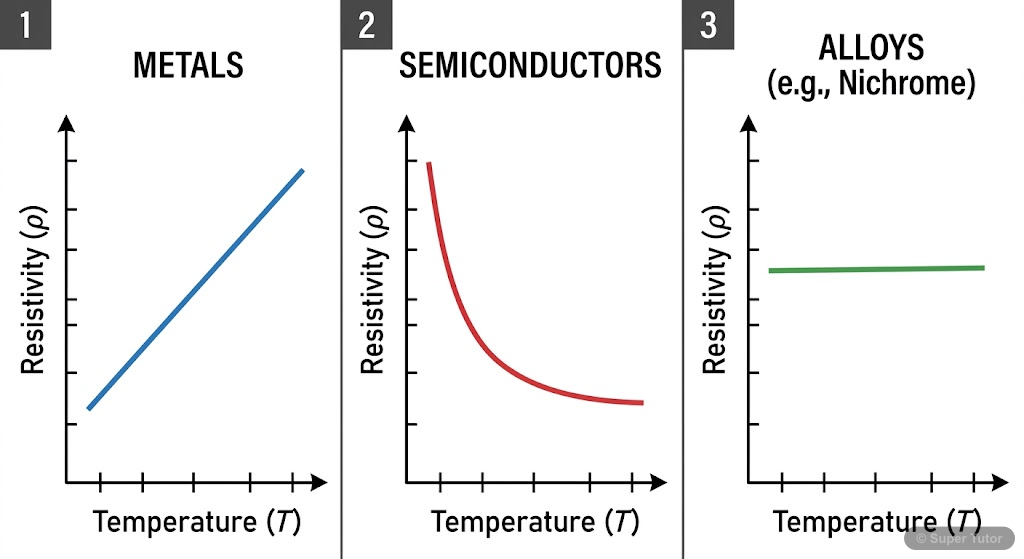
One of 8 illustrations for Electric Current in Super Tutor — alongside flashcards, concept maps and practice questions.
Topics in Electric Current
Electric Current — Definition and Basics
- Electric current is the rate of flow of electric charge through a cross-sectional area of a conductor.
- Conventional current flows from higher potential to lower potential (positive to negative terminal outside the cell). Electrons actually move in the opposite direction.
- If charge ΔQ flows in time Δt, average current I_av = ΔQ / Δt.
Ohm's Law, Resistance and Resistivity
- Ohm's Law: At constant temperature and pressure, the current through a conductor is directly proportional to the potential difference across it: V = IR.
- Resistance (R) = V/I. It opposes the flow of current. SI unit: Ohm (Ω). 1 Ω = 1 V/A.
- Ohmic conductors: Those that obey Ohm's Law (e.g., metals). Their I-V graph is a straight line through the origin.
Grouping of Resistors — Series and Parallel
- Series combination: Resistors are connected end-to-end. The SAME current flows through all resistors. Voltages add up.
- Series equivalent resistance: R_eq = R₁ + R₂ + R₃ + ... (always GREATER than any individual resistance).
- Parallel combination: Resistors share the same two terminal points. The SAME voltage appears across all resistors. Currents add up.
EMF, Internal Resistance, and Types of Cells
- EMF (Electromotive Force) of a cell = potential difference between terminals when NO current is drawn (open circuit). It is the maximum possible voltage of the cell.
- Internal resistance (r) is the resistance offered by the electrolyte and electrodes inside the cell to the flow of current.
- When current I is drawn: Terminal voltage V = E - Ir (less than EMF during discharge).
Key Concepts
Central concept: Electric Current
Work through every topic in Electric Current with notes and quizzes
Start This ChapterFrequently Asked Questions
What are the important topics in Electric Current for NIOS Class 12 Physics?
How should I revise Electric Current for the NIOS Class 12 board exam?
Sources & Official References
Content is aligned to the official syllabus. Refer to the board website for the latest curriculum.
More resources for Electric Current
Practice Quiz
Test yourself with a quick quiz
Important Questions
Exam-style questions with answers
Revision Notes
Key points for last-minute revision
Formula Sheet
The chapter's formulas in one place
Chapter Summary
Understand the chapter at a glance
Concept Maps
See how topics connect
Study Plan
Step-by-step plan for this chapter
Flashcards
Quick-fire cards for active recall
For serious students
Get the full Electric Current chapter — start free.
Quizzes, flashcards, an AI doubt solver and a study plan for NIOS Class 12 Physics. Free to start, no card needed.