Electric Current — Chapter Summary
NIOS · Class 12 · Physics
Summary of Electric Current for NIOS Class 12 Physics. Part of the NIOS Class 12 Physics syllabus. Electric current is one of the most fundamental.
Interactive on Super Tutor
Studying Electric Current? Get the full interactive chapter.
Quizzes, flashcards, AI doubt-solver and a step-by-step study plan — built for chapter summary and more.
Free trial, no card needed.
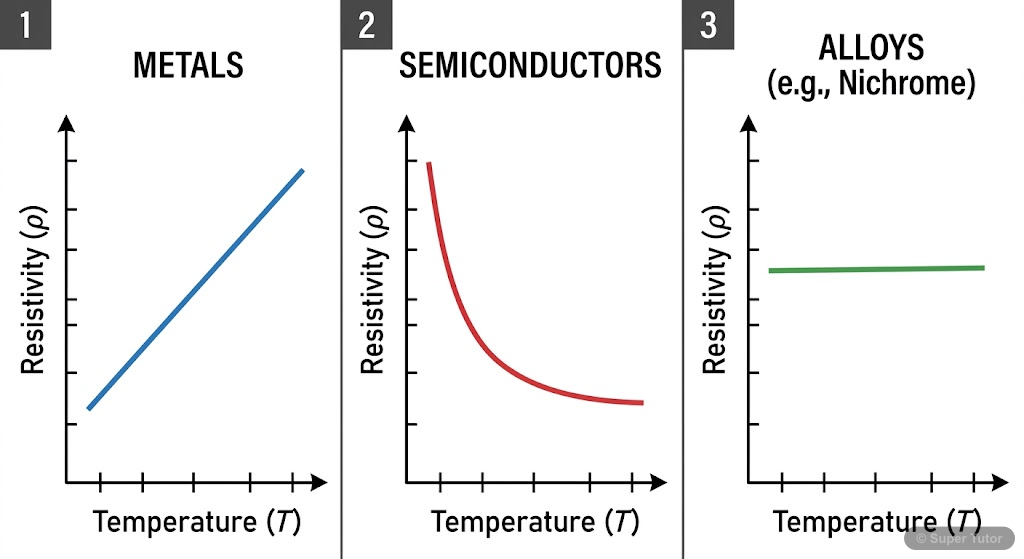
One of 8 illustrations for Electric Current in Super Tutor — alongside flashcards, concept maps and practice questions.
Overview
Electric current is one of the most fundamental and practically important concepts in Physics. In our daily life, every electrical device — from a simple bulb to a sophisticated computer — works because of electric current. This chapter explores what electric current actually is at the microscopic l
Key Concepts
Electric current is defined as
Electric current is defined as the rate of flow of electric charge through any cross-section of a conductor. If a charge ΔQ flows through a surface in
Ohm's Law (1828) states that
Ohm's Law (1828) states that the electric current through a conductor is directly proportional to the potential difference applied across it, provided
Experiments show that resistance of
Experiments show that resistance of a conductor is: (1) directly proportional to its length l: R ∝ l, and (2) inversely proportional to its cross-sect
Carbon resistors use a standard colour
Carbon resistors use a standard colour code system to indicate their resistance values. Four coloured bands are printed on the resistor body: Band 1 (
For most metals
For most metals, resistivity increases linearly with temperature over a limited range: ρ = ρ₀[1 + α(T - T₀)], where ρ₀ = resistivity at reference temp
Learning Objectives
- Define electric current and relate it to the flow of charge carriers in a conductor
- State Ohm's law and distinguish between ohmic and non-ohmic conductors with I-V graph analysis
- Define resistance and resistivity, and derive the formula R = ρl/A with proper units
- Calculate equivalent resistance for series and parallel combinations of resistors
- Understand the concept of EMF, internal resistance, and terminal potential difference of a cell
Frequently Asked Questions
What are the important topics in Electric Current for NIOS Class 12 Physics?
How should I revise Electric Current for the NIOS Class 12 board exam?
Sources & Official References
Content is aligned to the official syllabus. Refer to the board website for the latest curriculum.
More resources for Electric Current
Practice Quiz
Test yourself with a quick quiz
Important Questions
Exam-style questions with answers
Revision Notes
Key points for last-minute revision
Formula Sheet
The chapter's formulas in one place
Concept Maps
See how topics connect
Study Plan
Step-by-step plan for this chapter
Flashcards
Quick-fire cards for active recall
Syllabus
What topics to cover
For serious students
Get the full Electric Current chapter — start free.
Quizzes, flashcards, an AI doubt solver and a study plan for NIOS Class 12 Physics. Free to start, no card needed.