Electric Current — Important Questions
NIOS · Class 12 · Physics
45 important questions from Electric Current for NIOS Class 12 Physics, with answers. Includes multiple choice and multiple correct questions.
Interactive on Super Tutor
Studying Electric Current? Get the full interactive chapter.
Quizzes, flashcards, AI doubt-solver and a step-by-step study plan — built for important questions and more.
Free trial, no card needed.
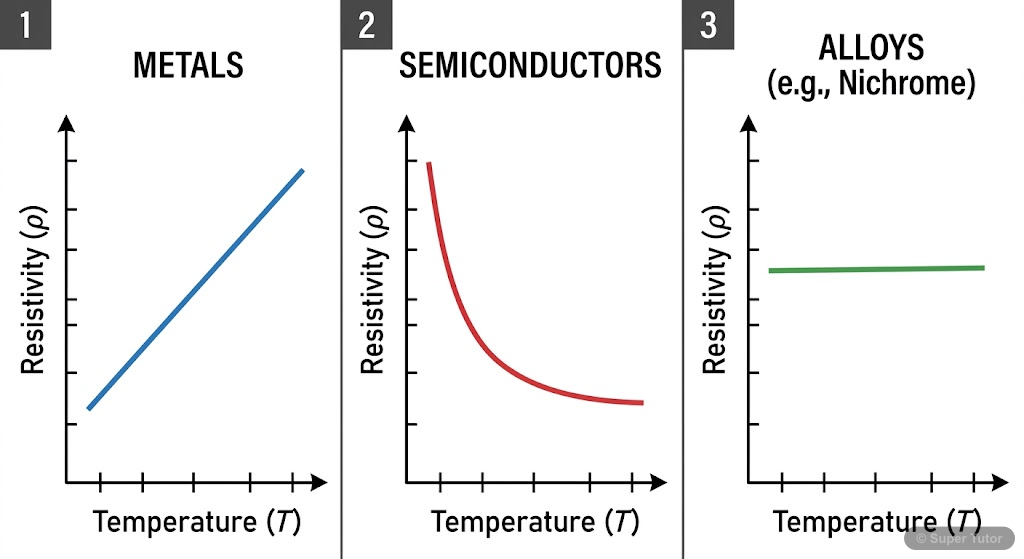
One of 8 illustrations for Electric Current in Super Tutor — alongside flashcards, concept maps and practice questions.
Important Questions from Electric Current
In a Wheatstone bridge, the four arms have resistances P = 10 Ω, Q = 5 Ω, and R = 20 Ω. If the bridge is balanced, what is the unknown resistance S?
Show answer
10 Ω
Step 1: The Wheatstone bridge balance condition is P/Q = R/S. Step 2: Rearranging for S: S = QR/P. Step 3: Substitute: S = (5 × 20) / 10 = 100 / 10 = 10 Ω. Step 4: Verify: P/Q = 10/5 = 2; R/S = 20/10 = 2 ✓ — bridge is balanced. Why 40 Ω is wrong: This comes from S = PR/Q = (10 × 20)/5 = 40, which inverts the formula. 20 Ω simply equals R without applying the balance condition.
The EMF of a cell is 10 V and its internal resistance is 2 Ω. When a resistor R = 8 Ω is connected externally, what is the terminal voltage of the cell?
Show answer
8 V
Step 1: Total resistance in the circuit = R + r = 8 + 2 = 10 Ω. Step 2: Current I = E / (R + r) = 10 / 10 = 1 A. Step 3: Terminal voltage V = E - Ir = 10 - (1 × 2) = 10 - 2 = 8 V. Alternatively, V = IR = 1 × 8 = 8 V ✓. Why 10 V is wrong: That would be the EMF, which equals terminal voltage only when no current flows (open circuit). 2 V is the voltage drop across internal resistance only. 5 V has no valid basis here.
According to Kirchhoff's Junction Rule (First Rule), what is conserved at a junction in an electrical circuit?
Show answer
Charge (or current)
Step 1: Kirchhoff's First Rule states that the sum of currents entering a junction equals the sum of currents leaving it: ΣI_in = ΣI_out. Step 2: This is based on the principle of conservation of charge — charge cannot accumulate at a junction in a steady-state circuit. Step 3: Energy conservation is expressed through Kirchhoff's Second Rule (Loop Rule), not the Junction Rule. Step 4: Voltage and power are not the conserved quantities at a junction — current is.
A 100 W bulb is connected to a 200 V supply. What is the current flowing through the bulb?
Show answer
0.5 A
Step 1: Power formula: P = VI, so I = P/V. Step 2: Substitute: I = 100 W / 200 V = 0.5 A. Step 3: Units check — W/V = (J/s)/(J/C) = C/s = A ✓. Why 2 A is wrong: That would mean P = 2 × 200 = 400 W, not 100 W. It comes from inverting (V/P instead of P/V). 20 A and 0.05 A are calculation errors with incorrect power-of-10 handling.
+41 more questions on Electric Current (NIOS Class 12 Physics)
Practise AllFrequently Asked Questions
What are the important topics in Electric Current for NIOS Class 12 Physics?
How many important questions are there in Electric Current?
Sources & Official References
Content is aligned to the official syllabus. Refer to the board website for the latest curriculum.
More resources for Electric Current
Practice Quiz
Test yourself with a quick quiz
Revision Notes
Key points for last-minute revision
Formula Sheet
The chapter's formulas in one place
Chapter Summary
Understand the chapter at a glance
Concept Maps
See how topics connect
Study Plan
Step-by-step plan for this chapter
Flashcards
Quick-fire cards for active recall
Syllabus
What topics to cover
For serious students
Get the full Electric Current chapter — start free.
Quizzes, flashcards, an AI doubt solver and a study plan for NIOS Class 12 Physics. Free to start, no card needed.