Animal Cell Culture — Revision Notes
CBSE · Class 12 · Biotechnology
Animal Cell Culture revision notes for CBSE Class 12 Biotechnology: 4 topics in quick points. Part of the CBSE Class 12 Biotechnology syllabus.
Interactive on Super Tutor
Studying Animal Cell Culture? Get the full interactive chapter.
Quizzes, flashcards, AI doubt-solver and a step-by-step study plan — built for revision notes and more.
Free trial, no card needed.
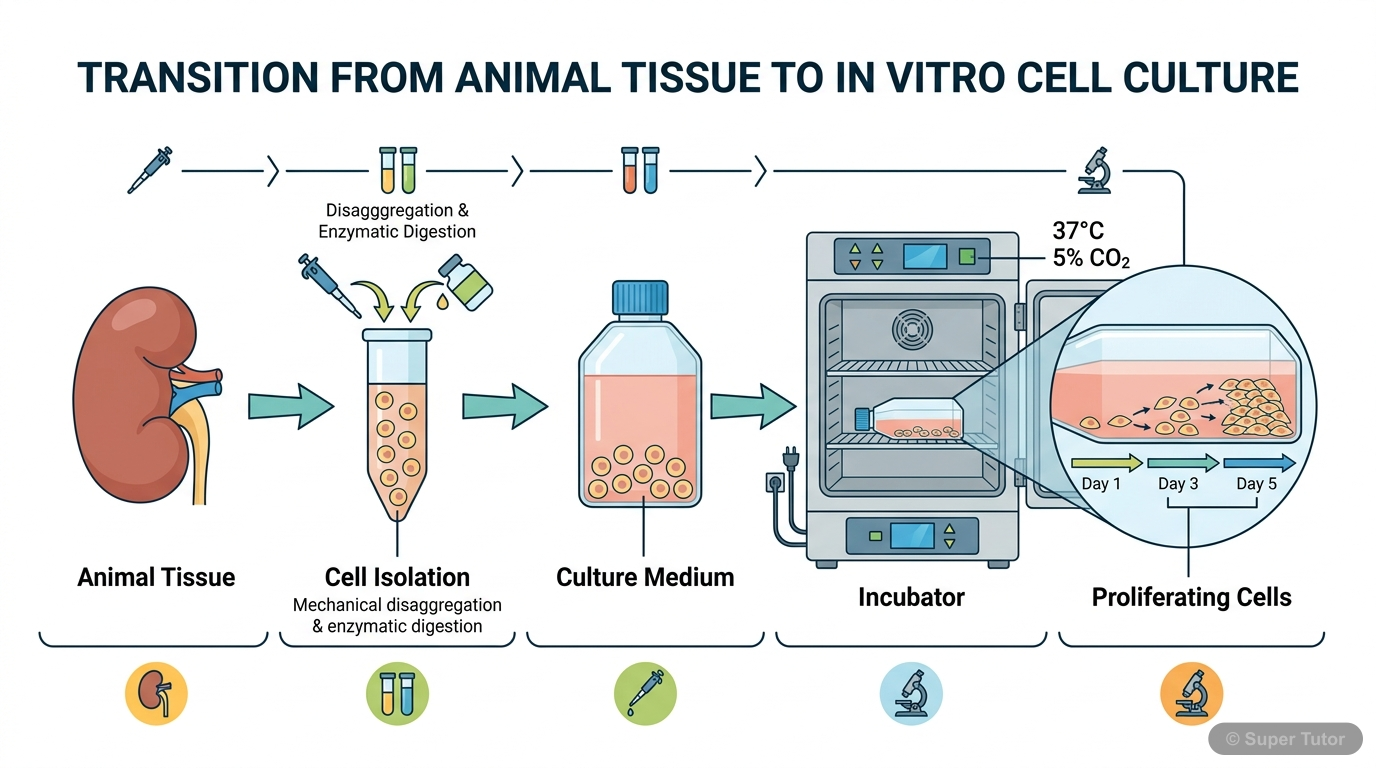
Learn better with visuals Super Tutor pairs illustrations like this with notes and quizzes for Animal Cell Culture.
Get startedKey Topics to Revise
1. Meaning, Features, and Basic Idea of Animal Cell Culture
- Animal cell culture means keeping animal cells alive and multiplying them outside the body under laboratory conditions.
- It is an in vitro process, unlike in vivo processes that occur inside the living body.
- Cells are isolated from animal tissue and placed in a suitable medium to support survival and growth.
2. Historical Development
- Sydney Ringer developed a balanced salt solution in 1882 and kept frog hearts alive after dissection.
- Ross Harrison published experiments in 1907 showing frog embryo nerve fibre growth in vitro.
- Alexis Carrel introduced aseptic techniques to tissue culture in 1912 and used trypsin, embryo extracts, and animal serum.
3. Culture Media and Supplements
- A suitable growth medium is the most critical requirement for cell culture.
- Culture media support cell survival, proliferation, pH balance, and osmolality.
- Natural media consist of biological substances such as plasma, serum, and tissue extract.
4. Physical Environment for Cell Growth
- Animal cells require controlled temperature, pH, osmolality, gas mixture, and support surface.
- CO2 incubators are used to grow mammalian cells at 37°C.
- Typical mammalian cell culture conditions are 37°C, 95% humidity, and 5% CO2.
Get complete notes with diagrams and examples
Full NotesKey Concepts
Frequently Asked Questions
What are the important topics in Animal Cell Culture for CBSE Class 12 Biotechnology?
How should I revise Animal Cell Culture for the CBSE Class 12 board exam?
Sources & Official References
- NCERT Official — ncert.nic.in
- CBSE Academic — cbseacademic.nic.in
- CBSE Official — cbse.gov.in
- National Education Policy 2020 — education.gov.in
Content is aligned to the official syllabus. Refer to the board website for the latest curriculum.
More resources for Animal Cell Culture
Practice Quiz
Test yourself with a quick quiz
Important Questions
Exam-style questions with answers
Chapter Summary
Understand the chapter at a glance
Concept Maps
See how topics connect
Study Plan
Step-by-step plan for this chapter
Flashcards
Quick-fire cards for active recall
Syllabus
What topics to cover
NCERT Solutions
Every textbook question solved step by step
For serious students
Get the full Animal Cell Culture chapter — start free.
Quizzes, flashcards, an AI doubt solver and a study plan for CBSE Class 12 Biotechnology. Free to start, no card needed.