Applications of Recombinant DNA Technology — Syllabus
CBSE · Class 12 · Biotechnology
What Applications of Recombinant DNA Technology covers in CBSE Class 12 Biotechnology: 4 topics, for the 2026-27 session.
Interactive on Super Tutor
Studying Applications of Recombinant DNA Technology? Get the full interactive chapter.
Quizzes, flashcards, AI doubt-solver and a step-by-step study plan — built for syllabus and more.
Free trial, no card needed.
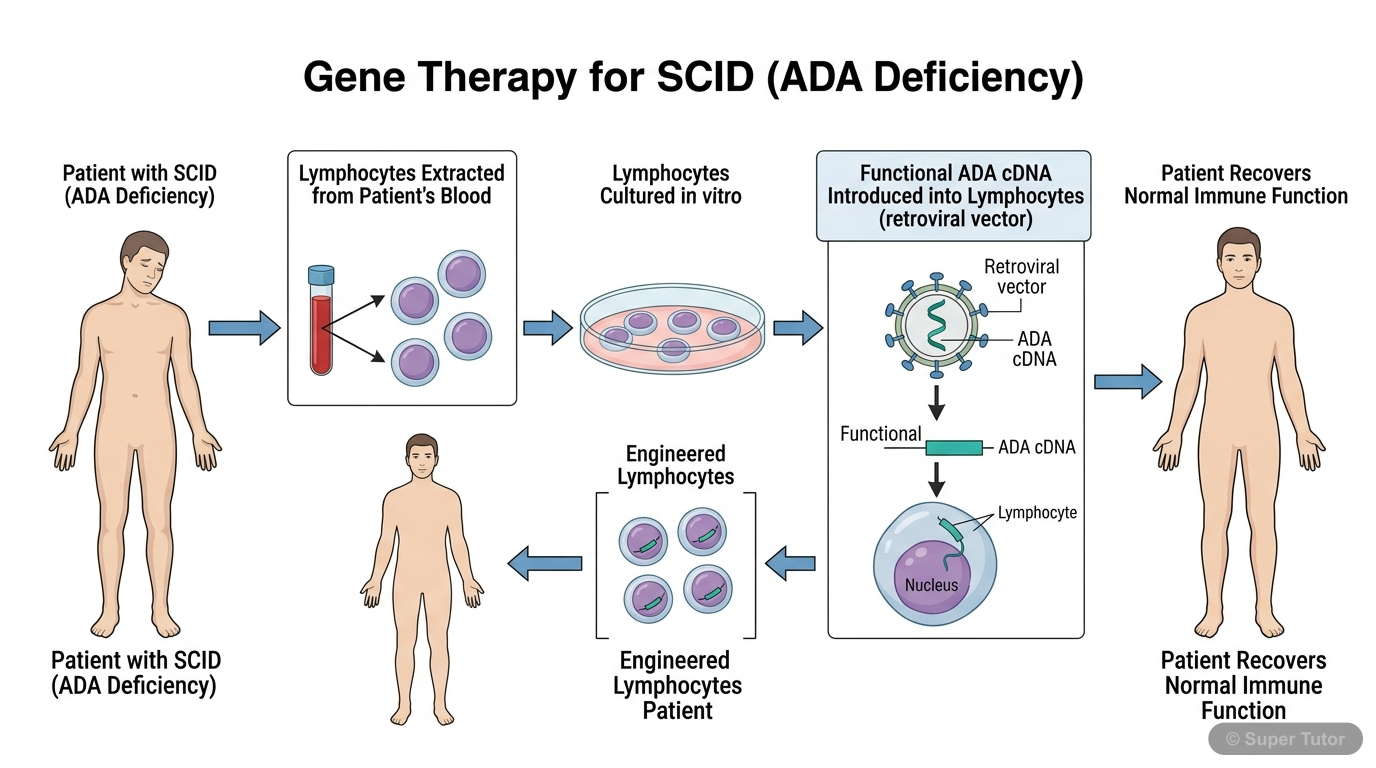
One of 28 illustrations for Applications of Recombinant DNA Technology in Super Tutor — alongside flashcards, concept maps and practice questions.
See them allTopics in Applications of Recombinant DNA Technology
DNA Fingerprinting
- DNA fingerprinting identifies individuals by using inherited variations in DNA.
- The human genome consists of 3.2 × 10^6 bp.
- About 99.9% of the human genome is the same in all humans, and the remaining 0.1% contains inherited variations.
Transgenic Organisms
- Transgenic organisms carry a foreign gene introduced by transgenesis.
- The first genetically modified organism was a bacterium made by Herbert Boyer and Stanley Cohen in 1973.
- The first transgenic animal, transgenic mice, was engineered by Rudolf Jaenisch and Beatrice Mintz in 1974.
Gene Therapy
- Gene therapy is designed to repair faulty genes by introducing correct genetic material into cells.
- The first gene therapy was performed in 1990 on a four-year-old girl with SCID caused by ADA gene defect.
- In this case, a functional ADA gene was inserted into a viral vector and introduced into lymphocytes.
Recombinant Vaccines
- A vaccine is a preparation of killed or weakened pathogen or its components that induces immunity.
- Edward Jenner coined the word vaccine from vacca, meaning cow, and used cowpox virus to protect against smallpox.
- Louis Pasteur coined the term vaccination in 1881.
Key Concepts
Central concept: Applications of recombinant DNA technology in medicine, agriculture, diagnostics, and biological research
Work through every topic in Applications of Recombinant DNA Technology with notes and quizzes
Start This ChapterFrequently Asked Questions
What are the important topics in Applications of Recombinant DNA Technology for CBSE Class 12 Biotechnology?
How should I revise Applications of Recombinant DNA Technology for the CBSE Class 12 board exam?
Sources & Official References
- NCERT Official — ncert.nic.in
- CBSE Academic — cbseacademic.nic.in
- CBSE Official — cbse.gov.in
- National Education Policy 2020 — education.gov.in
Content is aligned to the official syllabus. Refer to the board website for the latest curriculum.
More resources for Applications of Recombinant DNA Technology
Practice Quiz
Test yourself with a quick quiz
Important Questions
Exam-style questions with answers
Revision Notes
Key points for last-minute revision
Chapter Summary
Understand the chapter at a glance
Concept Maps
See how topics connect
Study Plan
Step-by-step plan for this chapter
Flashcards
Quick-fire cards for active recall
NCERT Solutions
Every textbook question solved step by step
For serious students
Get the full Applications of Recombinant DNA Technology chapter — start free.
Quizzes, flashcards, an AI doubt solver and a study plan for CBSE Class 12 Biotechnology. Free to start, no card needed.