Thermodynamics — Chapter Summary
ICSE · Class 11 · Physics
Summary of Thermodynamics for ICSE Class 11 Physics. Key concepts: A system is a fixed amount, Bodies in thermal equilibrium and If two bodies A and B.
Interactive on Super Tutor
Studying Thermodynamics? Get the full interactive chapter.
Quizzes, flashcards, AI doubt-solver and a step-by-step study plan — built for chapter summary and more.
Free trial, no card needed.
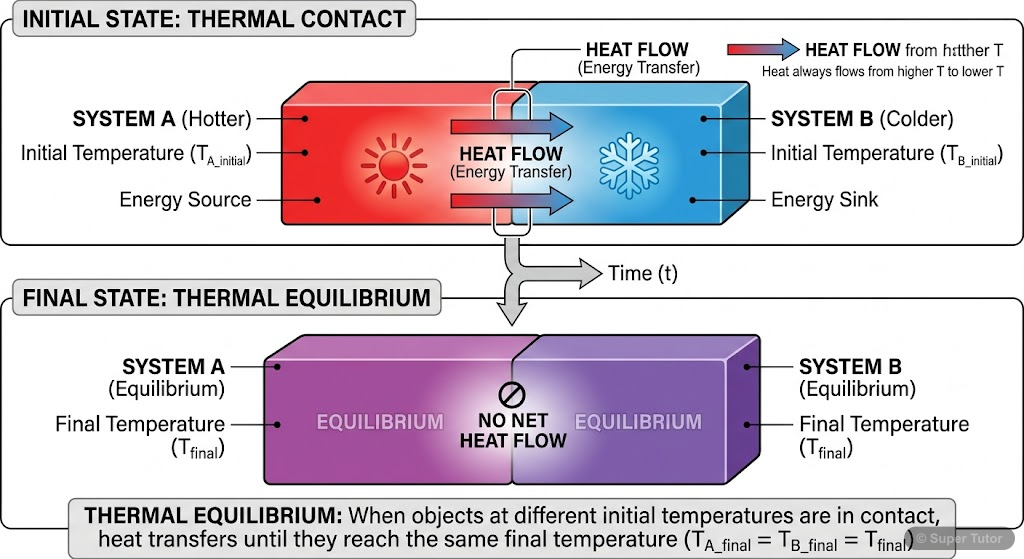
One of 6 illustrations for Thermodynamics in Super Tutor — alongside flashcards, concept maps and practice questions.
Overview
Thermodynamics studies heat, work, temperature, and the internal energy of a system. A system is a fixed amount of matter enclosed within a surface, while surroundings are everything outside the system. Thermal equilibrium gives the idea of temperature, and the Zeroth law states that if two bodies a
Key Concepts
A system is a fixed amount
A system is a fixed amount of matter enclosed within a boundary. Surroundings are everything outside the system. An isolated system cannot exchange ma
Bodies in thermal equilibrium have
Bodies in thermal equilibrium have the same temperature. If two bodies are separately in thermal equilibrium with a third body, then they are in therm
If two bodies A and B
If two bodies A and B are separately in thermal equilibrium with a third body C, then A and B are in thermal equilibrium with each other. The law was
Heat is energy transferred due
Heat is energy transferred due to temperature difference. Work is energy transferred without dependence on temperature difference. Heat taken by the s
Joule showed that 4
Joule showed that 4.18 × 10^3 joule of work is equivalent to 1 kilocalorie of heat. Also, 1 calorie = 4.18 joule. The quantity J = 4.18 J/cal or 4.18
Learning Objectives
- Define system, surroundings, and isolated system
- Explain thermal equilibrium and the Zeroth law of thermodynamics
- Understand heat, work, and internal energy as different energy ideas
- Use the mechanical equivalent of heat for conversion between calorie and joule
- Apply the sign convention for heat and work correctly
Frequently Asked Questions
What are the important topics in Thermodynamics for ICSE Class 11 Physics?
How should I revise Thermodynamics for Class 11 exams?
Sources & Official References
Content is aligned to the official syllabus. Refer to the board website for the latest curriculum.
More resources for Thermodynamics
Practice Quiz
Test yourself with a quick quiz
Important Questions
Exam-style questions with answers
Revision Notes
Key points for last-minute revision
Formula Sheet
The chapter's formulas in one place
Concept Maps
See how topics connect
Study Plan
Step-by-step plan for this chapter
Flashcards
Quick-fire cards for active recall
Syllabus
What topics to cover
For serious students
Get the full Thermodynamics chapter — start free.
Quizzes, flashcards, an AI doubt solver and a study plan for ICSE Class 11 Physics. Free to start, no card needed.