Chapter 8 of 28
Revision Notes
The United Nations Organization — Revision Notes
ICSE · Class 12 · History
The United Nations Organization revision notes for ICSE Class 12 History: 4 topics in quick points. Part of the ICSE Class 12 History syllabus.
44 questions44 flashcards5 concepts
Interactive on Super Tutor
Studying The United Nations Organization? Get the full interactive chapter.
Quizzes, flashcards, AI doubt-solver and a step-by-step study plan — built for revision notes and more.
Free trial, no card needed.
Super Tutor
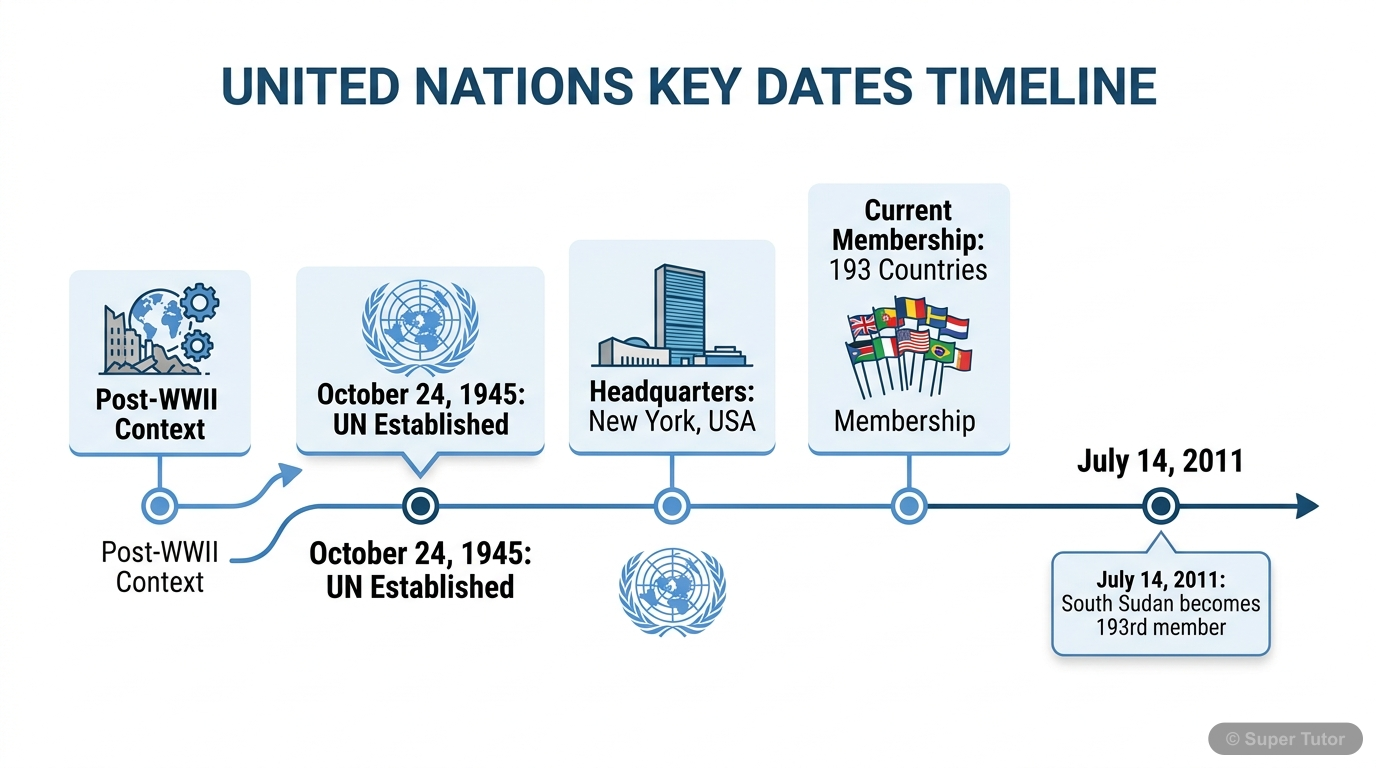
Learn better with visuals Super Tutor pairs illustrations like this with notes and quizzes for The United Nations Organization.
Key Topics to Revise
1
Origin, Aims, and Basic Idea
- The UNO officially came into existence in October 1945 after the Second World War.
- It was formed to replace the League of Nations, which had failed to restrain aggressive dictators like Hitler and Mussolini.
- The UN Charter was drawn up in San Francisco in 1945 and was based on earlier proposals made at Dumbarton Oaks in 1944 by the USSR, the USA, China, and Britain.
2
Structure of the United Nations
- The seven main organs of the UN are the General Assembly, Security Council, Secretariat, International Court of Justice, Trusteeship Council, Economic and Social Council, and the International Crimina
- The General Assembly is the meeting of representatives from all member nations; each nation has one vote and can send up to five representatives.
- The General Assembly meets once a year from September for about three months, with special sessions possible in a crisis.
3
Decision-Making in the UN
- Membership applications must be approved by the Security Council and then by a two-thirds majority in the General Assembly.
- A two-thirds majority in the General Assembly is required for important issues such as admitting or expelling members and peace-related action.
- The Security Council can act quickly in a crisis, but the veto can block action.
4
Secretary-Generals and Their Role
- The Secretary-General heads the Secretariat and acts as the main spokesperson for the UN.
- The post is deliberately filled by a person from a country that is not a major power to support impartiality.
- Chronological list of Secretaries-General includes Trygve Lie, Dag Hammarskjöld, U Thant, Kurt Waldheim, Javier Pérez de Cuellar, Boutros Boutros-Ghali, Kofi Annan, Ban Ki-moon, and António Guterres.
Get complete notes with diagrams and examples
Full NotesKey Concepts
The UNO came into existenceThe UN was formed to preserveThe General Assembly is the meetingThe Security Council sits in permanentAny permanent member can block
Frequently Asked Questions
What are the important topics in The United Nations Organization for ICSE Class 12 History?
Key topics in The United Nations Organization include Origin, Aims, and Basic Idea, Structure of the United Nations, Decision-Making in the UN, Secretary-Generals and Their Role. Study these first, then practise questions on each for the ICSE Class 12 board exam.
How should I revise The United Nations Organization for the ICSE Class 12 board exam?
Learn the core ideas first, then work through the 44 practice questions on The United Nations Organization. Revise definitions regularly and use flashcards for quick recall before the exam.
Sources & Official References
Content is aligned to the official syllabus. Refer to the board website for the latest curriculum.
More resources for The United Nations Organization
For serious students
Get the full The United Nations Organization chapter — start free.
Quizzes, flashcards, an AI doubt solver and a study plan for ICSE Class 12 History. Free to start, no card needed.