Pollination and Fertilization — Syllabus
ICSE · Class 9 · Biology
What Pollination and Fertilization covers in ICSE Class 9 Biology: 4 topics, for the 2026-27 session. Part of the ICSE Class 9 Biology syllabus.
Interactive on Super Tutor
Studying Pollination and Fertilization? Get the full interactive chapter.
Quizzes, flashcards, AI doubt-solver and a step-by-step study plan — built for syllabus and more.
Free trial, no card needed.
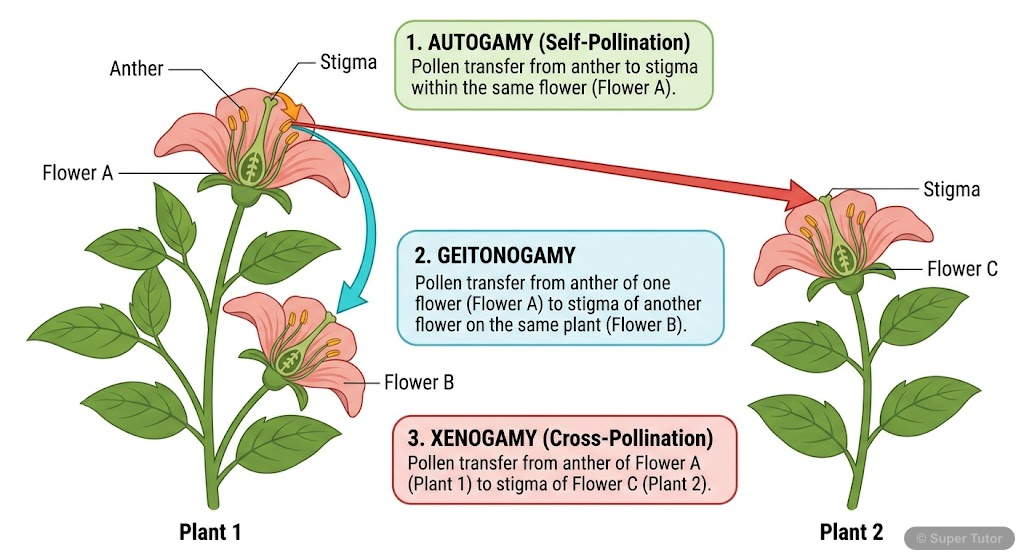
One of 6 illustrations for Pollination and Fertilization in Super Tutor — alongside flashcards, concept maps and practice questions.
Topics in Pollination and Fertilization
1. Pollination: Meaning and Types
- Pollination is the process of transference of pollen grains from the anther to the stigma.
- Pollination must occur between plants of the same species for successful reproduction; pollen of other species fails to germinate.
- There are two kinds of pollination: self-pollination and cross-pollination.
2. Devices That Favour Cross-Pollination
- Nature has several devices that favour cross-pollination.
- Unisexuality promotes cross-pollination because male and female flowers are separate.
- In papaya, male and female trees are usually separate, though rare hermaphrodite trees also occur.
3. Agents of Cross-Pollination
- The two commonest agents of cross-pollination are insects and wind.
- Water, birds, and elephants can also act as pollinating agents in some plants.
- Insect-pollinated flowers are large, brightly coloured, scented, nectar-producing, and have sticky or spiny pollen and a sticky stigma.
4. Fertilization and Double Fertilization
- Fertilisation is the union or fusion of the nuclei of male and female gamete.
- The pollen grain is the male gamete.
- The ovule inside the ovary is the female gamete.
Key Concepts
Central concept: Pollination and fertilization in flowering plants
Work through every topic in Pollination and Fertilization with notes and quizzes
Start This ChapterFrequently Asked Questions
What are the important topics in Pollination and Fertilization for ICSE Class 9 Biology?
How should I revise Pollination and Fertilization for Class 9 exams?
Sources & Official References
Content is aligned to the official syllabus. Refer to the board website for the latest curriculum.
More resources for Pollination and Fertilization
Practice Quiz
Test yourself with a quick quiz
Important Questions
Exam-style questions with answers
Revision Notes
Key points for last-minute revision
Chapter Summary
Understand the chapter at a glance
Concept Maps
See how topics connect
Study Plan
Step-by-step plan for this chapter
Flashcards
Quick-fire cards for active recall
For serious students
Get the full Pollination and Fertilization chapter — start free.
Quizzes, flashcards, an AI doubt solver and a study plan for ICSE Class 9 Biology. Free to start, no card needed.