Reproduction — Flashcards
NIOS · Class 10 · Science & Tech
40 flashcards for Reproduction (NIOS Class 10 Science & Tech) to test yourself on key terms and facts. Sample: "What is reproduction?"
Interactive on Super Tutor
Studying Reproduction? Get the full interactive chapter.
Quizzes, flashcards, AI doubt-solver and a step-by-step study plan — built for flashcards and more.
Free trial, no card needed.
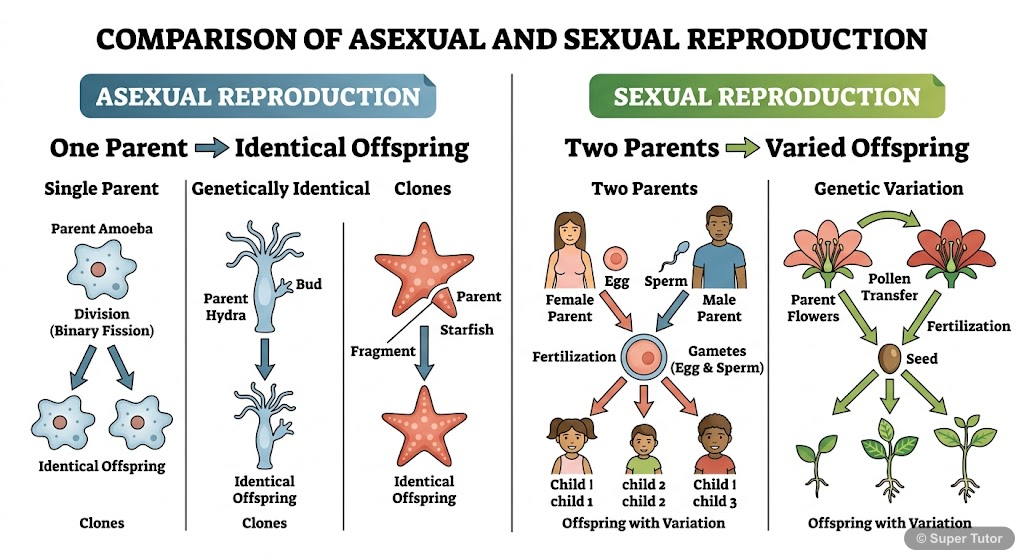
Learn better with visuals Super Tutor pairs illustrations like this with notes and quizzes for Reproduction.
What is reproduction?
Answer
Reproduction is the biological process by which organisms give rise to their own kind. It helps the species continue from one generation to the next.
What are the two ways reproduction occurs?
Answer
Reproduction occurs in two ways: asexual reproduction and sexual reproduction. Asexual reproduction involves a single parent, while sexual reproduction involves fusion of male and female gametes.
Why is Amoeba called an asexual organism in reproduction?
Answer
Amoeba reproduces by binary fission. One cell divides into two individuals, so only one parent is involved and no gametes are formed.
A student sees yeast multiplying on wet bread. What type of reproduction is this?
Answer
This is budding. In budding, a small outgrowth forms on the parent body, grows, and then separates to become a new individual.
How does Chlamydomonas reproduce asexually?
Answer
Chlamydomonas reproduces by spore formation. Its cytoplasm and nucleus divide successively to form 4 to 8 spores, and each spore can develop into a new individual.
Why is vegetative propagation called asexual reproduction in plants?
Answer
Vegetative propagation is asexual reproduction because a new plant grows from root, stem, or leaf parts of a single parent plant without fusion of gametes.
What is micropropagation?
Answer
Micropropagation is the raising of plants through tissue culture. A small plant piece is grown in nutrient medium to form callus and then new plantlets.
What is a callus in tissue culture?
Answer
Callus is an undifferentiated mass of cells formed in tissue culture. It can later give rise to new plantlets.
+32 more flashcards
Practise AllFrequently Asked Questions
What are the important topics in Reproduction for NIOS Class 10 Science & Tech?
How many flashcards are available for Reproduction?
How should I revise Reproduction for the NIOS Class 10 board exam?
Sources & Official References
Content is aligned to the official syllabus. Refer to the board website for the latest curriculum.
More resources for Reproduction
Practice Quiz
Test yourself with a quick quiz
Important Questions
Exam-style questions with answers
Revision Notes
Key points for last-minute revision
Chapter Summary
Understand the chapter at a glance
Concept Maps
See how topics connect
Study Plan
Step-by-step plan for this chapter
Syllabus
What topics to cover
For serious students
Get the full Reproduction chapter — start free.
Quizzes, flashcards, an AI doubt solver and a study plan for NIOS Class 10 Science & Tech. Free to start, no card needed.