Acids, Bases and Salts — Flashcards
NIOS · Class 10 · Science & Tech
30 flashcards for Acids, Bases and Salts (NIOS Class 10 Science & Tech) to test yourself on key terms and facts.
Interactive on Super Tutor
Studying Acids, Bases and Salts? Get the full interactive chapter.
Quizzes, flashcards, AI doubt-solver and a step-by-step study plan — built for flashcards and more.
Free trial, no card needed.
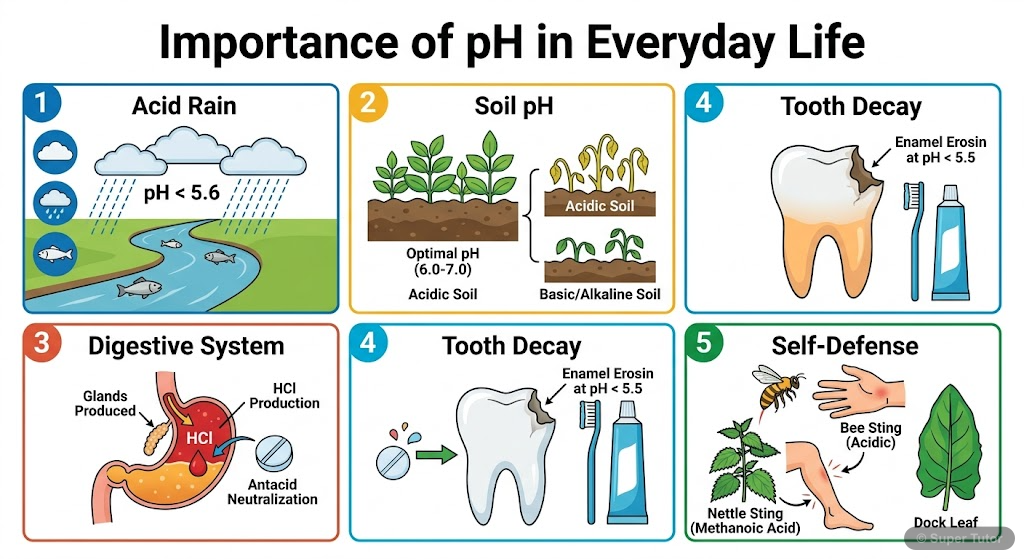
Learn better with visuals Super Tutor pairs illustrations like this with notes and quizzes for Acids, Bases and Salts.
What is an acid according to Arrhenius?
Answer
An acid is a substance which furnishes hydrogen ions (H+) when dissolved in water. Acids turn blue litmus red and can conduct electricity in aqueous solution.
What is a base according to Arrhenius?
Answer
A base is a substance which furnishes hydroxide ions (OH-) when dissolved in water. Bases turn red litmus blue and can conduct electricity in aqueous solution.
Why do acids and bases show their properties only in water?
Answer
Water helps acids and bases dissociate into ions. Dry HCl gas does not change dry blue litmus, and dry solid NaOH does not show basic nature until it absorbs moisture. So water is needed for free ions…
What happens when an acid reacts with a metal?
Answer
Acid + Metal → Salt + Hydrogen gas. Hydrogen gas can be confirmed by the pop sound when a burning matchstick is brought near it. Example: Zn + H2SO4 → ZnSO4 + H2.
What happens when acids react with metal carbonates or metal hydrogen carbonates?
Answer
Acid + metal carbonate or hydrogen carbonate → Salt + Water + Carbon dioxide. The carbon dioxide turns lime water milky. Excess carbon dioxide makes the milkiness disappear due to soluble calcium hydr…
Why does lime water first turn milky and then clear on passing extra carbon dioxide?
Answer
Carbon dioxide reacts with lime water to form white calcium carbonate, which makes it milky. When excess carbon dioxide is passed, the calcium carbonate changes into soluble calcium hydrogen carbonate…
What happens when an acid reacts with a metal oxide?
Answer
Metal oxide + Acid → Salt + Water. Example: CuO + 2HCl → CuCl2 + H2O. The black copper oxide dissolves and the solution becomes bluish green.
What is neutralization?
Answer
Neutralization is the reaction of an acid with a base to form salt and water. Example: HCl + NaOH → NaCl + H2O. This reaction reduces acidic and basic properties.
+22 more flashcards
Practise AllFrequently Asked Questions
What are the important topics in Acids, Bases and Salts for NIOS Class 10 Science & Tech?
How many flashcards are available for Acids, Bases and Salts?
How should I revise Acids, Bases and Salts for the NIOS Class 10 board exam?
Sources & Official References
Content is aligned to the official syllabus. Refer to the board website for the latest curriculum.
More resources for Acids, Bases and Salts
Practice Quiz
Test yourself with a quick quiz
Important Questions
Exam-style questions with answers
Revision Notes
Key points for last-minute revision
Formula Sheet
The chapter's formulas in one place
Chapter Summary
Understand the chapter at a glance
Concept Maps
See how topics connect
Study Plan
Step-by-step plan for this chapter
Syllabus
What topics to cover
For serious students
Get the full Acids, Bases and Salts chapter — start free.
Quizzes, flashcards, an AI doubt solver and a study plan for NIOS Class 10 Science & Tech. Free to start, no card needed.