Chemical Reaction and Equations — Chapter Summary
NIOS · Class 10 · Science & Tech
Summary of Chemical Reaction and Equations for NIOS Class 10 Science & Tech. Part of the NIOS Class 10 Science & Tech syllabus.
Interactive on Super Tutor
Studying Chemical Reaction and Equations? Get the full interactive chapter.
Quizzes, flashcards, AI doubt-solver and a step-by-step study plan — built for chapter summary and more.
Free trial, no card needed.
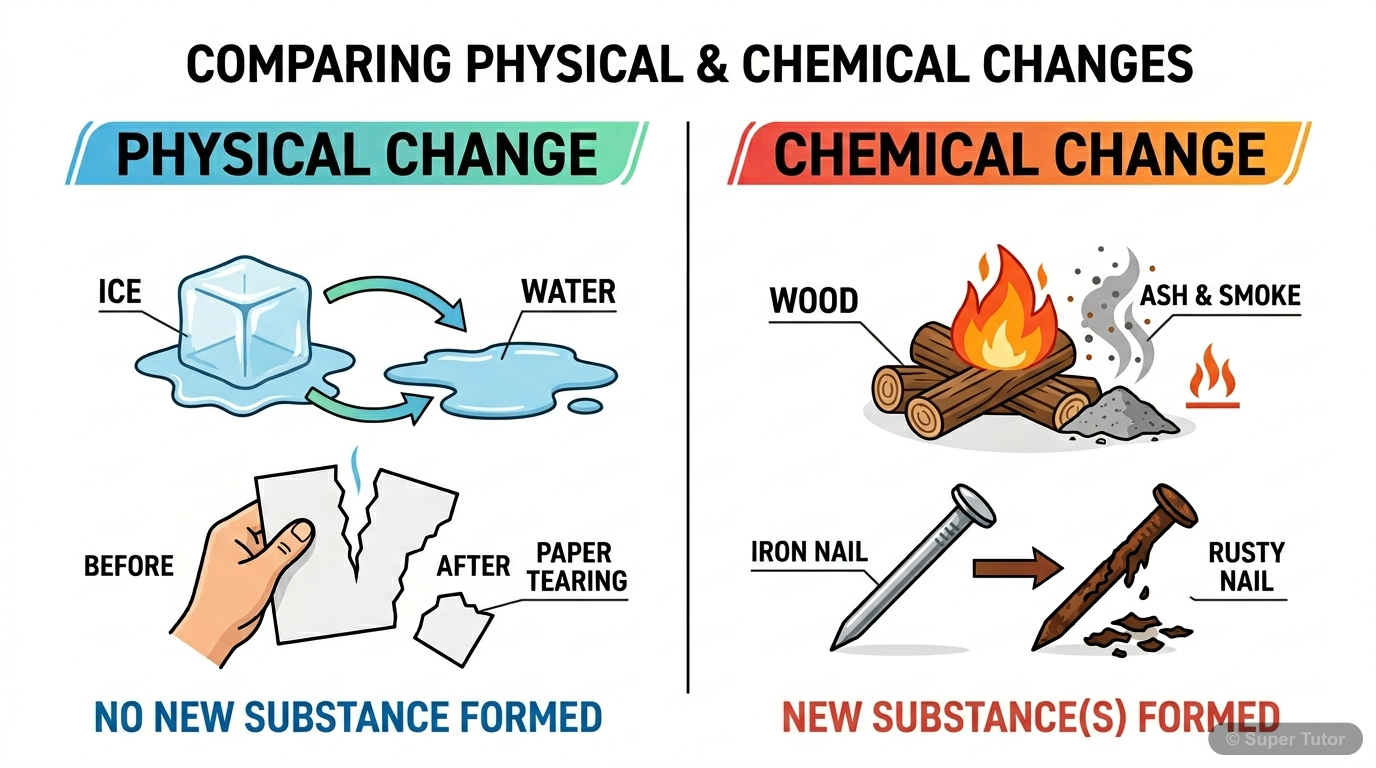
Learn better with visuals Super Tutor pairs illustrations like this with notes and quizzes for Chemical Reaction and Equations.
Overview
Chemical changes produce new substances, while physical changes are temporary and can return to the original form. A chemical equation gives a short symbolic description of a reaction, with reactants on the left, products on the right, and an arrow showing the change. Balancing a chemical equation i
Key Concepts
A chemical equation is a symbolic
A chemical equation is a symbolic way to write a chemical reaction. Reactants are written on the left, products on the right, and + is used when there
A balanced equation has the same
A balanced equation has the same number of atoms of each element on both sides of the arrow. It obeys the law of conservation of mass.
An equation with unequal numbers
An equation with unequal numbers of atoms on the two sides is called a skeletal chemical equation. For example, Mg + O2 -> MgO is skeletal.
Balancing is done by changing only
Balancing is done by changing only coefficients, not subscripts. The simplest whole-number coefficients are used.
A single product is formed from
A single product is formed from two or more reactants. Examples include 2Mg + O2 -> 2MgO and CaO + H2O -> Ca(OH)2.
Learning Objectives
- Write chemical equations using symbols and formulae
- Balance chemical equations using the hit and trial method
- Explain the importance of a balanced chemical equation
- Relate balanced equations to mole, mass, and volume
- Classify reactions as combination, decomposition, displacement, or double displacement
Frequently Asked Questions
What are the important topics in Chemical Reaction and Equations for NIOS Class 10 Science & Tech?
How should I revise Chemical Reaction and Equations for the NIOS Class 10 board exam?
Sources & Official References
Content is aligned to the official syllabus. Refer to the board website for the latest curriculum.
More resources for Chemical Reaction and Equations
Practice Quiz
Test yourself with a quick quiz
Important Questions
Exam-style questions with answers
Revision Notes
Key points for last-minute revision
Formula Sheet
The chapter's formulas in one place
Concept Maps
See how topics connect
Study Plan
Step-by-step plan for this chapter
Flashcards
Quick-fire cards for active recall
Syllabus
What topics to cover
For serious students
Get the full Chemical Reaction and Equations chapter — start free.
Quizzes, flashcards, an AI doubt solver and a study plan for NIOS Class 10 Science & Tech. Free to start, no card needed.