Classification of Living Organisms — Flashcards
NIOS · Class 10 · Science & Tech
32 flashcards for Classification of Living Organisms (NIOS Class 10 Science & Tech) to test yourself on key terms and facts.
Interactive on Super Tutor
Studying Classification of Living Organisms? Get the full interactive chapter.
Quizzes, flashcards, AI doubt-solver and a step-by-step study plan — built for flashcards and more.
Free trial, no card needed.
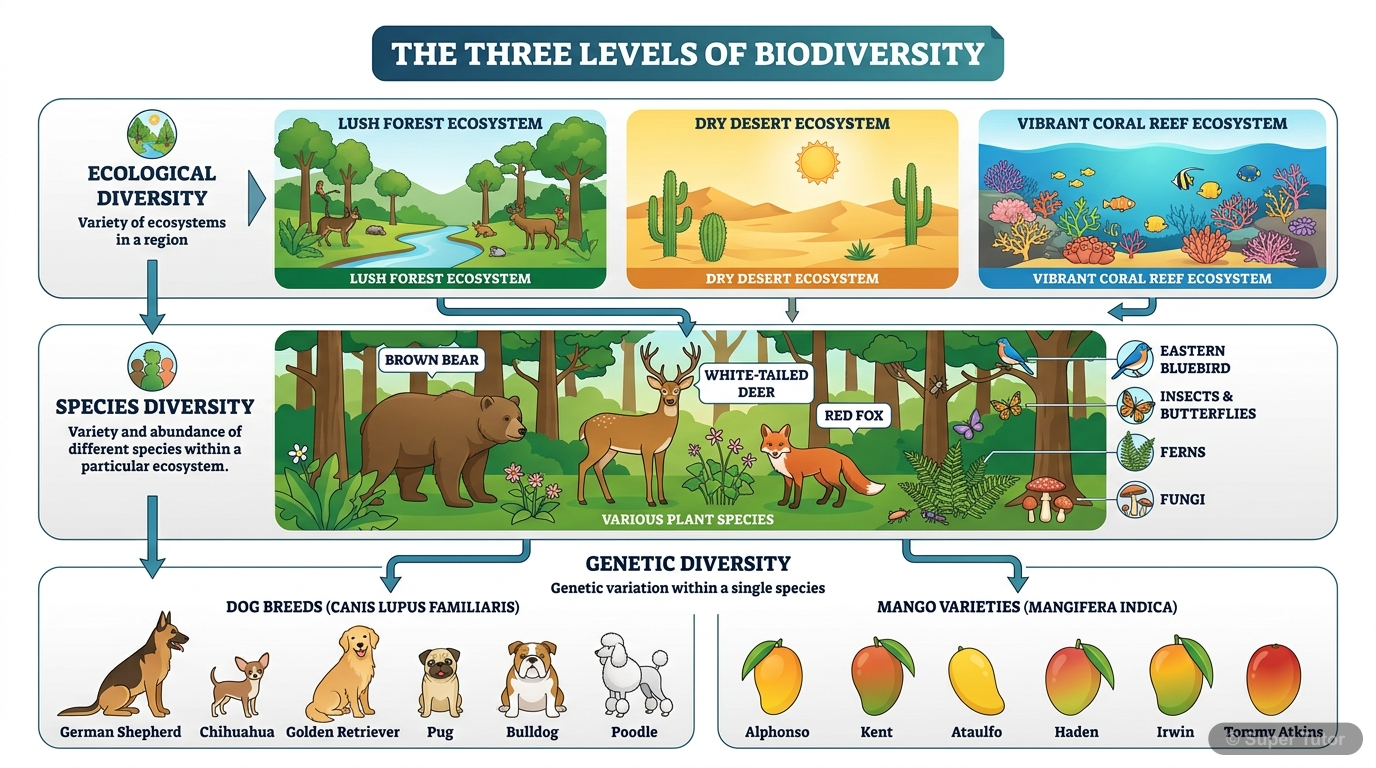
Learn better with visuals Super Tutor pairs illustrations like this with notes and quizzes for Classification of Living Organisms.
What does biodiversity mean?
Answer
Biodiversity means the enormous variety of living organisms on earth. It comes from bios meaning life and diversity meaning variety.
What are the three levels of biodiversity?
Answer
The three levels are ecological diversity, species diversity, and genetic diversity.
What is a species?
Answer
A species is a group of very similar organisms that can interbreed and produce fertile offspring. Members of one species cannot interbreed with another species to produce fertile offspring.
What is a biosphere?
Answer
The biosphere is the part of earth that supports life. Organisms live up to 8 km in air and up to 5 km below sea level.
Why is classification of living organisms needed?
Answer
Classification groups organisms according to similarities and differences. It makes the study of the huge diversity of life easier and shows evolutionary relationships.
What is the hierarchy of classification?
Answer
The hierarchy is Kingdom, Phylum, Class, Order, Family, Genus, and Species.
What are taxonomy and systematics?
Answer
Taxonomy is the science of classification. Systematics is another term for classification because it shows evolutionary relationships between organisms.
Who introduced the Binomial system of nomenclature?
Answer
Carolus Linnaeus, a Swedish naturalist of the 18th century, introduced the Binomial system of nomenclature.
+24 more flashcards
Practise AllFrequently Asked Questions
What are the important topics in Classification of Living Organisms for NIOS Class 10 Science & Tech?
How many flashcards are available for Classification of Living Organisms?
How should I revise Classification of Living Organisms for the NIOS Class 10 board exam?
Sources & Official References
Content is aligned to the official syllabus. Refer to the board website for the latest curriculum.
More resources for Classification of Living Organisms
Practice Quiz
Test yourself with a quick quiz
Important Questions
Exam-style questions with answers
Revision Notes
Key points for last-minute revision
Chapter Summary
Understand the chapter at a glance
Concept Maps
See how topics connect
Study Plan
Step-by-step plan for this chapter
Syllabus
What topics to cover
For serious students
Get the full Classification of Living Organisms chapter — start free.
Quizzes, flashcards, an AI doubt solver and a study plan for NIOS Class 10 Science & Tech. Free to start, no card needed.