Life Processes-1 Nutrition, Transportation and Excretion — Flashcards
NIOS · Class 10 · Science & Tech
47 flashcards for Life Processes-1 Nutrition, Transportation and Excretion (NIOS Class 10 Science & Tech) to test yourself on key terms and facts.
Interactive on Super Tutor
Studying Life Processes-1 Nutrition, Transportation and Excretion? Get the full interactive chapter.
Quizzes, flashcards, AI doubt-solver and a step-by-step study plan — built for flashcards and more.
Free trial, no card needed.
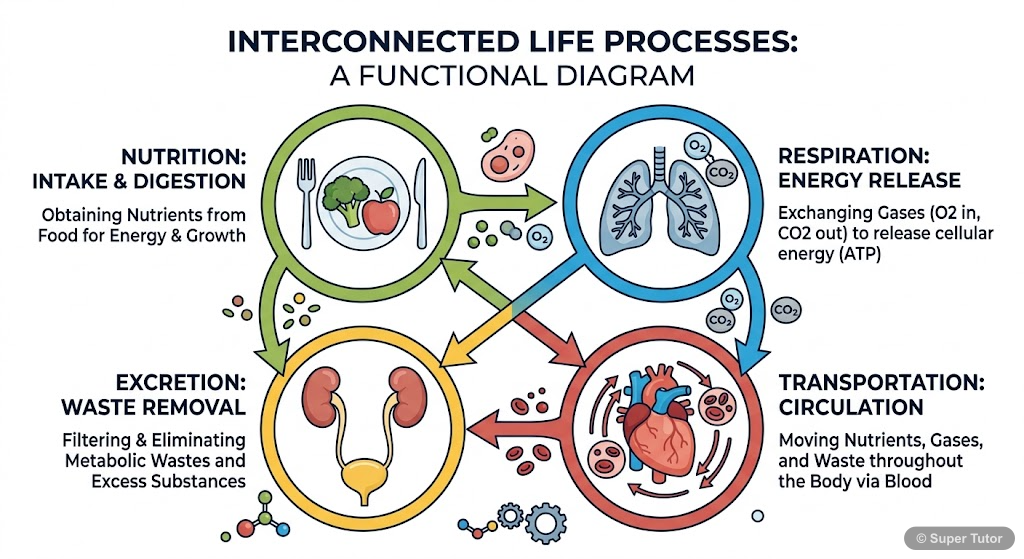
One of 20 illustrations for Life Processes-1 Nutrition, Transportation and Excretion in Super Tutor — alongside flashcards, concept maps and practice questions.
What is nutrition?
Answer
Nutrition is the process by which living beings obtain food, change food into simple absorbable forms, and use it to make substances needed by the body.
Why do living beings need food?
Answer
Food provides energy for life processes, helps in growth and repair of worn-out cells and tissues, and helps in the production of enzymes and hormones.
What are the two main types of nutrition?
Answer
The two main types are autotrophic nutrition and heterotrophic nutrition. Green plants, algae and some bacteria are autotrophs, while organisms that depend on others for food are heterotrophs.
How does holozoic nutrition differ from parasitic and saprotrophic nutrition?
Answer
Holozoic nutrition includes ingestion, digestion and absorption of food. Parasitic and saprotrophic nutrition do not require these three processes.
Why is Cuscuta called a parasite?
Answer
Cuscuta or Dodder plant (Amar bel) is a parasite on green plants. It takes food from the host plant and depends on it for nutrition.
Why are saprotrophs important in nature?
Answer
Saprotrophs feed on dead and decaying organic matter and help in cleaning the environment by decomposing it.
How do plants make their food?
Answer
Green plants make food by photosynthesis, a biochemical process in which carbon dioxide and water are used in the presence of sunlight and chlorophyll. Oxygen is released as a by-product.
What is the overall equation of photosynthesis?
Answer
6 CO2 + 12 H2O → C6H12O6 + 6 H2O + 6 O2 ↑…
+39 more flashcards
Practise AllFrequently Asked Questions
What are the important topics in Life Processes-1 Nutrition, Transportation and Excretion for NIOS Class 10 Science & Tech?
How many flashcards are available for Life Processes-1 Nutrition, Transportation and Excretion?
How should I revise Life Processes-1 Nutrition, Transportation and Excretion for the NIOS Class 10 board exam?
Sources & Official References
Content is aligned to the official syllabus. Refer to the board website for the latest curriculum.
More resources for Life Processes-1 Nutrition, Transportation and Excretion
Practice Quiz
Test yourself with a quick quiz
Important Questions
Exam-style questions with answers
Revision Notes
Key points for last-minute revision
Chapter Summary
Understand the chapter at a glance
Concept Maps
See how topics connect
Study Plan
Step-by-step plan for this chapter
Syllabus
What topics to cover
For serious students
Get the full Life Processes-1 Nutrition, Transportation and Excretion chapter — start free.
Quizzes, flashcards, an AI doubt solver and a study plan for NIOS Class 10 Science & Tech. Free to start, no card needed.