Sound and Communication — Flashcards
NIOS · Class 10 · Science & Tech
42 flashcards for Sound and Communication (NIOS Class 10 Science & Tech) to test yourself on key terms and facts.
Interactive on Super Tutor
Studying Sound and Communication? Get the full interactive chapter.
Quizzes, flashcards, AI doubt-solver and a step-by-step study plan — built for flashcards and more.
Free trial, no card needed.
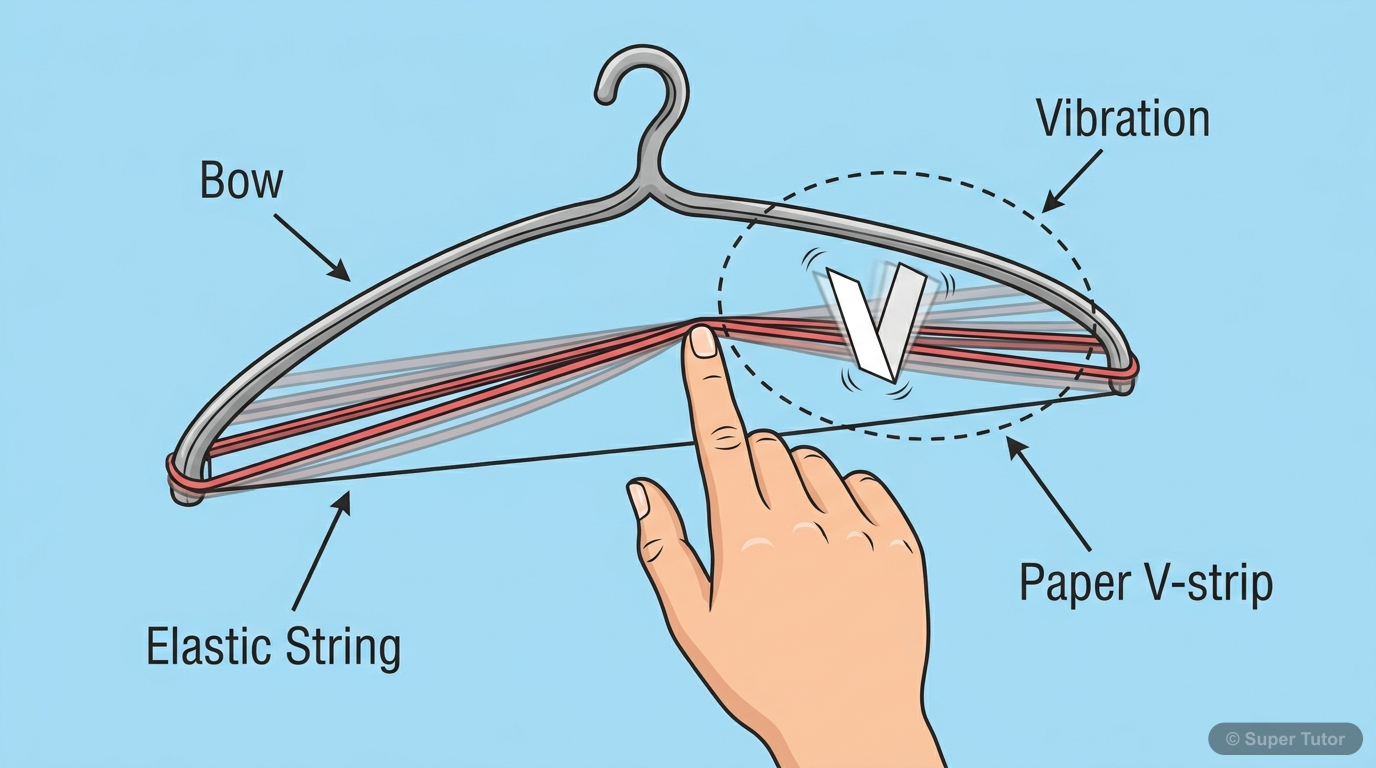
One of 13 illustrations for Sound and Communication in Super Tutor — alongside flashcards, concept maps and practice questions.
Why do we hear sound only when an object vibrates?
Answer
Sound is a result of vibration. A vibrating source sets the surrounding medium into motion, and the disturbance reaches the ear as a wave. When the vibration stops, the sound also stops.
Why can sound not travel on the Moon?
Answer
Sound needs a medium for travel, but the Moon has no usable air. Since sound is a mechanical wave, it cannot move without particles to carry the disturbance.
Why do we see lightning before hearing thunder?
Answer
Light travels much faster than sound. Speed of sound in air is 330 m/s, while speed of light in free space is about 2.997925×10^8 m/s. So light reaches first and sound comes later.
A sound wave travels at 330 m/s and has frequency 1000 Hz. What is its wavelength?
Answer
Use V = n × λ. Given V = 330 m/s and n = 1000 Hz. λ = V / n = 330 / 1000 = 0.33 m. Answer: 0.33 m…
A wave has frequency 100 Hz and another has frequency 500 Hz. Which has the larger wavelength?
Answer
For the same velocity, wavelength and frequency are inversely related. The 100 Hz wave has the larger wavelength, so its crests are farther apart.
What is the relation between time period and frequency?
Answer
Time period is inversely related to frequency. Formula: T = 1/n Here, T is time period and n is frequency.
What is the relation between wave velocity, frequency, and wavelength?
Answer
Wave velocity is given by V = n × λ. Here, V is velocity, n is frequency, and λ is wavelength.
Why are sound waves called mechanical waves?
Answer
Sound waves need a material medium to travel. They move by causing particles of the medium to vibrate, so they are mechanical waves.
+34 more flashcards
Practise AllFrequently Asked Questions
What are the important topics in Sound and Communication for NIOS Class 10 Science & Tech?
How many flashcards are available for Sound and Communication?
How should I revise Sound and Communication for the NIOS Class 10 board exam?
Sources & Official References
Content is aligned to the official syllabus. Refer to the board website for the latest curriculum.
More resources for Sound and Communication
Practice Quiz
Test yourself with a quick quiz
Important Questions
Exam-style questions with answers
Revision Notes
Key points for last-minute revision
Formula Sheet
The chapter's formulas in one place
Chapter Summary
Understand the chapter at a glance
Concept Maps
See how topics connect
Study Plan
Step-by-step plan for this chapter
Syllabus
What topics to cover
For serious students
Get the full Sound and Communication chapter — start free.
Quizzes, flashcards, an AI doubt solver and a study plan for NIOS Class 10 Science & Tech. Free to start, no card needed.