Electromagnetic Induction and Alternating Current — Important Questions
NIOS · Class 12 · Physics
45 important questions from Electromagnetic Induction and Alternating Current for NIOS Class 12 Physics, with answers. Written for the board exams 2027.
Interactive on Super Tutor
Studying Electromagnetic Induction and Alternating Current? Get the full interactive chapter.
Quizzes, flashcards, AI doubt-solver and a step-by-step study plan — built for important questions and more.
Free trial, no card needed.
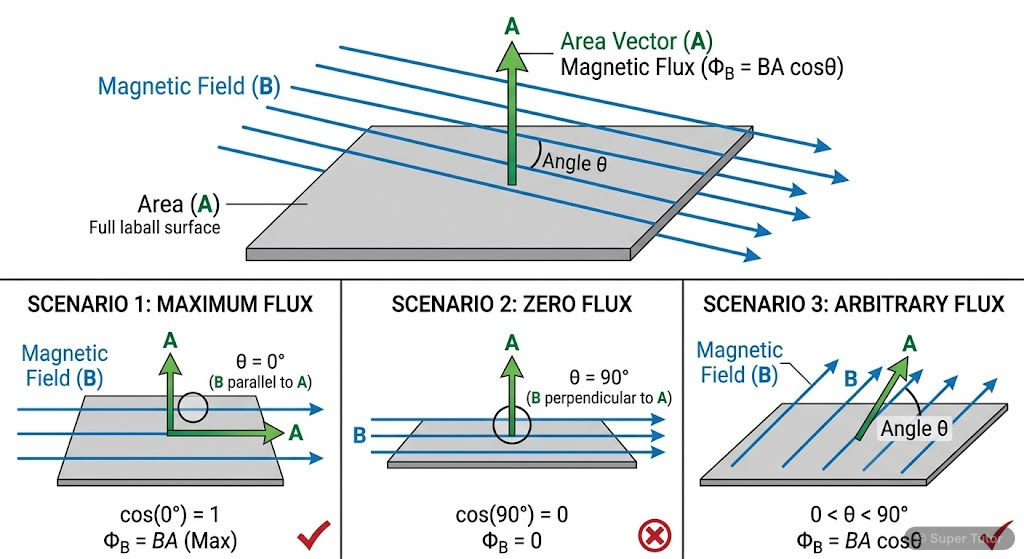
One of 26 illustrations for Electromagnetic Induction and Alternating Current in Super Tutor — alongside flashcards, concept maps and practice questions.
Important Questions from Electromagnetic Induction and Alternating Current
An AC generator produces an EMF given by ε(t) = ε₀ sin(ωt). If the coil has N turns, area A, and rotates in a field B with angular velocity ω, what is the peak EMF ε₀?
Show answer
ε₀ = NBAω
Step 1: The magnetic flux through a rotating coil: φ(t) = NBA cos(ωt). Step 2: By Faraday's Law for N turns: ε = -N dφ/dt. Step 3: Differentiating: ε = -N × (-NBAω sin(ωt)) — wait, for a single-turn flux NBA cosωt, ε = NBAω sin(ωt). Step 4: Therefore, the peak (maximum) EMF is ε₀ = NBAω. Step 5: Option A (NBA) is just the maximum flux, not the EMF. Option C (NBA/ω) confuses multiplication and division. Option D adds an extra N, which is incorrect.
A transformer has 100 turns in its primary and 500 turns in its secondary. If the primary voltage is 120 V and primary current is 3 A, what is the secondary current? (Assume ideal transformer)
Show answer
0.6 A
Step 1: For an ideal transformer: Np/Ns = Ip/Is (turns ratio equals inverse current ratio). Step 2: Given Np = 100, Ns = 500, Ip = 3 A. Step 3: Is = Ip × (Np/Ns) = 3 × (100/500) = 3 × 0.2 = 0.6 A. Step 4: Verification using power: Primary power = 120 × 3 = 360 W. Secondary voltage = 120 × (500/100) = 600 V. Secondary power = 600 × 0.6 = 360 W ✓ (ideal transformer, no power loss). Step 5: Option A (15 A) multiplies instead of dividing. Option B (3 A) ignores the turns ratio. Option D (1.5 A) uses an incorrect ratio calculation.
In a purely capacitive AC circuit, if the supply voltage is V = V_m cos(ωt), what is the phase relationship between the current and voltage?
Show answer
Current leads voltage by 90°
Step 1: For a capacitor, charge q = CV = CV_m cos(ωt). Step 2: Current I = dq/dt = -CV_m ω sin(ωt). Step 3: Since -sin(ωt) = cos(ωt + 90°), the current can be written as I = CV_m ω cos(ωt + 90°). Step 4: This shows the current is ahead of the voltage by 90°, i.e., current LEADS voltage by 90°. Step 5: Option A describes an inductor (current lags). Option B describes a pure resistor. Option D (45°) is incorrect — the phase difference for a pure capacitor is always exactly 90°.
The rms value of the AC mains voltage in India is 220 V. What is the peak (maximum) voltage?
Show answer
311 V
Step 1: The relationship between peak and rms values: V_rms = V_m / √2. Step 2: Rearranging: V_m = V_rms × √2. Step 3: Substituting: V_m = 220 × √2 = 220 × 1.414 ≈ 311 V. Step 4: This is why AC mains at 220 V (rms) can be dangerous — the peak voltage reaches about 311 V. Step 5: Option A (220 V) confuses rms with peak. Option B (155.6 V) divides by √2 instead of multiplying. Option D (440 V) doubles the rms value, which is incorrect.
+41 more questions on Electromagnetic Induction and Alternating Current (NIOS Class 12 Physics)
Practise AllFrequently Asked Questions
What are the important topics in Electromagnetic Induction and Alternating Current for NIOS Class 12 Physics?
How many important questions are there in Electromagnetic Induction and Alternating Current?
Sources & Official References
Content is aligned to the official syllabus. Refer to the board website for the latest curriculum.
More resources for Electromagnetic Induction and Alternating Current
Practice Quiz
Test yourself with a quick quiz
Revision Notes
Key points for last-minute revision
Formula Sheet
The chapter's formulas in one place
Chapter Summary
Understand the chapter at a glance
Concept Maps
See how topics connect
Study Plan
Step-by-step plan for this chapter
Flashcards
Quick-fire cards for active recall
Syllabus
What topics to cover
For serious students
Get the full Electromagnetic Induction and Alternating Current chapter — start free.
Quizzes, flashcards, an AI doubt solver and a study plan for NIOS Class 12 Physics. Free to start, no card needed.