Thermodynamics — Important Questions
NIOS · Class 12 · Physics
44 important questions from Thermodynamics for NIOS Class 12 Physics, with answers. Includes multiple choice and multiple correct questions.
Interactive on Super Tutor
Studying Thermodynamics? Get the full interactive chapter.
Quizzes, flashcards, AI doubt-solver and a step-by-step study plan — built for important questions and more.
Free trial, no card needed.
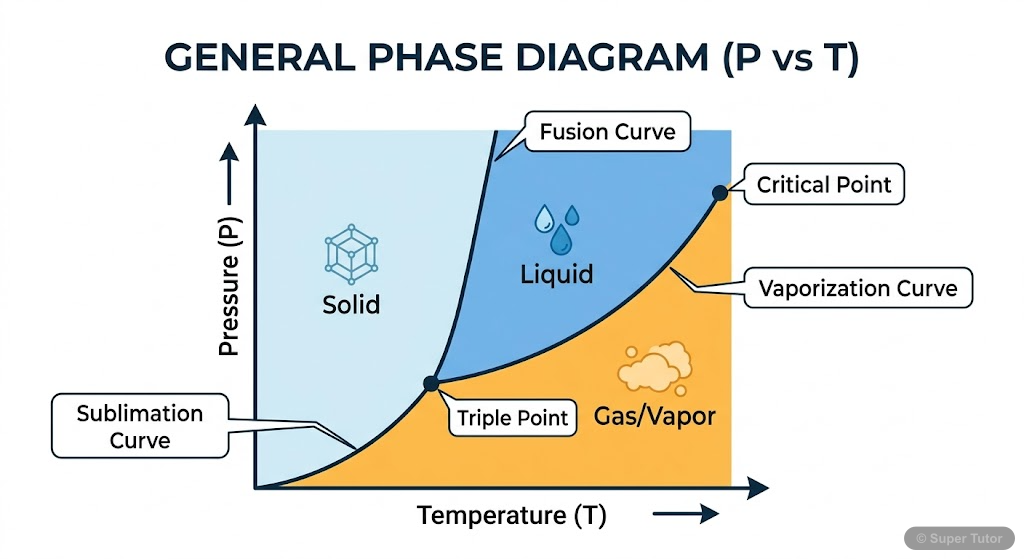
One of 7 illustrations for Thermodynamics in Super Tutor — alongside flashcards, concept maps and practice questions.
Important Questions from Thermodynamics
In an adiabatic process, a gas is compressed. Which of the following correctly describes what happens?
Show answer
Temperature increases, internal energy increases.
Step 1: In an adiabatic process, ΔQ = 0 (no heat exchange). Step 2: Applying the first law: ΔU = ΔQ − ΔW = 0 − ΔW. Step 3: During compression, work is done ON the gas, so ΔW is negative (work done BY the gas is negative). Therefore ΔU = −(negative value) = positive. Step 4: Since internal energy increases, the temperature of the gas also increases. The compression squeezes molecules together, increasing their kinetic energy. Why other options are wrong: Option A describes adiabatic expansion; Option C is for isothermal process; Option D contradicts the relationship between internal energy and
A Carnot engine has the same efficiency between temperatures 800 K and 400 K as between temperature T K and 800 K. What is the value of T?
Show answer
1600 K
Step 1: Efficiency between 800 K and 400 K: η₁ = 1 − (400/800) = 1 − 0.5 = 0.5. Step 2: For the second case (source T, sink 800 K): η₂ = 1 − (800/T). Step 3: Set η₁ = η₂: 0.5 = 1 − (800/T). Step 4: 800/T = 0.5, so T = 800/0.5 = 1600 K. Why other options are wrong: 400 K is the sink temperature in the first case; 1200 K would give η = 1 − 800/1200 = 0.33 ≠ 0.5; 200 K would be lower than the sink, which is physically meaningless for a source.
During an isochoric (constant volume) thermodynamic process, a gas is heated by supplying 800 J of heat. What is the work done by the gas?
Show answer
0 J
Step 1: In an isochoric process, volume remains constant (ΔV = 0). Step 2: Work done by a gas is given by ΔW = P·ΔV. Step 3: Since ΔV = 0, ΔW = P × 0 = 0 J. Step 4: All the heat supplied goes entirely into increasing the internal energy: ΔU = ΔQ = 800 J. Why other options are wrong: 800 J would be the work done if all heat were converted to work (impossible here since ΔV = 0); 400 J and −800 J have no physical basis for this constant-volume scenario.
The P-V indicator diagram of a thermodynamic process shows a closed loop. What does the area enclosed by this loop represent?
Show answer
The net work done by the system in one complete cycle
Step 1: In a P-V diagram, the area of a small strip = P·ΔV = work done for a small volume change. Step 2: Integrating over the entire path, the area under a curve from V₁ to V₂ gives total work done. Step 3: For a closed loop (cyclic process), the area enclosed = net work done in the complete cycle = W_expansion − W_compression. Step 4: Also, for a cyclic process, ΔU = 0, so net heat = net work (ΔQ = ΔW). Why other options are wrong: Total heat absorbed is not directly given by the loop area; ΔU = 0 for a cyclic process so option C is zero; heat rejected is only part of the energy exchange, no
+40 more questions on Thermodynamics (NIOS Class 12 Physics)
Practise AllFrequently Asked Questions
What are the important topics in Thermodynamics for NIOS Class 12 Physics?
How many important questions are there in Thermodynamics?
Sources & Official References
Content is aligned to the official syllabus. Refer to the board website for the latest curriculum.
More resources for Thermodynamics
Practice Quiz
Test yourself with a quick quiz
Revision Notes
Key points for last-minute revision
Formula Sheet
The chapter's formulas in one place
Chapter Summary
Understand the chapter at a glance
Concept Maps
See how topics connect
Study Plan
Step-by-step plan for this chapter
Flashcards
Quick-fire cards for active recall
Syllabus
What topics to cover
For serious students
Get the full Thermodynamics chapter — start free.
Quizzes, flashcards, an AI doubt solver and a study plan for NIOS Class 12 Physics. Free to start, no card needed.